b2o

  • Adin Lears–Bitcoin Vitalism and the Elixir of Life

    Adin Lears–Bitcoin Vitalism and the Elixir of Life

    This text is published as part of a special b2o issue titled “Critique as Care”, edited by Norberto Gomez, Frankie Mastrangelo, Jonathan Nichols, and Paul Robertson, and published in honor of our b2o and b2 colleague and friend, the late David Golumbia.

    Bitcoin Vitalism and the Elixir of Life

    Adin E. Lears

    At the 2021 Bitcoin convention in Miami, Michael Saylor, CEO of the business intelligence company MicroStrategy, lauded Bitcoin as a form of energy:

    Bitcoin is a system for collecting, channeling, and storing energy in the most efficient way we’ve ever invented. It is storing potential energy to stay alive. You have fat on your body? If I cut you off from food for ninety days, you’d still be alive…When you’re putting energy into Bitcoin, you’re storing fat. Fat is organic energy. Bitcoin is monetary energy (Saylor qtd. Stephenson 2022: 33).[1]

    Saylor seems to imagine Bitcoin here as an energy that is economic as well as biophysical: it is an energy that supports the condition of being alive. He seems to confuse the actual and the metaphorical, taking a metaphor—Bitcoin as energy—and treating it as an actuality—Bitcoin is life-energy. In doing so, he conflates the domains of the economic and the physical in a way that would seem to correlate material wealth with greater strength and longevity. There is a kind of vitalism to this thinking, which can be characterized as a belief that the foundations and processes of life are dependent on a force beyond the physical realm. What that force is—God? Money?—remains unclear.

    Saylor’s vitalist and specifically physio-economic thought is the logical extension of a rationale for cryptocurrency writ large. Proponents of crypto believe that the US dollar has been devalued at the whim of an establishment of banking “elites,” effectively breaking down the strength and vigor of the US economic system. Saylor—and other proponents—believe Bitcoin offers a better, stronger alternative. It is a means of bringing economic control, autonomy, and “sovereignty” back to the people. Ultimately, as I will show, proponents like the economist Saifedean Ammous believe that this will bring about a social and cultural revitalization, improving the quality of art, ending war, and even restoring nutrients to the soil.

    Tracing the ideologies of Bitcoin back to the formation of the John Birch Society in the 1960s, David Golumbia (2016: 14-16) has detailed how such an emphasis on freedom and individual sovereignty—among other techno-utopian promises—evinces a form of cyberlibertarianism particular to the alt-right. Here I find early quickenings of such vitalism in another techno- utopian pursuit driven by a desire for both economic and physical vigor: the alchemy of the European middle ages. Since its inception among ancient natural philosophers, alchemy sought to purify and vivify matter, turning base metal into gold and restoring youth with the elixir of life. Through the European middle ages, alchemical pursuits were often informed by the promise of alchemical knowledge as a means of restoring the perfection humans had lost as a result of the biblical Fall. For many of its proponents, Bitcoin offers a similar means of eluding the constraints of government and banking “elites” and revivifying a “fallen” culture. As Elizabeth Povinelli (2016: 20) reminds us, a spirit of vitalism undergirds capitalism writ large in its impulse to see in all things a volatile potential to create profit. Bitcoin’s vitalism literalizes this perspective, yoking an animist language of material communalism with processes of economic and social exploitation and extraction. Attending to this long history of economic vitalism allows us to look past the rationalist logic favored by proponents of Bitcoin to identify its quasi-mystical appeal.

    Medieval Alchemy and the Elixir of Life

    In recent decades, alchemy’s vitalism has been a vexed subject among historians of science, many of whom have sought to rescue alchemy from the realm of occult esotericism by accentuating its concern with physical materials, processes, and transformations. Indeed, the influence of early alchemical theories and practices on modern chemistry and pharmacology has been well-established (DeVun 2009; Chang 2011). Yet, as scholars like Leah DeVun (2009: 102-105) and Zachary Matus (2017: 7-14) have demonstrated, alchemy’s spirituality and materialism are mutually imbricated: its theology underpins its understanding of the material world and material practices drive its spiritual aims. It is hardly necessary to keep these two realms separate in the study of medieval alchemy. This is especially true in the realm of alchemy’s metaphors, which frequently draw from religious imagery and ideas in the process of describing alchemical materials and processes. As DeVun (2009; 102-28) argues, such spiritual metaphors reveal the complexly theological basis that underpins much medieval alchemy and, moreover, serve at least two rhetorical aims: first, to render abstract scientific processes in more widely comprehensible terms and second, to imbue alchemical programs with the heft of the spiritual, even revelatory. As we will see, in articulating the meaning and value of Bitcoin, its proponents walk a similar line, melding “hard” science with the spiritual affects and feelings of religious belief.

    Medieval alchemy was, in a fundamental sense, a life science. It drew from Aristotelian natural philosophy and other intellectual traditions, seeking to create an elixir or “Philosophers’ Stone” that would purify metal and prolong human life. Medieval natural philosophers drew on the ideas of Arabic naturalists, who posited a “medicine” that would heal metals, turning them from base metal into gold and silver (DeVun 2009: 84). The original aim of alchemy was this transmutation of metal; the Arabic word al-iksīr, from which the word elixir derives, originally referred only to the perfection of metals (Matus 2017: 40-41). Yet medieval thinkers like the thirteenth-century English philosopher and Franciscan friar Roger Bacon (d. 1292), perhaps influenced by earlier Chinese Taoist ideas about the prolongation of human life, combined the aim of purifying or tempering metal with treating the human body (DeVun 2009: 84).

    The relationship between the purification of metal to gold and the prolongation of human life was not a metaphor: the same alchemical principles governed each one. For early alchemists who sought to turn base metal into gold, all metallic matter was constituted by “primary qualities”—hot, dry, wet, or cold—which could be transformed through alchemy, along with the metal’s appearance. The primary quality of tin, for example, was dry. But this quality could be transformed into the heat attributed to gold or the cold attributed to silver, through the elixir. In this way, alchemy was believed to transform both the constitutive substance and the superficial appearance of metal. Yet these primary qualities—hot, dry, cold, and wet—constituted not only metal but elemental matter—fire, earth, air, and water. And these elements, in turn, comprised the humoral matter that made up the human body: yellow bile, black bile, blood, and phlegm. This material correspondence between matter and the human body enabled medieval thinkers to extend the logic of the elixir from the purification of metal to the prolongation of human life (Matus 2017: 40-41). Bacon, for example, held that all material substances, including both metals and flesh, were composed of elemental humors (Newman 1997: 319-23). The goal of alchemy was to encourage a state of what Bacon called “equal complexion”: to temper matter—metallic or fleshly—so that all of its elemental qualities or humors were in perfect balance (Newman 1997: 328-32).

    Bacon’s theory of alchemical medicine offers a useful example of medieval alchemy’s techno utopianism: its aim to improve the state of the physical body, and also the value of the immaterial soul. The elixir had the capacity for moral as well as physical improvement. Bacon’s ideas on the possibility of achieving “equal complexion,” and with it the perfection of the body and soul, were grounded in biblical accounts of both prelapsarian corporeality and Pauline accounts of the resurrection of the body. In his Opus Majus, Bacon wrote:

    For this condition [of immortality] will exist in our bodies after the resurrection. For an equality of elements in those bodies excludes corruption forever. For this equality is the ultimate end of the natural matter in mixed bodies, because it is the noblest state, and therefore in it the appetite of matter would cease, and would desire nothing beyond. The body of Adam did not possess elements in full equality, and therefore the contrary elements in him acted and were acted on, and consequently there was waste, and he required nourishment. For this reason, he was commanded not to eat the fruit of life. But since the elements in him approached equality, there was very little waste in him; and hence he was fit for immortality, which he could have secured if he had eaten always the fruit of the tree of life. For this fruit is thought to have elements approaching equality; and therefore it was able to continue incorruption in Adam, which would have happened if he had not sinned (DeVun 2009: 85-86).

    Bacon stresses that the equal complexion of the resurrected body can be achieved on earth. He reasons that Adam’s prelapsarian body was subject to humoral imbalance that could be adjusted and equalized by consuming from the tree of life; if Adam had not sinned, consuming the tree of life might have sustained him forever. Significantly, Bacon equates alchemical “equal medicine” with the fruit of the tree of life: both possess material elements in perfect balance and both have the capacity to transfer this perfection to the body of Adam (Matus 2017: 44-46; Newman 1997: 325; DeVun 2009: 85-86). Here and across his corpus of work, Bacon stresses a direct relationship between sin and the physical body: sin caused the body to deteriorate and lose its life force; purification from sin could make the human body more vigorous and extend life. His aim was to use alchemy to turn the human body to a more pure state: a natural balance of equal complexion that approached immortality. In comparing the therapeutic effects of the alchemical elixir to the effects of the resurrection, Bacon reveals his aim to promote the perfection of heaven on earth (DeVun 2009: 86).

    Indeed, for Bacon, alchemy was not simply a potent medicine. It also offered a means of converting the physical complexions and corresponding morals of non-Christians. In outlining alchemy’s purpose in this endeavor, Bacon drew on the purported advice from Aristotle to Alexander the Great presented in the pseudo-Aristotelian text the Secret of Secrets. Because various regions had their own complexions, which in turn influenced the physiology and morals of the people who dwelled there, the Secrets-author reasoned that changing the landscape would influence the bodies and minds of the inhabitants, “pacifying” them into submission. In the absence of details supplied in the Secret of Secrets, Bacon offered his alchemical elixir as a means of accomplishing this change in landscape, physiology, and moral make-up (Matus 2017: 49-52).

    Bacon was not alone in his desire to draw the perfection of heaven into the earthly realm. Writing several decades after Bacon, the early fourteenth-century French Franciscan alchemist John of Rupicessa (b. 1310) elaborated on the alchemical theory of Bacon to articulate a “quintessence” that might extend life (DeVun 2009: 81-89). Rupicessa’s alchemical quintessence was based on a “fifth element,” drawn in part from Aristotelian and Stoic conceptions of the pneuma, or vital spirit pervading all things, which Rupicessa understood as a manifestation of heaven on earth (DeVun 2009: 67). Whereas the primary qualities of the four earthly elements were fixed—fire is hot and dry and cannot become cold or moist—Rupicessa held that the fifth element could shift in its quality when it is necessary, making it “strong against all opposing things” (DeVun 2009: 66). It was a kind of universal cure, adding any “quality” needed to balance the humoral complexion.

    Like his predecessor, Roger Bacon, Rupicessa’s description of the process of the creation and operations of the quintessence sought the restoration of spiritual purity. He extended this ideal, by additionally emphasizing that such purification could be achieved through a distinctly human ingenuity.  Describing the quintessence, Rupicessa wrote:

    [T]hrough the virtue which God contributed to ornamented nature and subjected to human magisterium, man is able to cure the inconveniences of old age—which impeded the works of the Evangelical life too much among the ancient men of the gospel—and to restore the loss of youth and to recover the pristine powers and to have them again….This is what all who have worked to seek the thing created for the use of humans desire, to be able to protect the corruptible body from putrefaction and to conserve it without diminution so that it may be conserved, if it is possible, in perpetuity. This is the thing that all desire naturally: never to be corrupted, nor to die” (DeVun 2009: 65).

    Though he does not frame the operation of the quintessence in terms of the biblical Fall, as Bacon does, Rupicessa’s account here nevertheless evinces a similar desire to “restore” and “recover” a “pristine power” that has been lost. Significantly, Rupicessa’s account emphasizes human exceptionalism as a foundation for scientific ingenuity. Nature has “virtue” (virtutem)—an early term for vital power or force. But this natural force is ultimately “subjected” to “human magisterium.” Such an emphasis on human power over nature implicitly recalls the prelapsarian condition of Genesis, in which God created Adam in his own image, giving him dominion over all other creatures (Genesis 1:26).

    Rupicessa’s emphasis on restoring purity through human control over nature extends into his account of the materials of the quintessence. For Rupicessa, the quintessence should be made of:

    something which is in itself incorruptible (if it exists in eternity), and which always makes anything that comes into unity with it uncorrupted, most of all flesh, something which nurses the virtue and spirit of life and augments and restores it; something which digests all rawness, and reduces all that has been digested to equality, and which removes from anything all excess of any quality and restores to it any lost quality (DeVun 2009: 66).

    The elusive “something” Rupicessa seeks is a substance that is entirely original and sovereign; it is incorruptible “in itself,” i.e. through its own force or power, and not through something added. Its originary power allows it to exert a force that influences any matter it comes in contact with, including corruptible human flesh. Using a viscerally material metaphor of digestion, Rupicessa describes the work of the quintessence as a process of breaking human flesh down to an essence and adding back what has been lost. The originality of this substance—its purity and self-sufficiency—gestures to the ways that Rupicessa’s ideals of purity inform a related standard of sovereignty. His quintessence, in short, sought a substance of such purity and sovereign force that it could transfer such qualities to the human body and soul, restoring some of the perfection lost in the Fall.

    Indeed, Rupicessa’s ideal of human sovereignty is particularly evident in his rationale for the quintessence, which emerged from the theory that humans suffered three kinds of death: natural death, violent death, and “death [that] arrives sooner than the end predetermined by God.” Medicine was fruitless against the first two. But the last kind was “because of too much regeneration and dissolution, or through too much austere abstinence or despair, or through negligence in avoiding danger of death, one kills oneself” (DeVun 2009: 64-65). In other words: Rupicessa’s third form of death was due to human error and failure to avoid danger. His quintessence sought to address this last kind of death. By acknowledging that some, not all, deaths could be prevented, Rupicessa maintained that supreme power lay in the hands of God. At the same time, he suggests a kind of human culpability for certain illness, corruption, and death, a premise undergirded by a belief in human free will. Medieval theologies of the Fall understood the postlapsarian condition as a state of spiritual slavery, defined by the sinful violation of divine law (Wyatt 2009: 248-49). Nevertheless, unlike animals, humans could exercise free will, enabling them to attain a certain freedom, even in their sinful lapsed state (Shannon 2013: 135-41; Davis 2016: 158-60).  By situating his quintessence as a remedy for “bad” human choices, Rupicessa reinforces the theology of the Fall as a crucial cornerstone of his alchemical theory. Eschewing foundational religious ideals of poverty, humility, and charity, such theory weaves the alchemical pursuit of longevity with a desire for a sovereign self-sufficiency and control.

    Indeed, such individualism informed Rupicessa’s political program for the quintessence.  As DeVun has shown, Rupicessa’s “apocalyptic alchemy” was informed and made urgent by a millenarian mindset that predicted the imminent arrival of the Antichrist (DeVun 2009: 57). His quintessence promised to bolster the strength of the institutional Church at multiple levels. The alchemical production of precious metals could be used to buy necessities for Christians, and therefore contribute to funding the Church’s war against the Antichrist (DeVun 2009: 58). At the same time, alchemy’s medicinal uses could help to heal the bodily injuries resulting from that war; stronger human bodies would in turn mean longer-lived evangelizing, more powerful adversaries for the Antichrist and allies for the Church (DeVun 2009: 61-62). In this way, Rupicessa’s religious beliefs and ideals were fundamental to his alchemical theories and aims. Attending to the convergence of spiritual and material registers in medieval alchemy can amplify its emphasis on physical and moral purification, as well as human ingenuity and mastery over the natural world—all ideas that also emerge in the vitalism that undergirds much contemporary discourse on Bitcoin.

    Bitcoin Vitalism

    As Golumbia (2016: 14-16) has shown, the conspiratorial affects and cyberlibertarian ideals around Bitcoin arguably found their origins in the paranoid economic theory popularized by the John Birch Society, whose founder Robert Welch was among the first to give voice to notions of economic control by government and banking elites. Welch’s essay, “The Truth in Time” (1966) framed social welfare programs—many of them emerging directly from the New Deal—as a means of reducing the responsibility and thus autonomy of individual citizens while building the authority and reach of the federal government. Other John Birch Society publications outlined how the US Federal Reserve has devalued the US dollar while maintaining sole control over the issuance of bank notes. Bitcoin’s emergence as a “decentralized” or “distributed” economic system responds in part to this paranoia about government control over banking. The software does not exist in a single physical location, nor is it hosted by a single company like Amazon or Google. It is, instead, networked across multiple machines. For these reasons, proponents of Bitcoin have lauded it as a form of “distributed authority” which places economic power back in the hands of ordinary people rather than banking elites. Yet, as Golumbia shows, this idea of distributed authority masks a commitment to the sovereign individuality of Bitcoin’s users, who remain free from government regulation and interference (Golumbia 2016: 27-32; 2024: 281-96).

    These alt-right impulses toward freedom and individual sovereignty masked in an anti-authority, even quasi-communalist ethos are evident in Bitcoin’s vitalist currents. In his book, The Bitcoin Standard (2018: 75-76), the economist Saifdean Ammous argued that, as a sound money system less subject to the fluctuations in value emerging from fiat-systems, Bitcoin could cultivate the low time preference that he believes is essential for a flourishing human culture. For Ammous, those with low time preference are more apt to think about the future; they are more likely to delay gratification and invest, thereby yielding higher returns on their investments. In contrast, those with a high time preference tend to live in the moment, seeking instant gratification. For Ammous, this is the prevailing economic atmosphere today, a form of Keynesian economics centered on “a creed of consumption and spending to satisfy immediate wants.” He continues:

     By constantly expanding the money supply, central banks’ monetary policy makes saving and investment less attractive and thus it encourages people to save less and invest less while consuming more. The real impact of this is the widespread culture of conspicuous consumption, where people live their lives to buy ever-larger quantities of crap they do not need…The financial decisions of people also reflect on all other aspects of their personality, engendering a high time preference in all aspects of life: depreciating currency causes less saving, more borrowing, more short-termism in economic production and in artistic and cultural endeavors, and perhaps most damagingly, the depletion of the soil of its nutrients, leading to ever-lower levels of nutrients in food (141).

    The baggy environmentalism of this passage—Ammous loosely links overconsumption of resources to depletion of nutrients in the earth’s soil, without explaining the relationship—amplifies a vitalist current in Ammous’s thinking: as a sound money system, Bitcoin can repair cultural and environmental devitalization.[2] More pointedly, the logic of the passage moves seamlessly from economic value to cultural value to organic value: an inability or failure to accumulate wealth dilutes cultural production to cheap “crap,” which in turn diminishes nutrients from the soil. Humans are not living up to our full potential, Ammous implies. Our civilization is watered down and as a result, the environment around us is failing to support our basic needs. We may not even be fully human anymore, since, as Ammous makes clear in an earlier passage, animals have a higher time preference than humans (74).

    Indeed, Ammous’s logic of devolution implies a desire to return to a more pure, vigorous, and human state of being, proposing that Bitcoin offers a means for such a return. He writes at length on the “artistic flourishing” of Europe under systems of sound money, juxtaposing the work of Bach and Beethoven with the “animalistic noises” produced in contemporary recording studios, which turn a profit by “selling to man the titillation of his basest instincts.” A prior  “golden era” produced music that “spoke to man’s soul and awakened him to think of higher callings than the mundane grind of daily life.” In contrast, “today’s musical noises speak to man’s most base animalistic instincts, distracting him from the realities of life by inviting him to indulge in immediate sensory pleasures (99).” Similarly, Michelangelo spent four years painting the Sistine Chapel, eating very little in order to perfect his craft. Modern art—Ammous has a particular disdain for Rothko—could have been made in several hours by “a bored six-year-old” (100). Today’s art is animalistic and childish, a devolution from the mature vigor of the past. With tremendous self-control, the great artists of prior centuries eschewed base materialism, holding their minds on the higher spiritual realm of beauty and “refined tast[e]” (101). For Ammous, Bitcoin approaches a social ethic, through which human culture can return to a thriving and peaceful state—his discussion of sound money and individual freedom makes a claim that unsound money creates the conditions for “perpetual war” (145-49). Yet it is a vision not of mutual aid, but of individual self-sufficiency. The purity implied in his logic of devolution—the “return” to material potency in both high value cultural production and greater health—underscores Ammous’s claim that sound money generates the individual freedom and self-governance that undergirds an idealized golden age of high culture.

    There is a fascistic impulse to these ideals of purity and self-governance—one that becomes apparent as we consider the strange aesthetics and materialism that emerges in the use of another blockchain technology: non-fungible tokens (NFTs), a digital identifier recorded on blockchain, which typically compiles visual and audio digital files into a kind of collage of digital art. As Arne De Boever (2021) has shown, NFTs enact a strange transfiguration of value that reinforces a fetishistic affirmation of the sovereign individual, even as it purports to distribute authority. With their emphasis on the creation of art in a digital space through copies of previously existing works, NFTs have been lauded as a more “democratic” art form, unmoored from categories like authorship, ownership, and value that tie art to the market. Yet, as De Boever argues, NFTs reinforce the very categories of authenticity, creativity, and eternal value they seem to refute, buttressing an “aesthetic exceptionalism” that accentuates the singular, even transcendent qualities of the work of art and the artist. The value of NFTs is so exceptional, in fact, that the material work of art does not matter. Rather than physical objects of art, buyers of NFTs receive “cultic objects”—a token, a certificate, even a clump of hair—to signify their ownership. Such objects refer obsessively to the gross materiality of the human body. Buyers of work by the NFT artist known as Beeple, whose art sold for a record $69,346,250 at Christies in 2021, receive a small token with a cloth, which can be used to clean the token, or “to clean yourself up after blasting a hot load in yer pants.” De Boever calls this “alt-right materialis[m]” a kind of trolling assertion of excess and often sexualized materiality to mask the immateriality of the NFT. The vitalist currents that circulate through Bitcoin discourse are another example of such alt-right materialism. Though such gross tokens are a far cry from the high culture promised by Ammous, both ultimately reinforce individual sovereignty through ideals of aesthetic exceptionalism. And they hide their immaterial nature with a persistent emphasis on matter: the stuff of the human body and the living earth.

    The vitalism and alt-right materialism that is implicit in Ammous’s purist vision of Bitcoin becomes far more explicit in Michael Saylor’s insistent assertion that Bitcoin is energy. In an interview with Robert Breedlove, the influencer and host of the Bitcoin-promoting “What is Money?” podcast, Saylor compares Bitcoin to other digitally networked systems like Apple, Google, and Facebook. Once they reach a certain point of economic development, these corporations are “fires that have been unleashed into society…and the effect is exothermal.”[3] He goes on:

    We have the collapse, the dematerialization of some product or service or virtue or some ineffable quality, be it friendship, or mobile devices, or information. It’s collapsing into a lower energy state. And as it collapses into a lower-energy state, huge amounts of energy in the form of profit, cash flow, and value, get given off….Facebook can improve the way you communicate to your loved ones overnight for a nickel…[W]hen you have these massive dematerializations of value and they get on a network with a network effect, it’s almost like… a crystallizing structure: you’ve got an amorphous substance and as it crystalizes we go from steam to water to ice. It collapses, it gives off energy. [Bitcoin] is that first digital monetary system: it’s collapsing into a much more efficient form; it’s giving off energy. And that just brings us back to the entire subject of how important is energy to the human race.

    Saylor moves freely between descriptive and analogical modes here with a rhetorical style suitable to a venue promoting itself as “a podcast about Wisdom, Intelligence and Meaning” and “one of the most powerful philosophy podcasts in the world.” The effect is to muddle the relationship between the literal and the metaphorical, so that the analogy of Bitcoin as geothermal energy lends a vital physicality to an abstract monetary process: Bitcoin “gives off energy.” This confusion of the literal and the metaphorical is a rhetorical extension of the alt-right materialism that DeBoever identifies in NFT tokens. Just as the gross and often sexualized materiality of the token stands in for the fact that there is no material piece of art, Saylor’s Bitcoin vitalism occludes the immateriality of the currency. The stakes are higher with Saylor, however. The cultic fetish objects that stand in for NFTs make no claim they will help extend life (indeed, while their common references to masturbatory climax suggest virility, it also implies an expense of life force). For Saylor, Bitcoin can make a claim to such longevity.

    The animating energy Saylor attributes to Bitcoin suffuses it with agency: later in his interview with Breedlove, Saylor describes how monetary energy “leaps from gold to Bitcoin” and “leaps from fiat to Bitcoin.” Humans can harness this energy for their own ends. Saylor explains “Money is the highest form of energy that human beings can channel. So if I went back through time, human beings as a species prosper by channeling energy. When we mastered fire, we channeled chemical energy. When we mastered missiles, we channeled kinetic energy…” Adopting Bitcoin is the next phase in human technological development necessary to prosper as a species. Like Frankenstein’s monster, the paradigmatic “creature” or “created thing” animated through the genius of human ingenuity, Bitcoin has come alive. And Saylor seeks to harness its life force.

    Indeed, Saylor inadvertently places himself within a Shelleyan historical and literary genealogy of animated technology, invoking the corporation as a creature. In an interview with the Austrian podcaster and Bitcoin enthusiast Robin Seyr, Saylor responds to a question Seyr poses about what a future might look like under a Bitcoin standard:

    I think, if you look at economic creatures, the classic economic creature in modern society is the corporation. The average life expectancy of the corporation is something like ten years…The number of corporations that are more than a hundred years old [trails off]. What percentage of people live to be more than a hundred, like .1 percent or .01 percent? What percent of corporations live to be more than a hundred, .0001 percent. Well, what if I told you I could make your company live forever?

    In his comparison between the corporation and the “creature,” and in his attention to the lifespan of the corporation, Saylor’s response amplifies the etymological root of “corporation” in the post-classical Latin corporare: “to form into a body.” In doing so, it frames Bitcoin as a kind of vital medicine that can heal and protect the corporation, extending its lifespan to previously unseen proportions. Significantly, Saylor moves back and forth between corporate endurance and human longevity. His explicit claim is that the animating force of Bitcoin can invigorate corporations, making them “live forever.” But submerged within his response is the implicit claim that such economic energy might extend the human lifespan as well.

    The logistics of Bitcoin’s capacity to improve human lifespan are unclear, beyond the simple fact that a currency perceived to build wealth might also offer more resources to live longer—better food, exercise, and healthcare, to name a few. But Saylor never substantively acknowledges the effects of economic imparity. He asks vaguely, “What’s the difference between perfect money and imperfect money?” And responds “Perfect money is economic immortality. Imperfect money is: we all have a short, brutal life.” He juxtaposes “people living in skyscrapers on the 80th floor” with “people in Africa living in mud huts.” His answers set aside any concern for the ways Bitcoin might offer practical material improvement for economic imbalances, nor does he make any attempt to understand the culturally-specific context of such conditions, in Africa or elsewhere. Instead, he is animated by a zealous drive for human improvement. Bitcoin as a new phase in human development, one in which science has realized aims that had previously been consigned to the realm of thought alone—the domain of art and religion:

    Projecting economic energy through time and space has really been more of an aspirational fantasy…or an art than it was ever a science or engineering discipline. Bitcoin takes something from the artistic and from the religious and from the political domain and it moves it into the engineering domain where now there is actually a precise way to move capital…How will the world change? Profoundly [shrug]. I can create an AI that can live in cyberspace capitalized by Bitcoin that will live forever, that will have economic immortality that is completely sovereign from a company, a person, a country. That AI could, in theory split itself…spawn ten million more AIs that are all sovereign. It’s a life form….I could endow a university or nonprofit with Bitcoin that could conceivably last a thousand years without anybody working for it….I can create a company with a likely life expectancy of one hundred or five hundred or a thousand years.

    Here is Saylor’s clearest turn to rhetorical alt-right materialism. By proposing that Bitcoin will materialize what has previously been consigned to the realms of art and religion, he makes literal the ideas that have dwelled in the domain of imaginative speculation and spiritual faith, sealing them with the certainty of science. In doing so, he proposes a future out of science fiction itself, one in which a new and sovereign life form is capable of spawning itself into an infinite number of other sovereign beings: a chilling vision of sovereignty on steroids.

    Conclusion

    I have argued that attending to the ways science and technology was—and is—imbricated with certain religious and spiritual affects amplifies the political ideals—freedom, individualism, sovereignty—behind both. Without drawing a direct line of influence between medieval alchemy and contemporary Bitcoin, I have shown how they are similar techno-utopian projects, seeking to use advances in science and technology to “perfect” society, or to bring about a utopian ideal. What is clear from the alchemical theory of Bacon and Rupicessa is that the purifying impulses of medieval alchemy could be used in the service of assuring Christian dominion: a totalizing project demanding the power of the one—the sovereign individual, nation, or faith—over the rest. Bitcoin poses a similar threat.

    Alchemy was a contested subject and practice in the middle ages. Some of its critics saw it as a form of counterfeiting: if false gold entered economic circulation it could lead real gold to lose its value in the marketplace. Others took a more theological view, asserting that alchemy was a dangerous improvement on God’s creation by hubristic scientists too focused on earthly power and authority (Newman 2004: 34-114; Principe 2012: 59-60). In his under-appreciated Canterbury tale, The Canon’s Yeoman’s Tale, Geoffrey Chaucer (d. 1400), offered a powerful critique of the wasting effects of alchemical labor in fruitless pursuit of the Philosophers’ Stone. The tale is, in part, a fictional autobiography or confession from the perspective of an apprentice alchemist on the verge of shucking the ideals of mastery that have been hammered into him by a domineering master alchemist (Lears 2024). In one passage, the Yeoman describes how

    He [the Philosophers’ Stone] hath ymaad us [the alchemists] spenden muchel good,

    For sorwe of which almoost we wexen wood,

    But that good hope crepeth in oure herte,

    Supposynge evere though we sore smerte,

    To be releeved by hym afterward.

    Swich supposyng and hope is sharp and hard;

    I warne yow wel, it is to seken evere.

    That future temps hath maad men to dissevere,

    In trust therof, from al that evere they hadde (Chaucer 2008: 274).

    The passage vividly attests to the “sharp” and “hard” feeling of hope as the yeomen alchemists invest both their money and their bodies in the pursuit of the Philosophers’ Stone. Such desperate labor has affected them both physically and spiritually in their loss of “good”—both material goods and the more abstract quality that comprises what is good about them. The allure of “future temps”—of some promise of wealth or happiness—has resulted in the laborers’ separation from “al that ever they hadde.”

    Chaucer wrote in a time of great social and civil unrest, as England was still recovering from the ravages of the plague and the economic and social transformations it had wrought. The enchanted promise of gold is keenly alive in the Yeoman’s tale; and Chaucer is sensitive to it. He acknowledges both alchemy’s promise of happiness and the ways that the pursuit of such happiness creates the very conditions the Yeoman seeks to escape: the feelings of a life dulled by work, of being used up. The mystical promise of medieval alchemy was a very real and human response to the material conditions of living in the European middle ages. As Zachary Matus has argued, alchemy was an extension of the emphasis on embodied and affective experience that suffused late-medieval religiosity (Matus 2017: 8-9). The blood of the suffering and dying body of Christ was a reminder of one’s own fleshly vulnerability and, for many alchemists, a potent symbol of the everlasting life they sought through the elixir (DeVun 2009: 116-27).

    Behind the rationalist quasi-logic of Bitcoin is a similar mystical appeal. At the time of writing this essay, the Crypto platform Kraken was running an ad during Premier League soccer coverage, comparing Bitcoin to “digital gold” and promising that “it can never be counterfeited,” and that “no one can decide to just print more or shut it down.” The ad concludes with the image of a hand holding a golden ball of light, currents of buzzing electricity coursing from it, against the claim: “it puts the power back in all our hands.” In our current moment, as market-oriented government, economic, and healthcare institutions bear down upon us, foreclosing our capacity to thrive, who wouldn’t want such autonomy—for themselves and for everyone? The ad promises both.

    The appeal of Bitcoin and other cryptocurrencies and blockchain-based technologies has weathered a host of controversies since Bitcoin’s inauguration in 2009. Its ascendancy appears to be all but assured, particularly after the 2024 election of Donald Trump. David Golumbia’s critiques of the alt-right origins and ideals of Bitcoin offer a powerful and real model of critique as care. Attending to the mystical aspects of Bitcoin’s appeal is, I hope, an extension of this impulse—one that seeks to identify not only the dangers of Bitcoin and its misleading rhetoric, but also to look deeper, probing the dangerously wounded spirit at its core.

    I thank the editors and guest editors at b2o for including me in this special issue on “Critique as Care” in honor of my friend and colleague David Golumbia. Special thanks must go to the memory of David himself, who first made me believe I might have something to say about Bitcoin and alchemy. This essay is for him.

    Adin E. Lears is the author of World of Echo: Noise and Knowing in Late-Medieval England (Cornell, 2020) as well as articles and essays on medieval embodiment and poetics and their implications for thinking about contemporary life. Her current book project offers a premodern history of life force and its social and literary effects in post-plague England. She is an Associate Professor at Virginia Commonwealth University.

    References

    Ammous, Saifedean. 2018. The Bitcoin Standard: The Decentralized Alternative to Central Banking. Hoboken, NJ: John Wiley and Sons.

    Breedlove, Robert. “Michael Saylor: Bitcoin, Energy, and Humanity.” Swan Bitcoin. https://www.youtube.com/watch?v=07nAJvGoU9g&t=160s (accessed February 25, 2025).

    ____. “Robert Breedlove.” https://www.youtube.com/@RobertBreedlove22 (accessed February 25, 2025).

    Chang, Ku-Ming. 2011. “Alchemy as Studies of Life and Matter: Reconsidering the Place of Vitalism in Early Modern Chymistry.” Isis 102, no. 2: 322-29.

    Chaucer, Geoffrey. 2008. “The Canon’s Yeoman’s Tale” in The Riverside Chaucer, gen. ed. Larry D. Benson, 3rd ed. Oxford: Oxford University Press. 272-81.

    Davis, Rebecca. 2016. Piers Plowman and the Books of Nature. Oxford: Oxford University Press.

    De Boever, Arne. 2021. “The End of Art (Once Again).” boundary 2https://www.boundary2.org/2021/03/arne-de-boever-the-end-of-art-once-again/ (accessed February 25, 2025).

    DeVun, Leah. 2009. Prophesy, Alchemy, and the End of Time: John of Rupicessa in the Late Middle Ages. New York: Columbia University Press.

    Golumbia, David. 2016. The Politics of Bitcoin: Software as Right-Wing Extremism. Minneapolis: University of Minnesota Press.

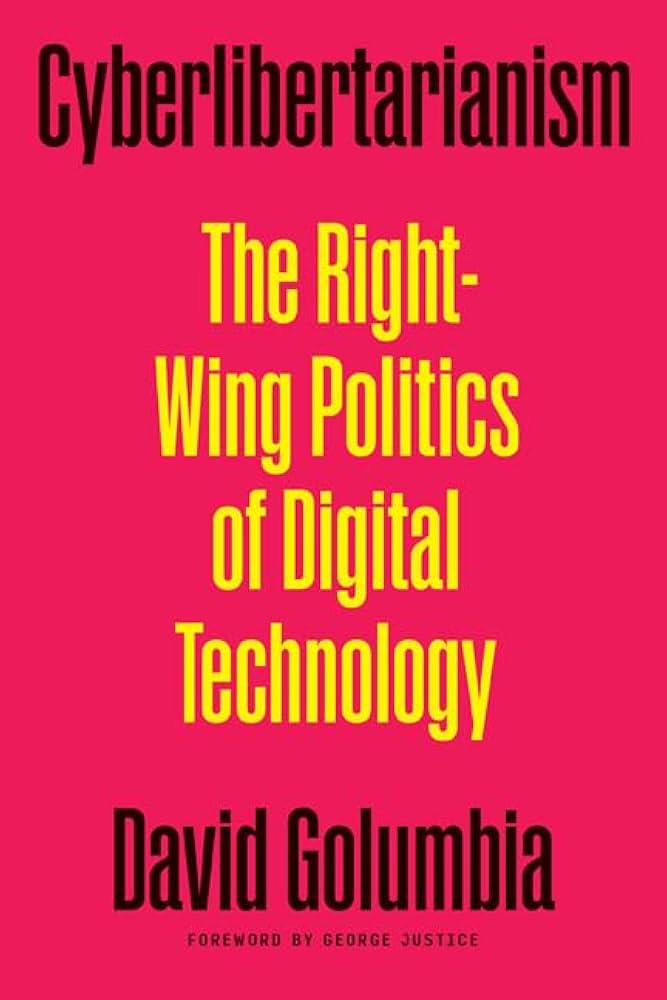
    ____, 2024. Cyberlibertarianism: The Right-Wing Politics of Digital Technology (Minneapolis: University of Minnesota Press.

    Huestis, Samuel. 2023. “Cryptocurrency’s Energy Consumption Problem.” Rocky Mountain Institute. https://rmi.org/cryptocurrencys-energy-consumption-problem/ (accessed February 25, 2025).

    Kraken Crypto Exchange. “See What Bitcoin Can Be.” https://www.youtube.com/watch?v=W4YkblM3McM (accessed February 25, 2025).

    Lears, Adin E. 2024. “Corruption, Consumption, and Chaucer’s Reenchantment of Craft in the Canon’s Yeoman’s Tale.” Studies in the Age of Chaucer 46: 37-65

    Matus, Zachary. 2017. Franciscans and the Elixir of Life: Religion and Science in the Late Middle Ages. Philadelphia: University of Pennsylvania Press.

    Middle English Dictionary, s.v. “god n.2,” https://quod.lib.umich.edu/m/middle-english-dictionary/dictionary/MED18946/track?counter=4&search_id=173783 (accessed February 25, 2025).

    Newman, William R. 1997. “An Overview of Roger Bacon’s Alchemy.” In Roger Bacon and the Sciences: Commemorative Essays, edited by Jeremiah Hackett, 317-36. Leiden, NL: Brill.

    ____.  2004. Promethean Ambitions: Alchemy and the Quest to Perfect Nature. Chicago: University of Chicago Press.

    Oxford English Dictionary, s.v. “creature (n.),” December 2024, https://doi.org/10.1093/OED/8061309761.

    Oxford English Dictionary, s.v. “corporation (n.),” December 2024, https://doi.org/10.1093/OED/1200365536.

    Povinelli, Elizabeth. 2016. Geontologies: A Requiem to Late Capitalism. Durham, NC: Duke University Press.

    Principe, Lawrence M. 2012. The Secrets of Alchemy. Chicago: University of Chicago Press.

    Seyr, Robin. “Michael Saylor: ‘Bitcoin is Economic Immortality’.” https://www.youtube.com/watch?v=A60jVnAIX40 (accessed February 25, 2025).

    Shannon, Laurie. 2013. The Accommodated Animal: Cosmopolity in Shakespeare. Chicago: University of Chicago Press.

    Stephenson, Will. 2022. “Cryptonomicon: Among the Bitcoin Maximalists.” Harpers Magazine 344, no. 2062: 25-34.

    Wyatt, David. 2009. Slaves and Warriors in Medieval Britain and Ireland, 800-1200. Leiden, NL: Brill. 

    1 There is, of course, an irony to the idea that Bitcoin might be a boon to the environment. Energy consumption is a leading cause of the current climate crisis and in 2023, Bitcoin alone (setting aside other cryptocurrencies) was estimated to consume 127 terawatt hours per year; more than many developed nations (Huestis 2023).

    2 Quotations from Saylor have been lightly edited for clarity and to avoid repetition.

  • Charles Bernstein–In Memoriam Pierre Joris (1946-2025)

    Charles Bernstein–In Memoriam Pierre Joris (1946-2025)

    boundary 2 and its community are mourning our friend Pierre Joris, whose work appeared in both boundary 2 and boundary 2 online:

    Charles Bernstein, “NoOnesRose: An Interview with Pierre Joris”

    Pierre Joris, “A Nomad Poetics Revisited: Poetry and Translation in a Global Age”

    In Memoriam Pierre Joris (1946–2025)

    Charles Bernstein

    Pierre Joris is a poet, essayist, anthologist, and translator, each an aspect of multidimensional artmaking rarely seen among American poets. His poetry and poetics are interwoven with his anthologies of twentieth century “free thinking” world poetry (with Jerome Rothenberg) and of the poetry of the maghrib (with Habib Tengour), which, in turn, are an extension of his translations (Celan, Adonis, Blanchot, Schwitters, Picasso, Safaa Fathy, Meddeb, &c).

    Joris’s works are never solemn, but they acknowledge the “darkness that surrounds,” as Robert Creeley once put it, that we are always behind our ideals, hopes, aspirations, premonitions, regrets, fears–behind both in the sense of supporting and after, trying to catch up, desperately for the most part, but in these poems not desperate but fortunate, in good humors and with humor.

    American poetry is born in second languages, it is our bounty and the secret of our success, if we have any, as much as Samson’s long hair was, once upon a time, the source of his strength. That’s why any attempt to homogenize and assimilate undermines the foundations of our poetics.

    Joris’s work is marked by a rare virtue for an American poet: courage: fierce and loving. Everybody is always talking about affect but no one ever does anything about it. We used to say “lifts your spirits” but that applies more to Thanksgiving balloons than to verse that challenges. I want a poetry and poetics, like Joris’s, that change my mind, puts me in the sway of currents of resistance and change. Where the courage is not just what is said but what is refused: the sanctity of the fixed place, nation or ideal, banner or standard. It’s not just the tyranny of monolingualism that Joris’s verse contests, it’s the tyranny of all forms of monomania: single-mindedness in perspective, style, politics, form, language, identity, desire. “I speak in voices / always always / other people’s voices / a thousand mouths.”–We all turned away from virtues when that meant some uppity guy telling us the way we lead our lives is base. What happens if the base speaks in a basso profundo, as in being pro fun with doing more than the done?

    Intellectus is not a dirty word. While so much of American poetry culture has run from thick historical context and wit as if they were a European disease, Joris has made a poetry that overthrows the hierarchies but not the minding, tending, churning, plowing, fermenting, and fomenting.

    I want to claim Joris as an American poet par excellence, but that is only if we understand “American” as dissolving into the “image nation” (Robin Blaser’s term)–“the city which is syntax”–of non-national possibility. To be neither here nor there, French nor German, Luxembourgish nor Americanische, is to inhabit a provisionality among and between, a toggling that creates a space of rhythmic intensities (“true movement unencumbered”) that confounds binaries and repels axiomatic allegiances.

    In “An Alif Baa,” Joris speaks of the a “zig” connecting to “orphaned” zag, evoking the nomadic condition of letters before they coalesce into words, what he calls in another poem the “zigzag nomad.” The distance from the orphaned “zag” to the “zig” of history or place or name is “irreducible.” The space from zig to zag is the antinomian space between (“between lips / be silk between / be between,” “between the ephemeral & the invariant”). This is a space Joris claims as the nomadic possibility of poetry and thought, what sometimes goes by the name of imagination but also fancy, emptiness, and negation.

    Joris’s poetry is an unexpected overlay of Expressionism (“eye turned inside out”) and Dada (“A fistful / of consonants / drifts from mouth to / mouth”), parataxis (“break the ice / to know”) and lyric (“what is is / shimmers, stammers / on the vocal-cords-bridge, in the / Great Inbetween / with all that has room in it / even without speech”).

    Voicings and thing language.

    His ever burning searching is tempered by the realpolitik (“postmortem”) of images, images that are uneasy, that propel a querical (queasy) inquiry.

    Joris’s “daily song” is a tracing of a definite but undefined course. The poet recognizes the necessity of a rhetorical address from “the center of my center of nowhere.” No where but still always here, at this long-delayed hearing that determines neither guilt nor innocence but rather makes ways (makes waves) to actualize copability (the ability to cope), which along with adaption, translation, miscegenation, and élan is a guiding force of Joris’s beguiling works.

    Adapted from The Kinds of Poetry I Want: Essays and Comedies (University of Chicago Press, 2025). See my conversation with Joris in boundary 2 50:4 (2023) and his contribution to 99 Poets/1999: An International Poetics Symposium, an issue of boundary 2 that I edited: 26:1 (1999). 

  • Naveeda Khan, Bareesh Hasan Chowdhury, and Shrobona Shafique Dipti–Shomonnoyok or Who Wants to be a Student Leader?

    Naveeda Khan, Bareesh Hasan Chowdhury, and Shrobona Shafique Dipti–Shomonnoyok or Who Wants to be a Student Leader?

    ©Mashruk Ahmed

    This post is Part Two of “The Bangladesh Chapter” of the b2o review’s “The University in Turmoil: Global Perspectives” dossier.

    Shomonnoyok or Who Wants to Be a Student Leader?

    Naveeda Khan, Bareesh Hasan Chowdhury, and Shrobona Shafique Dipti

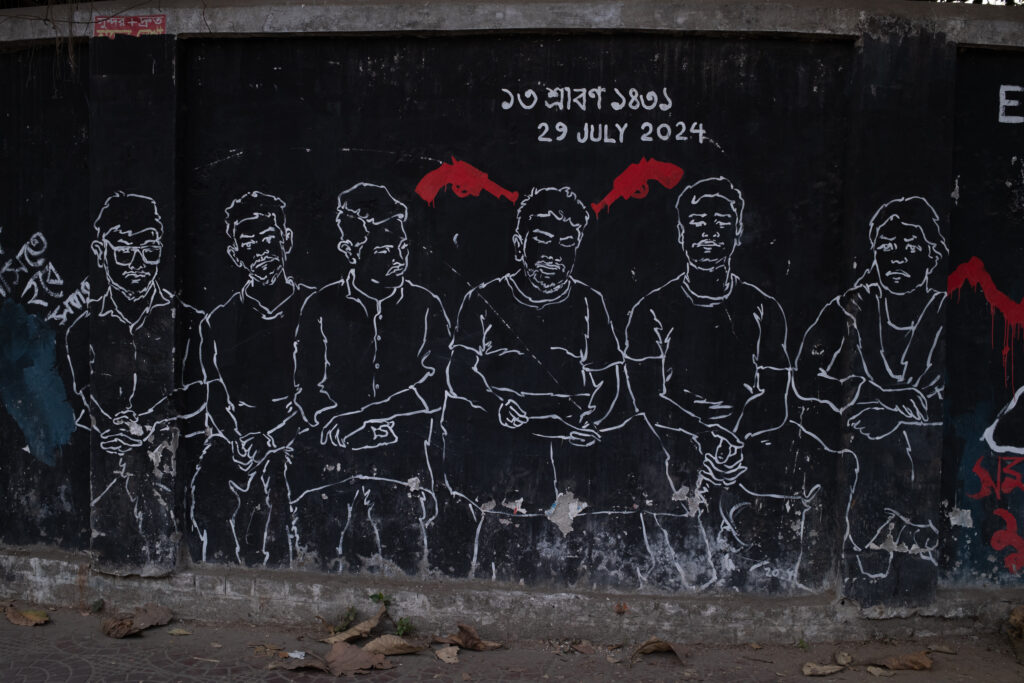
    On July 26, 2024, the police in Dhaka city picked up three students by the names of Nahid Islam, Abu Baker Majumdar and Asif Mahmud. Over the next two day, three more students were taken into custody: Sarjis Alam, Hasnat Abdullah, and–the only woman in the initial group–Nusrat Tabassum. The 2024 Quota Reform Movement had already turned violent by this time: the Awami League’s student organization had begun beating the protestors; the police had fired on unarmed crowds; and some in the public had retaliated by burning government buildings and infrastructure.

    This instance of the police detaining students had broader consequences. It had broader consequences because by taking in specific students the Sheikh Hasina government was for the first time acknowledging that the movement was not just composed of innocent (read “ignorant”) students being manipulated by anti-state agitators; it was after all an organized effort led by the students themselves. The government could not help but identify several students as leaders of the movement simply by picking them up, supposedly for their own protection. Among these student leaders, Nahid Islam had already been picked up earlier and beaten, no doubt because he was most visible in the media. But this group sweep suggested that the Awami League government felt they had identified and seized the most influential of the student leaders, without whom the protests would surely come to a halt. This action repeated the strategy of the government during the 2018 Quota Movement when several key leaders were taken into custody by the detective branch of the police to break the movement.

    This performance of concern for the student leaders—they weren’t being arrested; they were being taken into protective custody—was also violent in a psychological sense as it forced the six students to partake in televised displays of their cordial relations with the police. They were filmed sharing a meal with their captors. For many, the scene of the students gathered in the main detective branch of the Dhaka Metropolitan Police to take a meal with the notorious chief of the branch, Harun-ur Rashid (also referred to as DB Harun), evoked many earlier scenes. In them DB Harun was shown on television to be breaking bread with those he had picked up without warrant and, one heard, was mistreating, if not torturing, sometimes before these tablemates were permanently “disappeared.” There was a macabre humor to the students being feted in what had come to be referred to as “Harun’s Rice Hotel” (“Haruner Bhater Hotel”).

    ©Shrobona Shafique Dipti, graffiti at Dhaka University of the six students in custody.

    Under ordinary circumstances, the leaders appearing on television, being made to read out a statement calling off the movement, would have marked the end of the student action, cut off at the head, with viewers savoring the forced jollity of condemned prisoners partaking of a last meal. But not this time. Not only did viewers balk at this effort to quell a movement by excising the efforts of the young, but the other students also watching the television performance rejected the statement to call off the movement and openly repudiated the leadership of the six.

    The act of seeking out and gathering student coordinators in the police station marked a moment of failed recognition by the government. It failed to recognize that the category of the student coordinator, the self-named shomonnoyok, well exceeded the six who had been picked up, having evolved into a generic category to include anyone willing to take up the reins of organization as befitting the decentralized nature of the movement. True to form, the extorted call to end the protests was answered by other self-proclaimed shomonnoyoks vowing to continue the protests regardless. Many shomonnoyoks in cities such as Chittagong and Rangpur, previously unknown to the public, came to dominate the TV screens and front pages of the newspapers, marking the proliferating lines of the movement in towns and cities outside of the capital.

    A precursor to such organizing was the 2018 Road Safety Movement, which had followed the first Quota Movement of 2018. This had been initiated by schoolchildren, who had concluded that their erstwhile pleadings with the government to make roads safe for the young would go unheard. The young protestors had unintentionally adopted a decentralized mode of gathering, shouting slogans such as “neta hotey ashi nain” (“We have not come to be leaders”), only to be met with violence. Perhaps, the decentralized nature of organizing by the current shomonnoyoks was informed by that earlier movement. Undoubtedly many of the school children involved in it were now of age to participate in the 2024 Quota Movement. They likely drew upon their past practices and encounters with the state and violent memories of that past to fuel their mobilization in the present. Or perhaps it was just the call of the hour; the 2024 movement had come too far and reached too deeply into the conscience of Bangladeshi society for it to falter on a statement made clearly under duress by the six shomonnoyoks in the police station. “Bhoi kete giyeche,” “Fear has gone.” The fear that had once tempered protests and empowered the regime had given way.

    While a message was shared widely across social media clarifying that students were to offer themselves as mere coordinators and not take on the mantle of leaders, it is not clear by what modality any decision on this question was taken, agreed upon, faithfully transmitted and taken up. The mimetic doubling, redoubling, multiplying of the figure of the shomonnoyoks was so forceful within the movement that the term, previously in general use in Bangladesh to refer to the coordinator of any movement, be it garment factory workers protesting better work conditions and wages or environmentalists protesting pollution, seems likely henceforth to refer only to the countless, effectively nameless leaders of the Quota Reform Movement, a number of whom gave their lives to bring down Hasina.

    The importance of the category of the shomonnoyok is manifest even after the fall of the Hasina government and the winding down of street protests. However, it has now gone from being a labile, even generic category donned by anybody to being a marker of some distinction, of a person backed by a successful uprising. Some, such as Abu Sayeed, deemed the first student to be killed in the movement, have been memorialized as martyred shomonnoyoks. Others, such as Nahid Islam and Asif Mahmud of the original six who were imprisoned, have taken up seats in government and acquired distinction that way. Others, such as Umama Fatema, have gained publicity by complaining of women students being left out of government despite being in the maelstrom from the start. But what is interesting is how the very act of claiming the title of shomonnoyok or being deputed by a shomonnoyok has come to indicate that one is authorized. Since the fall of Hasina, there have been notable incidents of those claiming to be shomonnoyoks or authorized by shomonnoyoks to carry out a range of activities, from enforcing change within institutions to rid them of Awami League loyalists to carrying out extortion rackets.

    As if to remind us that the title of the shomonnoyok carries no particular distinction and may be time-bound to the movement alone, Nahid Islam, one of the original six and now in the interim government as an upadeshta or advisor overseeing post, telecommunication and information technology, recently felt compelled to address a letter to various ministries assuring them that he had nothing to do with anyone claiming to be acting on his behalf: “Recently, some individuals have been using my name or claiming to be my relatives to seek favours in different offices, to fulfil their personal interests and gain illegal benefits, which is entirely unethical. This is tarnishing my reputation.” Newspaper reportage had him saying that if anyone tries to use his name or claim to be his relative in order to get something done or make a request, it should not be considered under any circumstances (The Business Standard, 2 January 2025). In effect, he was disavowing that his name meant anything in particular, as in the original meaning of shomonnoyok.

    At present, students in the government, such as Nahid Islam, are seen to be growing more pragmatic by the day: they have lost their shomonnoyok quality of splitting off and leading in the face of opposition. They are seen to emphasize instead broad-based consensus across political parties. Meanwhile others have gathered to take on the mantle of shomonnoyok, leaning into its demonstrated capacity to proliferate. The umbrella group of the movement, the Boishommo Birodhi Chhatra Andolon (Anti-Discrimination Students Movement) formed in 2024 has been joined by the 55 member-Jatiya Nagorik Committee (National Citizens Committee), also spearheaded by student coordinators during the July Uprising. The first seeks to represent students, while the second seeks to represent citizens more widely.

    These newest versions of shomonnoyoks have vowed to pressure the interim government to deliver on its promise of reforms to the country’s constitution, election process, and civil administration such that fascism may be forever stayed. Yet they were foiled in their most recent effort to get a declaration from the government, dubbed the July Proclamation, attesting to the rightfulness of the student uprising. They had sought such a proclamation so that the uprising may go down in the history books as necessary and legitimate, securing the legacy of the shomonnoyoks. They also sought to protect those who had been involved in the movement from future retaliatory action, as in the form of a general amnesty. The Proclamation was deferred, as the interim government sought consensus across party lines. However, such deferral is seen to be having a deleterious impact on the ability of students to deliver change, compounded by the fast recouped strength of traditional political parties who have been quick to capture political spaces. It is notable that Nurul Haque Nur and Rashed Khan, who had been leaders of the 2018 Quota Movement, became national level leaders in the aftermath of the movement, just as Nahid and others are now on their way to being. They may have wanted to stay shomonnoyoks, as Nahid’s recent words quoted above indicate, but it appears that they may be becoming student “netas” (“leaders”) in the old way.

    The July Uprising was a moment of unity in the face of unprecedented brutality by a regime that ultimately had no recourse for the decentralized and multitudinous movement of shomonnoyoks. But just as the population came together from different ideological fronts to uphold and support the evolving movement, in a post-uprising Bangladesh, they are fracturing once again. Islamists, nationalists and leftists marched together in July but have since recovered their differences. The shomonnoyoks have decided to focus on building a new political front. But that requires originality of thought and pursuit. Can an identity premised on schismatic mimesis to be effective provide such focus and newness?

    Naveeda Khan is professor of anthropology at Johns Hopkins University.  She has worked on religious violence and everyday life in urban Pakistan.  Her more recent work is on riverine lives in Bangladesh and UN-led global climate negotiations.  Her field dispatches from Dhaka in the middle of the July Uprising may be found here.

    Bareesh Hasan Chowdhury is a campaigner working for the Bangladesh Environmental Lawyers Association on climate, policy, renewable energy and human rights. 

    Shrobona Shafique Dipti, a graduate of the University of Dhaka, is an urban anthropologist and lecturer at the University of Liberal Arts Bangladesh with an interest in environmental humanities and multi-species entanglements. 

  • Naveeda Khan, Bareesh Hasan Chowdhury, and Shrobona Shafique Dipti–The July Movement of 2024

    Naveeda Khan, Bareesh Hasan Chowdhury, and Shrobona Shafique Dipti–The July Movement of 2024

    ©Rahul Talukder

    This post is Part One of “The Bangladesh Chapter” of the b2o review’s “The University in Turmoil: Global Perspectives” dossier.

    The July Movement of 2024

    Naveeda Khan, Bareesh Hasan Chowdhury, and Shrobona Shafique Dipti

    Raised on stories of the rebellious 1960s, we are aware of the large role played by students across the world protesting war, racial inequities, and human rights violations, among other issues. We are also well versed in the stories of reaction that set in soon afterwards, as police and armies beat back students, conservative governments came to power, and free-market ideology became dominant nearly everywhere. What, then, would it mean to encounter student protests in the present without this past determining its reception? How should we think about protests in parts of the world other than those which have been endowed with the capacity for historical change? Can we take our learning from emergent events whose trajectory we cannot claim to know in advance?

    In “The Bangladesh Chapter” of “The University in Turmoil”, we explore what the country’s student-led July Movement of 2024 has to teach us in terms of the contours of student demands, the nature of student organizing, the spatial conditions of possibility for protests, and the narrative battle over the past in order to secure a different future. From the outset we do not claim the movement to be a success or even that it has been liberatory; we will, rather, follow its grain to arrive at a dense emplotment of what it is to struggle for meaning and political salience from within universities in our present. We begin with an account of the July Movement to contextualize our contributions to this chapter.

    ©Faysal Zaman

    Starting in June 2024, students at the University of Dhaka, the eminent public university established in 1921, gathered in Shahbag, an area in the capital city well known for hosting protests. They demanded what seemed like an oddly specific thing. They wanted the reform of a quota system for lucrative government jobs that held a large quota (some 30%) for the children and grandchildren of those who had fought in the liberation struggle of 1971, which had secured Bangladesh’s independence from Pakistan. This quota for freedom fighters and their families had been reduced once already in the face of strong student protests in 2018, when it was brought down from 56% to 30%. The students’ request in 2024 to get rid of quotas entirely, including those for women, seemed specific and retrograde to boot. Intellectuals and ordinary people alike watched the protests from afar, uncertain as to whether it ought to matter to them or not.

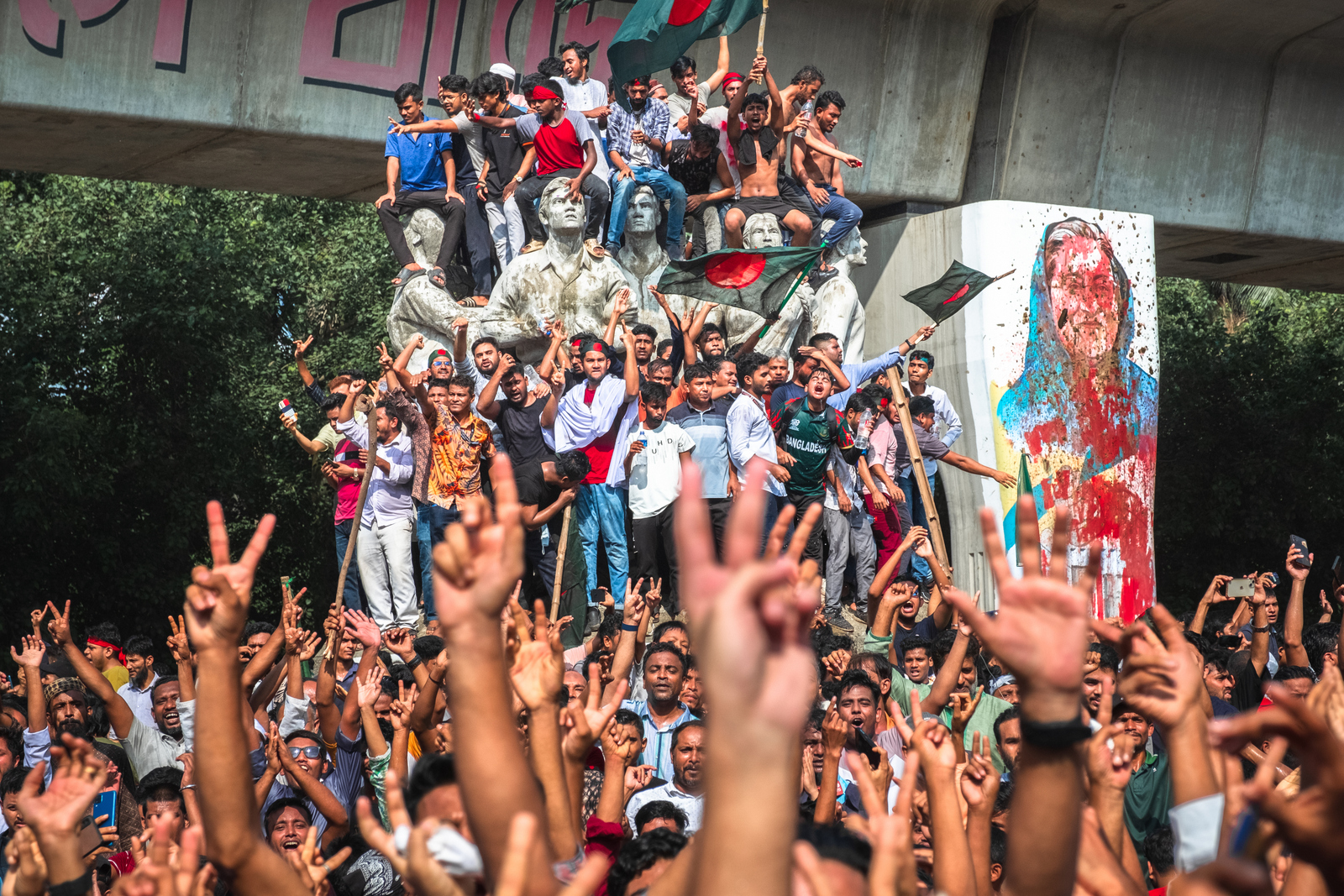
    A series of discursive missteps by then Prime Minister Sheikh Hasina soon made clear that the protests turned on more than policy, that she herself was a problem, particularly her personalistic and paranoid mode of running the country. Hasina was the child of an assassinated politician, the very same one generally credited with liberating the nation from Pakistan. Almost her entire family, barring her sister, was assassinated in 1975. Her framing of the protests exposed her Manichean view of the world, divided between those who were with her and those against her. And the students who protested a quota system that favored those who fought in the liberation struggle alongside her father were clearly not with her. Despite putatively accepting their demands, her hostility to the students was made apparent by the escalating attacks on them, first by the student wing of the Awami League, the ruling party, then by law-enforcement personnel, and finally to an extent by the military, alongside a campaign of disinformation and an unprecedented internet and communications blackout. Joined by their peers from other educational institutions, notably both public and private, the students took to the streets with bricks, sticks and rods to engage in street battles with state forces. Those from the working class soon joined the fray.

    Many expected the government to dig in and massacre as many as required to hold onto power, but this was averted when the army chief of staff, who, reading the unrest in the streets and among rank-and-file soldiers, forced Sheikh Hasina to leave the country. It was a testimony to the hold that Hasina had over her party that her resignation couldn’t be salved by placing a more conciliatory member of the party as the interim head of the government. Her removal from the scene meant the collapse and universal discrediting of the Awami League party.

    Even as students most publicly associated with what has come to be called the July Movement or July Uprising negotiated over the composition of the interim government with army officials and members of the opposition parties, long ill-treated by Hasina, they–the students–made clear that this government was not to assume the usual caretaker role of calling elections to usher in a new administration. Rather, the interim government was to reform the existing political system such that fascibad or fascism may never again triumph. Representatives of the students who organized the movement took up seats of government to ensure this, while others took to the streets first to uphold order in the immediate aftermath of the fall of the government, then to keep pressure on the interim government not to cave to reconciliation with the prior ruling party or other parties but to stay the course of reform.

    What is meant by reform, however, and how it is to be brought about are still being deliberated some six months after the fall of the Awami League government. In that time the usual ageist, gerontological reaction to the utpat or mischief of the young has set in, particularly among the intelligentsia of the elite, and even some of the working class who strongly supported the students. And the students, those in government and those on the street, seem uncertain of the way forward. Recently, a large crowd of primarily young men demolished Hasina’s father’s house in Dhaka, once memorialized as a museum, out of a desire to be done with the past. Their past is of tyranny and trauma, and not of the progress recently preached by Hasina in an online address to her followers.

    It is from within this present that we think it important to return to the July Movement, not to memorialize it, but to ask: what were the unique features of this movement that laid the foundations for its efficacy? And just how efficacious has it been? Is that efficacy faltering?  The moment is complex. There are as many answers as there are questions.

    Naveeda Khan is professor of anthropology at Johns Hopkins University. She has worked on religious violence and everyday life in urban Pakistan. Her more recent work is on riverine lives in Bangladesh and UN-led global climate negotiations. Her field dispatches from Dhaka in the middle of the July Uprising may be found here.

    Bareesh Hasan Chowdhury is a campaigner working for the Bangladesh Environmental Lawyers Association on climate, policy, renewable energy and human rights. 

    Shrobona Shafique Dipti, a graduate of the University of Dhaka, is an urban anthropologist and lecturer at the University of Liberal Arts Bangladesh with an interest in environmental humanities and multi-species entanglements.

  • Winnie Wong–Why Have There Been No Great Women Forgers?

    Winnie Wong–Why Have There Been No Great Women Forgers?

    Why Have There Been No Great Women Artists Forgers?

    Winnie Wong, with apologies to Linda Nochlin

                …truth, whose mother is history, rival of time, depository of deeds, witness of the past, exemplar and adviser to the present, and the future’s counselor. 

                                Pierre Menard, Author of the Quixote[1]

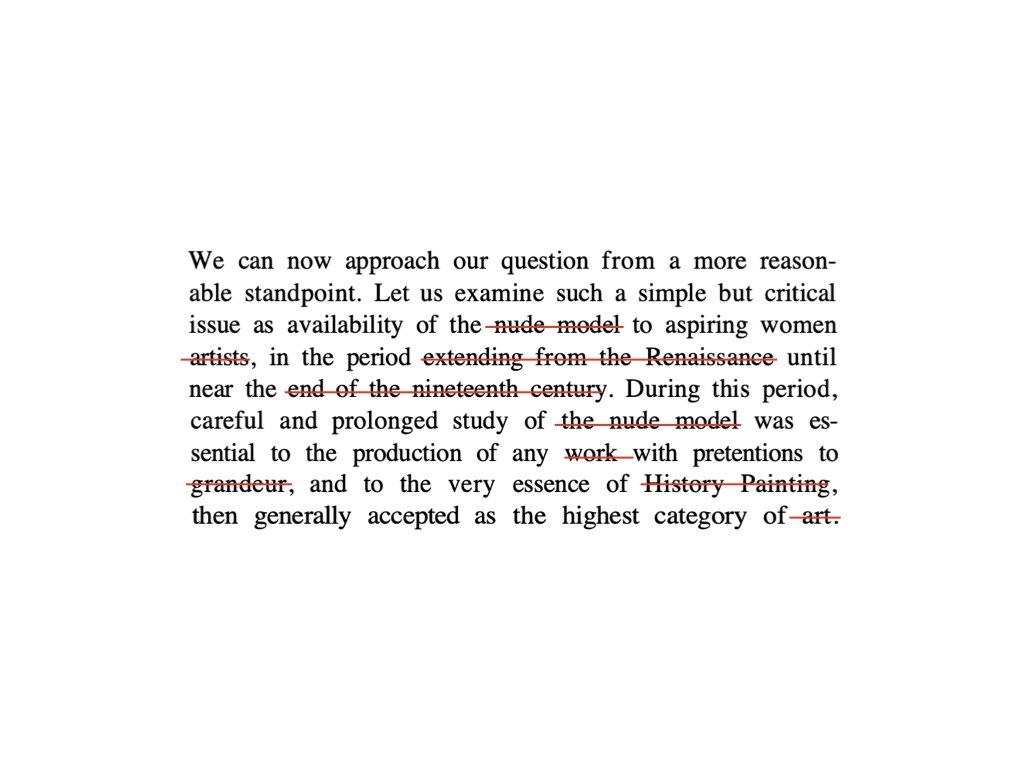
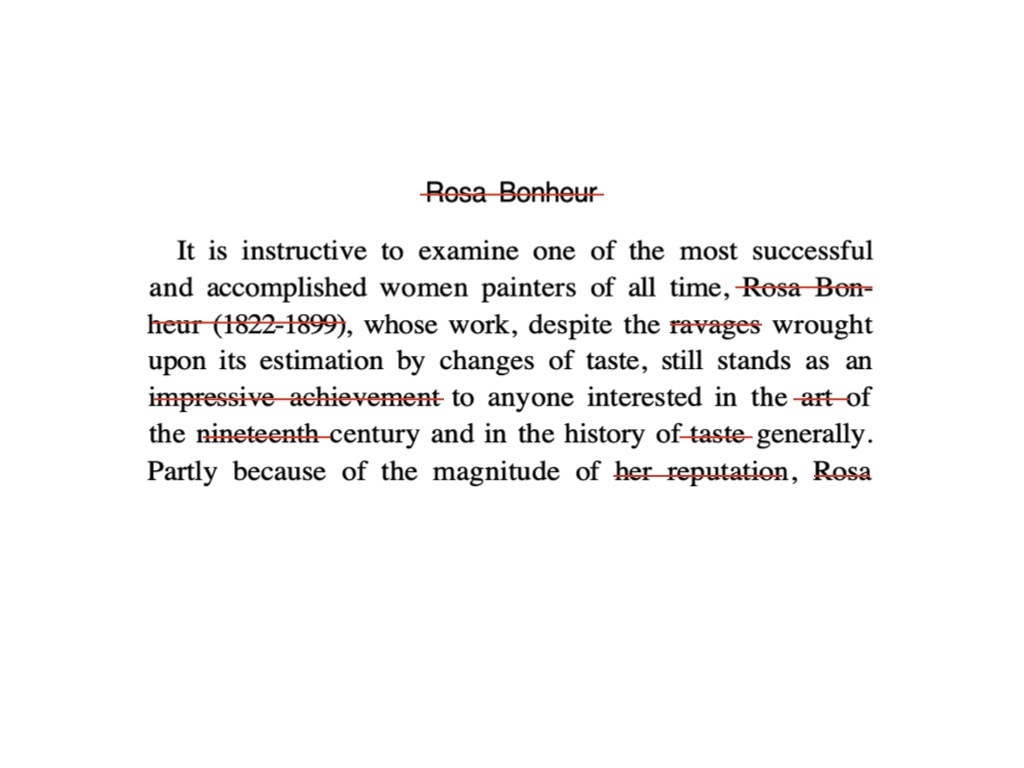
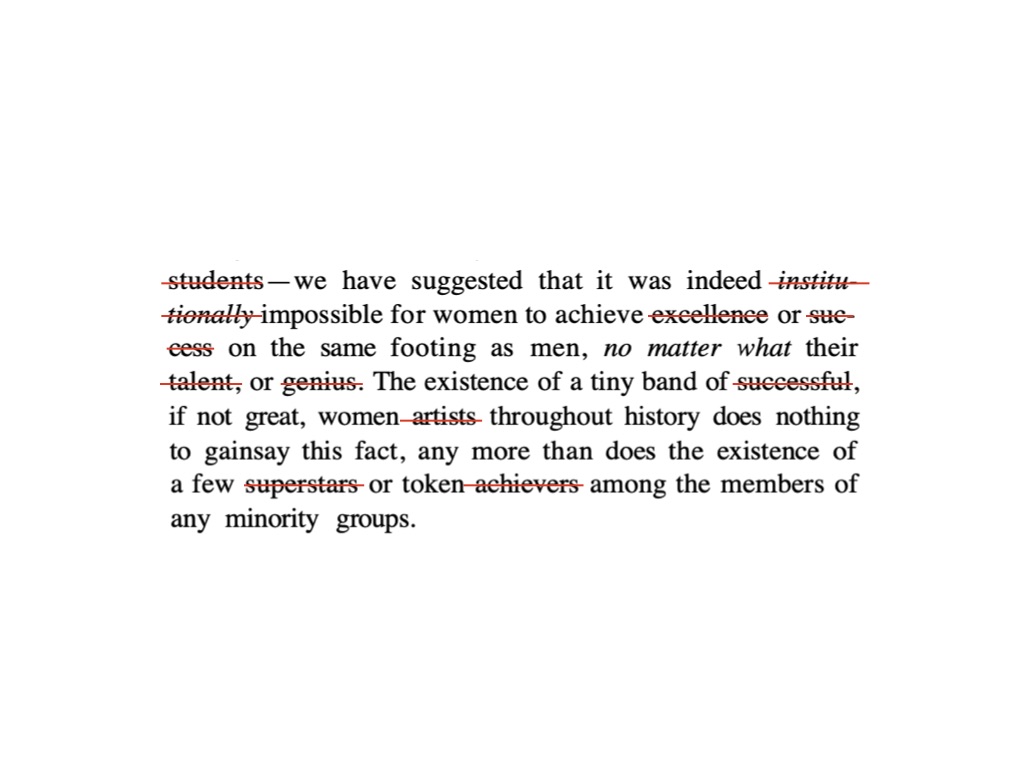
    Linda Nochlin’s “Why Have There Been No Great Women Artists?” first appeared in ARTnews in January 1971. It was described by ARTnews then as “based on a section of the anthology, Woman in Sexist Society: Studies in Power and Powerlessness,” which was to be published some months later, with the not-yet past-tense title, “Why Are There No Great Women Artists?” (cf. Woman in Sexist Society: Studies in Power and Powerlessness, edited by Vivian Gornick and Barbara K. Moran, NY: Basic Books, 1971, 344-366). Subsequently, that original––but therefore not first––version was “reprinted,” though “in revised form,” in Art and Sexual Politics: Women’s Liberation, Women Artists, and Art History (edited by Thomas Hess and Elizabeth Baker, NY: Macmillan, 1973, 1-43), where it was further described as “a shortened version.” Meanwhile, the first-but-not-original 1971 ARTnews version appears again, with other modifications, in Linda Nochlin’s Women, Art, and Power and Other Essays (NY: Harper & Row, 1988), and the same non-original was “pre-posted” on May 30, 2015 on the ARTnews website, in the “Retrospective” section of the June 2015 issue. However that pre-posted non-original essay does not appear to have been actually printed in the June 2015 issue of ARTnews, at least not in the copy currently residing in the Art History Library of the University of California, Berkeley. Separately, pdfs made from scanning the reprinted, revised, and shortened second copy (the one published in Art and Sexual Politics) appear online from time to time in various art educators’s course readings. Preferring the brevity and relative-originality of this second copy, as well as its fugitive accessibility on the internet, this is the version that I have rewritten here.

    *

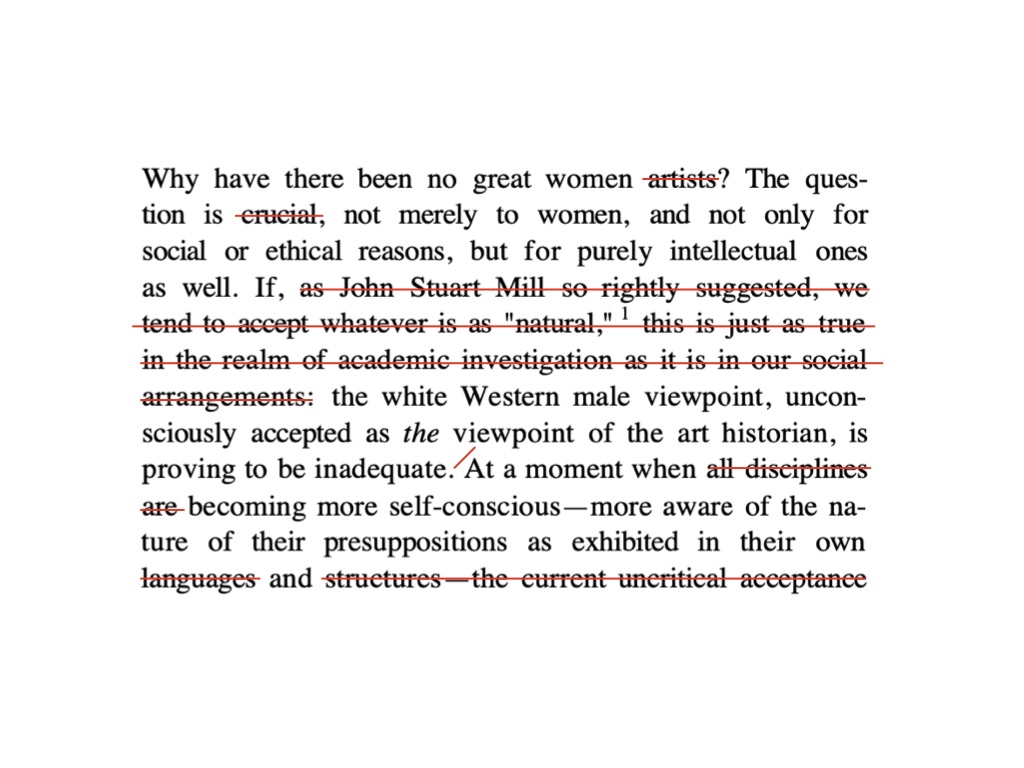
    “Why have there been no great women forgers?” The question is curious, not merely to women, and not only for social or ethical reasons, but for purely intellectual ones as well. If the white Western male viewpoint, unconsciously accepted as the viewpoint of the art world professional, has proven to be inadequate, then it ought to follow that women have also been secretly, deceptively, and even subversively, painting works great enough to be recognized as masterpieces, but for which they cannot, or have not yet, claimed authorship. At a moment when a series of scandals has once again forced the art world to become more self-conscious—more aware of the nature of its presuppositions as exhibited in its own sureties and valuations, we ought to be confronted by many a great woman forger, skilled yet frustrated artists who have cunningly laid waste to the false ideology of authenticity spun by art experts, dealers, auctioneers, and museum directors. An art historical record corrected of the unstated domination of white male subjectivity ought to hold as many women forgers as it does Michelangelo, Marcantonio Raimondi, Pierre Mignard (or even Menard), Han van Meegeren, Elmyr de Hory, Lother Malskat, Zhang Daqian, Eric Hebborn, Tom Keating, and Wolfgang Beltracchi.

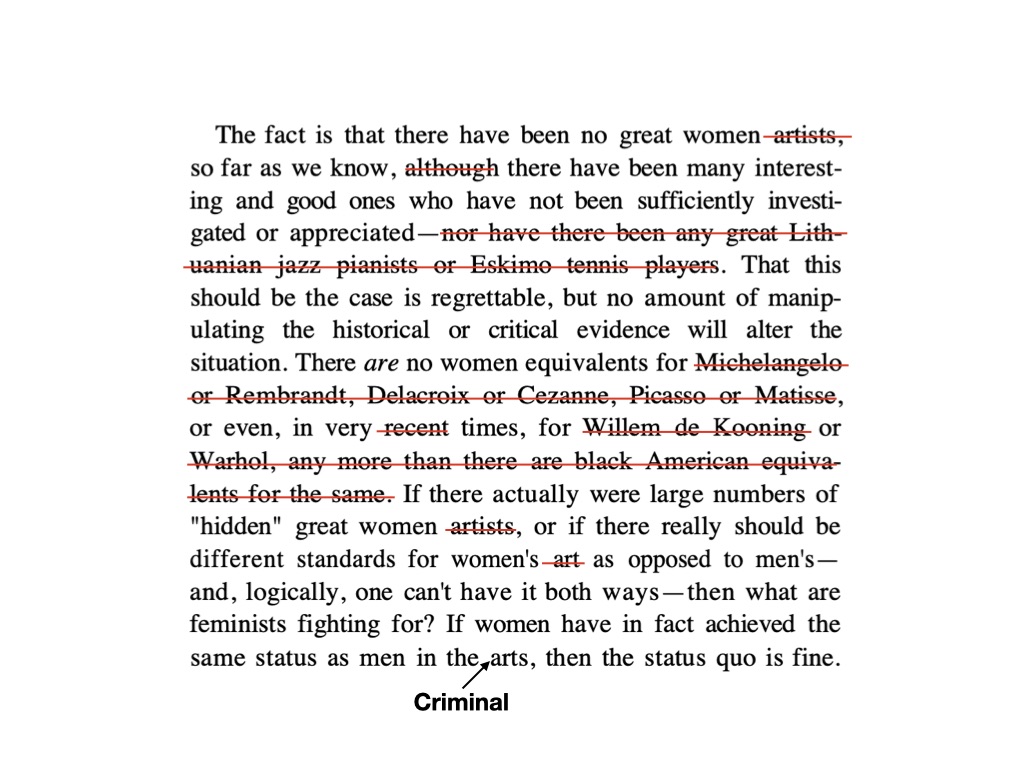
    Today, the first reaction is still to swallow the bait and attempt to answer the question as it is put: to dig up examples of insufficiently appreciated women forgers throughout history; to rehabilitate modestly detectable, if interesting and productive, careers of forgotten copyists, insolent assistants, wayward ghost-painters, and defiant amanuenses; to “rediscover” the women behind male pseudonyms and masculine personae and make a case for them. We have indeed uncovered the careers of many wives, girlfriends, and daughters whose men appropriated their authorship in various guises. A court determined, and a movie popularized, that behind Walter Keane’s big-eyed waifs was the talent and imagination of his wife Margaret Keane. A 12th-century connoisseur fretted that the artist-emperor Sung Huizong’s personal and masculine calligraphy could not actually be distinguished from those of his palace ladies. An art historian is devoted to the theory that Vermeer’s daughter painted some of the greatest masterpieces attributed to him. A newspaper got the Australian Aboriginal artist Turkey Tolson Tjupurrula to sign a statutory declaration attesting that he autographed works that his daughters and daughters-in-law had painted for his dealer.[2] It is my own suspicion that Duchamp’s girlfriend Yvonne Chastel was “A. Klang,” the “sign painter” supposedly hired to paint the pointed forefinger of Tu m’, Duchamp’s last painting.[3] Such attempts at scholarly reevaluation are certainly well worth the effort, adding to our knowledge of women’s labor behind painting generally.

    There are also of course the women who were accomplices or even orchestrators behind fabulous forgery schemes: Glafira Rosales was the art dealer who profited US$33.2 million by consigning to Knoedler Gallery 60 forgeries painted by Chinese (male) painter Pei Qian-shen. Helene Beltracchi served a prison sentence for fraudulently selling her husband Wolfgang’s forgeries, supposedly from her grandfather’s collection.[4] Olive Greenhalgh pled guilty to conspiracy charges for helping to pass off the “antiques” made by her teenaged son Shaun Greenhalgh, the multimedia forger prodigy. While crucial to the scheme, none of these women were art forgers themselves.

    Then there are the women copyists who do not claim to be forgers, let alone great ones. Jane Stuart’s father Gilbert Stuart called her “boy,” and his “best copyist,” though as far as we know did not pass off any as his.[5] Marino Massimo de Caro, the orchestrator of the forgeries of Galileo’s Sidereus Nuncius, stated that a woman in Buenos Aires duplicated the etchings for some of his fake books, but did not bother to name her.[6] In West Hollywood, a conservator and film set decorator Maria Apelo Cruz was tricked into copying a Picasso pastel drawing for the dealer Tatiana Khan, who pled guilty to various fraud charges in 2006.[7] The American collector Andrew Hall sued Lorrettan Gascard and her son Nikolas for selling him paintings purported to be by Leon Golub. Hall’s suit insinuated that Lorrettan Gascard (a former student of Leon Golub’s) may have forged the paintings herself, yet Lorrettan has not publicly claimed credit for those paintings.[8] We could imagine rewriting a career for these women as forgers reluctant to unmask themselves. A great deal could still be done in this area, but unfortunately, such attempts do not really confront the question “Why have there been no great women forgers?”; on the contrary, by attempting to answer it, they merely reinforce its negative (or positive) implications.

    There is another approach to the question. Many contemporary feminists might assert that there is actually a different kind of greatness for women’s forgery than for men’s. They might posit, that, due to the unique character of women’s situation and experience—their meticulous care for detail, their love of craft, their uncanny ability for dissimulation—that their forgeries are so skilled that they have thus far been impossible to detect.

    This might seem reasonable enough: in general, women’s experience and situation in society, and hence as forgers, is different from men’s, and certainly a body of forgery of all kinds produced by women secretly but entirely disunited in character and intent might indeed all be so masterful as to be unidentifiable presently. Perhaps possessing higher intelligence and survival skills in general, women criminals may simply be less likely to be caught. Unfortunately, though this remains within the realm of possibility, as far as we can know, so far, it has not occurred.

    It might also be asserted that women are simply more inward-looking, and therefore not as likely to engage in the imitation or appropriation of another’s stock or style. Perhaps self-expression is an innately more feminine drive, and route imitation and self-effacement unlikely garner their interest. But is Richard Prince really less slavish than Sherry Levine? Is Jeff Koons less subtle than Sturtevant? Is Banksy more anonymous than the Guerrilla Girls? Is Tino Seghal less evasive than Lutz Bacher? In every instance, women appropriationists would seem to be closer to other artists of their own period and outlook than they are to each other.

    The problem lies not so much with the feminist conception of what femininity in forgery might or might not be, but rather with a misconception of what forgery is: with the popular idea that forgery is the direct, personal expression of individual emotional experience—a translation of frustrated ambition into artistic deception. Yet forgery is almost never that; great forgery certainly never. The making of a forgery involves a self-inconsistent language of form, more or less dependent upon, while also free from, given temporally-defined conventions, schemata, or systems of notation, which have to be learned or worked out, through study, apprenticeship, or a long period of individual experimentation. In order to defraud an art market and institutional establishment, the great forger must endure, for some period, disciplined anonymity. Yet in order to embrace the notoriety of a great forger, one must also ultimately accept criminal liability and then fascinate the public with performances of heroic iconoclasm.

    The fact is that there have been no great women forgers, so far as we know. There are not even many interesting and good ones who have not been sufficiently investigated or appreciated. That this should be the case is regrettable (or laudable), but no amount of manipulating the historical or critical evidence will alter the situation. There are no women equivalents for van Meegeren or de Hory, or even in the invented mode, Ern Malley. If there actually were large numbers of “hidden” great women forgers, or if there really should be different standards for women’s forgery than men’s—and, logically, one can’t have it both ways—then what are feminists fighting for? If women have in fact achieved the same status as men in the criminal arts, then the status quo is fine.

    In other artistic misconduct, indeed, women have achieved equality. While there have never been any great women forgers, there have been scandalous women literary forgers and impersonators. The biographer Lee Israel successfully forged fake personal letters of famous authors and signed their signatures, using her broken tv as a lightbox. After serving a short period of house arrest, she wrote a short memoir apologetically entitled, “Can You Ever Forgive Me?” A Hollywood biopic made from it probed the depths of her pathos, and has her sincerely and tearfully testifying to the court at her sentencing hearing, “I think I have realized that I am not a real writer…and that it was not worth it.” Helen Darville, as “Helen Demidenko,” published a novel which readers were led to believe was based upon her Ukrainian family’s collaboration with the Nazis in the Holocaust. The book won three major literary awards in Australia. At the ceremony where she accepted one, Demidenko performed Ukrainian dances dressed in a traditional Ukrainian blouse, the kind of performance she would increasingly embrace over two years. But the intense literary debate over the book’s anti-Semitism was thrown into deeper shock when her ethnic identity—utterly lacking any Ukrainian heritage––was unmasked by her parents and high school teachers in the news media. After that, numerous instances of plagiarism were newly discovered in the novel, and Demidenko/Darville was scrutinized, in book-length academic studies, for authentic signs of remorse over the banality of her evil. By finding instances of plagiarism throughout the previously-award-winning book, it would seem that the literary world was condemning her fraud as also a forgery, multiplying, rather than vindicating, her moral crimes. It could not be that women as a whole shy away from the turpitudes of lies, fraud, plagiarism, impersonation, immorality, bigotry and other improprieties in the arts.

    It is no accident that the whole crucial question of the conditions generally productive of great forgery has so rarely been investigated. Yet a dispassionate, impersonal, sociologically- and institutionally-oriented approach would reveal the entire romantic, elitist, individual-glorifying and monograph-producing substructure upon which the profession of forgery detection, unmasking, heroization and popularization is based.

    Underlying the question about women as forgers, we find the whole myth of the Great Forger—subject of a handful of movies and biographies, masterful, impish, misunderstood, bearing within his person since birth a mysterious essence, called Thwarted Genius.

    The magical aura surrounding the representational arts and their forgers have, of course, given birth to forgers’s autobiographies and self-representations since the earliest times. Interestingly enough, the same magical abilities attributed by Vasari to Michelangelo and his forgery of an “ancient” Cupid[9]—the ability to copy anything, “the genius to do this and more,” the lack of any corrupt motivation except the hoodwinking of ignorant collectors—is repeated as late as the recent 2014 documentary on Wolfgang Beltracchi. The fairy tale of the Boy Joker, able to copy any artist’s style, quickly and easily, but finding his own art rejected by dealers and experts who therefore deserve to be outwitted, has been stock-in-trade of forger mythology since Vasari immortalized Michelangelo and embarrassed the Cardinal San Giorgio. Through mysterious coincidence, later forgers were all portrayed as tricksters who exposed the art market in similar manner. Even when the Great Forger was quite avaricious in his long-running crimes, his motivations in retrospect always seem to contain subversive artistic intent. In the end, the art establishment is portrayed as so inexpert that the forger’s greatest fear is that no one will believe he is the true maker of the fakes. Pierre Mignard painted a “Guido Reni” to test and humiliate his court rival Le Brun. Han van Meegeren demonstrated his abilities in court in order to prove that he could really paint “Vermeers,” and that he had not sold Dutch national cultural property to the Nazis. Tom Keating planted “time bombs” in his forgeries that conservators would overlook but that would later prove his hand unequivocally. Lothar Malskat ended up suing himself and serving as both expert and witness at his trial. In the theory of forgery sleuths, and often the great forgers themselves, a great forger always eventually unmasks himself, because revealing his craftsmanship is the only way to bring down the art establishment that rejected him as a great artist long ago. He then writes a memoir, a tell-all or a how-to handbook, before starring in a TV series, a movie, a documentary or two. The public cheers, admires, and respects him for the ruse, for it is only snobby experts and ignorant collectors who have committed the true crimes against art.

    Despite the actual basis in fact of some of these late-bloomer stories, the tenor of such tales is itself misleading. Yet all too often, art historians, while pooh-poohing this sort of narrative based around artistic intention, nevertheless retain it as the unconscious basis of their scholarly assumptions. Forgery biographies, moreover, forward the notion of the Great Forger’s mastery of his craft, as demonstrated by the social and institutional structures which rejected his art but that now he has duped. This is now the golden-nugget theory of Thwarted Genius. On this basis, women’s lack of achievement in forgery may be formulated in a disturbing syllogism: If women have been thwarted by the social and institutional constructions of art, they would reveal its bias through forgery. But they have never revealed it. Q.E.D. women do not have the golden nugget of artistic genius, which has not even been thwarted.

    Yet if one casts a dispassionate eye on the actual social and institutional situation in which important forgers have been valorized throughout history, one finds that the fruitful or relevant questions for the historian to ask shape up rather differently. One would like to ask, for instance, from what artistic traditions were forgers were most likely to come at different periods of art history? What proportion of major forgers work within traditions in which originality and auto-genesis are overburdened with aesthetic value? Despite the Orientalist sentiment that constructs Chinese or “Eastern” cultures as ones that prize honorific emulation or accept outright piracy, one might well be forced to admit that a larger proportion of forgers, great and not-so-great, were white and Western European.

    As to the relationship between forgery and culture, an interesting paradigm for the question “Why have there been no great women forgers?” is the question: “Why have there been no great women forgers from China?” If, in other words, Chinese civilization accords such high value to copying, why have there not been armies of great Chinese women forgers, to diametrically oppose the utter lack of Western women forgers? Even in contemporary Dafen village, a community of 6000 registered painters derided as forgers and assembly-line copyists, the vast majority of the painters are men rather than women. Could it be possible that thwarted genius is missing from the Chinese make-up in the same way that it is from the feminine psyche? Or is it rather that the kinds of demands and expectations placed before both non-Westerners and women—radical self-invention, outrageous rebellion, brazen public performance—simply makes the heroization of racialized, ethnicized, or gendered lawbreakers unthinkable?

    When the right questions are finally asked about the conditions for producing forgery of which the production of great forgery is a subtopic, it will no doubt have to include some discussion of the situational concomitants of psychology and skill generally, not merely of artistic craftsmanship. As Foucault and others have stressed, the modern authorial persona is built up minutely, step by step, from infancy onward, and the patterns of discipline-punishment may be established so early that they may indeed appear to be innate to the ahistorical observer. Such investigations imply that scholars will have to abandon the notion, consciously articulated or not, of artistic authorship as innate, even for those who have been denied it.

    The Question of the Original

    We can now approach our question from a more reasonable standpoint. Let us examine such a simple but critical issue as the availability of original masterpieces to aspiring women forgers, from the period after the establishment of public museums to the present day. During this period, careful and prolonged study—indeed, love––of original masterworks has been imagined as essential to the production of any forgery with pretentions to pass muster, and to the very essence of a Perfect Copy, which is generally accepted as the highest category of forgery. Forgers are thought to admire and eventually develop an obsession for the artists whom they are emulating, in various ways even modeling their own lives after them. In movies, forgery schemes are often motivated by an art thief who plans to steal a work out of some misguided sense of personal ownership, while the original is meticulously imitated by the forger to hide the theft. The Perfect Copy is supposed to be what the great forger produces—a copy so exactingly duplicative of the original that no one can tell the difference.

    The hypothetical of indistinguishability has occupied many an aesthetic philosopher over the twentieth century. But in fact forgers rarely need much access to the original to make a passable forgery, for great forgers are never copyists. A brief survey of the history of forgery reveals: masterpiece forgeries are almost always inventions—original works that do not reproduce any existing work. Han van Meegeren’s infamous “Vermeers” were not intimate domestic bourgeois genre pictures but large, Caravaggio-influenced religious canvases that fooled art historians and museum directors into identifying them as the “missing link” between Vermeer’s early and late periods. Riverbank, a painting that divides historians of Chinese art into two irreconcilable camps, is either a recovered and restored 10th-century painting by Dong Yuan or a 20th-century pastiche by Zhang Daqian. As the forger Wolfgang Beltracchi put it, what a successful forger needs to do is to find is a painting that doesn’t appear in any catalogue of works, but that is mentioned or hypothesized in the art historical literature. In other words, a successful forgery is an original invention that fills in the narrative history in which the artist’s works have been organized in retrospect. As in the case of van Meegeren’s forgeries, the forger’s audacity is all the more canny when he dupes the most prominent art historian of his day, whose theory or narrative is “proven” by the newly “discovered” masterwork.

    An exception among the great forgers who successfully passed off copies is the American Mark A. Landis, famous for donating all of his forgeries to small museums throughout the United States, for no apparent financial gain. Landis’s forgeries are modestly sized reproductions of major artists’ minor works. His method is so rudimentary that he simply pastes photocopies made from art catalogues directly onto wood panels that he has cut for him at Lowe’s hardware store. He stains the wood panels with instant coffee, and then paints over the photocopies, simulating the look of thick paint with “that stuff I got” from the craft supply chainstore Hobby Lobby. Said Mark Landis while reproducing a portrait: “Heaven only knows how he painted it. They’re not going to know either, so…..” Landis’ forgeries are easily confirmed through the most cursory of visual “tests,” for example, examination with a magnifying glass would reveal the dot matrix print patterns in the photocopy beneath the paint, as would a simple visual inspection with a black light. But technically-aided visual scrutiny is not even necessary, for the registrar who first detected Landis’ forgeries figured out the scam by simply finding other copies of the same works donated to other museums by the same man—some of those gifts were even announced with photographs in press releases. What is remarkable of Landis’ forgeries is not that they are perfect fakes—in fact they are ridiculously imperfect copies. Posing as an eccentric art collector and potential benefactor, what he elegantly demonstrates is how unlikely museums would subject gifts from a benefactor to any level of scrutiny at all. As one museum director put it, “He knew where to hit us. Our soft spot. Art and Money.”[10]

    I have gone into the question of the unimportance of originals, a single aspect of the automatic, popularly maintained mythos of forgery, in such detail to demonstrate that the universality of this discrimination against women lies not in this particular facet of institutional access. In fact, the focus on the forger’s craft belies the importance of the performative role of those––often women––who pass off the forged works. This fixation sustains the ongoing fetishization of the original masterpieces and the institutions that protect and trade on them, and only rehearses the fantasy of the gendered relationship between great male artists and their preferred artistic object—the female nude. The power of this gendered relation lies in the uncritical notion that the male artists’ relationship to the nude should be the same relationship as the forger’s relationship to the original masterpiece—a relationship of possession, dominance, and (moral) violation. In perfect opposition, women are inevitably cast in the opposing role as guardians of institutional authority and caretakers of institutional property. This is most evident in popular art heist movies, where women take on the nerdy and rule-following roles of curators, archivists, insurance experts, or conservators, distracted from their professional duty by handsome but roguish male thieves. Deprived of the motivations for (counter-) revolution or even intentional disruption, it is almost unheard for women to seek redress in forgery for a higher artistic cause.

    It also becomes apparent why women who were able to compete on far more equal terms with men in literary forgery or plagiarism are vilified and deemed impersonators. When women are found to have committed misconduct in the arts, condemnation rather than heroine-ization often ensues — their fakery is never seen to serve a nobler or even picaresque causes, but seriously disturbing ones. They are understood to be misguided figures, unable to take possession of their true selves and make sense of the world with it. Naturally this oversimplifies, but it still gives a clue as to the discomforting focus on Lee Israel’s inexplicable deficiencies in personal hygiene (her inability to smell her cat’s feces under her bed), or the grave moral excoriation lodged against Helen Darville/Demidenko’s dystopian family fantasy.

    Of course, we have not even gone into the “fringe” requirements for major forgers, which have been, for the most part, both normatively and socially closed to the figure of “woman.” In the modern period and after, the Great Forger, after he is unmasked, takes on a cheeky public role as his authorship can now be revealed. He now revels in counterintuitive declarations and even contradictory claims, he establishes new relationships with biographers, historians, documentary filmmakers, travels widely and freely, and perhaps becomes involved in other postmodernist hoaxes and intrigues. Nor have we mentioned the sheer organizational acumen and ability involved in rehabilitating oneself as a celebrity. An enormous amount of self-confidence and courage is needed by a great mastermind-turned-thespian, both in the running of the production and selling of forgeries, and in the control and maintenance of numerous rehabilitative postures. In all of these performances, the great forger’s true self––his Thwarted Genius––is never in doubt.

    The Lady’s Employments

    Against the single-mindedness and commitment demanded of a great forger, we might set the image of the “lady forger” established in a popular novel that imagines one. The insistence upon a wrenching internal moral debate over the value of the original—the looking upon great art as a masculine presence, even, as the object of sexual desire—militates against any real malfeasance on the part of women. It is this emphasis which transforms serious defiance into emotional self-sabotage, busy work or occupational therapy, and even today, in urban bastions of female competence, tends to distort the whole notion of what authenticity is and what kind of social role it plays.

    In the American novelist B.A. Shapiro’s not very widely read The Art Forger, published in 2012––a book offering one of the few fictional treatments of a woman art forger in popular literature, readers are warned against the snare of forgery at which she is fully capable to excel. The novel’s protagonist, Claire Roth, is a commercial reproduction artist (working for “Reproductions.com” as a “certified Degas copyist”). She is commissioned by her former lover’s art dealer to reproduce a painting in exchange for cash and the opportunity for an exhibition of her own work. The painting she is to copy is gradually revealed to her. When she realizes that it is Edgar Degas’ After the Bath, a (fictional) painting stolen from the Isabella Stewart Gardner Museum in 1990, Claire responds to it with breathless, physical subjugation:

    My heart races. I’m going to have the incredible good fortune of living with a work by Degas, touching it, breathing it in, studying its every last detail, ferreting out the master’s secrets. It’s a great gift. Perhaps the greatest. One that will inform my painting forever. Sweet. Incredibly sweet. Now I really can’t breathe. …I stand speechless, mesmerized, unable to move to help him, unable even to think. Degas, Degas, Degas is the only refrain my brain can dole out.[11]

    This bit of paralyzed worship of man’s genius has a familiar ring. Propped up by a bit of Lacanism, it is the reversal of the very mainstay of artistic masterworks in the popular imagination. Of course, the popular equivalence of the 19th-century male artist’s painting of his female lover’s nude body will rear back its misogynistic head. For Claire, the Degas painting takes on the immobilizing presence of an aggressive male body: “The room is dark, and I’m lying on my mattress. I’ve been up most of the night. I feel After the Bath like a human presence: massive, breathing, haunting, yet also comforting. As if Degas himself is with me, risen from the dead. His genius, his brushstrokes, his heart.”[12] This ideological phantasy is then transferred to the charming male art dealer who owns the painting, whom Claire naturally desires. (Luckily he falls in love with her too.)

    As the plot twists its melodramatic ways, Claire comes to discover that the Degas painting is itself a forgery, but she nevertheless copies it—so hers is therefore not a forgery but “a copy of a copy.” She produces a perfect fake, and all are fooled. Meanwhile, the narrative takes us back to a period three years earlier, in which Claire attempted to claim credit for ghost-painting a work of her then-boyfriend-and-former-art-teacher (“I loved him and wanted to help him.”), a painting which was then (fictionally) in the MoMA collection. A museum committee rejected her claims, but the ordeal ended with her ex-boyfriend-teacher committing suicide, a tragedy for which she continues to blame herself. Back in the present day, her new lover-the-art-dealer is thrown in jail for selling the forgery and suspicion of being connected to the Gardner heist. Visiting him in jail, Claire reveals to him that she believes the “original” to be a forgery itself. Unfortunately, the only way to prove his “innocence” in the forgery scam would be to find the original-original Degas. She finally does so, in the home of Isabella Stewart Gardner’s (fictional) niece’s granddaughter. Differently from the forged-Degas painting, the original-original Degas depicts Isabella Stewart Gardner in the nude, which apparently suggests a tantalizing love affair between Isabella and Degas. As if this closed circle of elective affinities between painted/loved object and artist-author-lover-owner were insufficient, Claire finally discovers that the original/actual forger of the Degas painting was also the lover of Isabella’s niece.

    In sum, the fictional woman forger in B.A. Shapiro’s novel ends up occupying virtually every subject position a woman is expected to hold in the history of art: ghost-painter to her lover/former teacher, skilled reproduction painter, diligent provenance researcher, beloved of her dealer, savior of an art thief, and struggling contemporary artist. But ultimately, and most critically, she is anything but the actual, titular, art forger. That person turns out, however outlandishly, to be a man. Claire herself never produces a forgery—only a perfect fake that happens to be a copy of a copy. This exonerates her totally and makes it possible for the moralistic happy ending: she is recognized as an artist “in her own right” (that is, not exactly a great one). As in 19th-century etiquette manuals, Claire has excelled in many occupations without acclaim, and success for her is defined as a commercial gallery show put up by her lover from prison.

    Lest we feel we have made a great deal of progress in this area in the past 50 years, it would seem that even in our cultural imagination, a woman with the skills to produce a perfect fake would do so only in service of her boyfriends, lovers, teachers, and dealers, and even then only because she has found a morally-acceptable loophole. Now, as in the late-twentieth century, women’s professionalism feeds the reliance of the daring, risk-taking man who is engaged in “fake” work and can (with a certain justice) point to his girlfriend’s reliable toolkit of excellent skills. For our culture, the “real” work of women is only that which directly or indirectly serves her desire for romantic love. Any other commitment falls under the rubric of delusion, selfishness, egomania, or at the unspoken extreme, castration anxiety. The circle is a vicious one, in which self-satisfaction and meniality mutually reinforce each other, in life as in fiction.

    Accomplices

    But what of the small band of villainous women who, despite obstacles, have achieved infamy in forgery scams? Are there any qualities that may be said to have characterized them, as a group and as individuals? While we cannot investigate the subject in detail, we can point to one striking fact: almost all women accomplices in forgery scandals were either the wives, daughters, or mothers of male forgers, or, they worked in concert with another male accomplice who was their husband. In contrast, the reverse would be quite unusual for women copyists: the few we know of rarely receive artistic or criminal assistance from their lovers, husbands, brothers, or sons. It appears to be quite difficult for women to appropriate the labor of their male family members, but the opposite is true almost without exception for their masculine counterparts. In the rehabilitation of great forgers, wives and daughters too play a crucial but supportive role: Helene Beltracchi’s central role in performing the “provenance” story of Wolfgang Beltracchi’s forgeries have already been mentioned. After their release from prison, she and Wolfgang published a joint autobiography and their prison love letters—publications which generated further public endearment. Zhang Daqian’s daughter, Chang Sing Sheng, studied at Berkeley with the art historian James Cahill, who was adamant and tireless in tracking Zhang’s forgery career, and arguing for the attribution of major canonical works to Zhang’s mischievous ways.

    It would be interesting to investigate the role of wives, girlfriends, daughters and mothers in forgery enterprises more generally. We may well extend this inquiry to the role of queer partners in the successes of great forgers as well—Elmyr de Hory’s personal assistant and companion, Mark Forgy, wrote a biography honoring de Hory’s career, in which he declares “even I was a victim of his lies,” but that “nothing assails my love for him.”[13]

    In the absence of any thoroughgoing investigation, one can only gather impressionistic data about the presence or absence of affective labor by supportive women and men in the lives of great forgers, and whether women may indeed be granted less of this criminal assistance from their romantic and domestic partners. One thing, however, is clear: for a man to opt for a career in forgery has required a certain degree of collaboration, or at least quiet acquiescence, from the family and friends around him.[14] And it is probably by appropriating, however covertly, women’s labor, that great forgers have succeeded, and continue to succeed, in the world of forgery.

    Elizabeth Durack

    It is instructive to examine one of the few successful and accomplished women artists accused of “forgery,” Elizabeth Durack (1915-2000), whose work as Aboriginal male artist “Eddie Burrup,” because of the repulsion wrought upon by that revelation, stands as a challenging episode to anyone interested in faking and the history of the self generally. Partly because of the public outrage that the scandal provoked, Elizabeth Durack is a woman forger in whom all the various conflicts, all the internal and external contradictions and struggles typical of her sex and profession, stand out in severe relief.

    The success of Elizabeth Durack’s paintings as “Eddie Burrup,” an invented persona for whom she (and her daughter, also her gallerist), created an entire website, emphasizes the role of gender and racial identity in relation to achievement in global contemporary art. We might say that Durack, at the late age of 79 after a long career as a West Australian painter who primarily depicted Aboriginal land and people, picked a deplorable time to adopt the “nom de plume” or “alter-ego” of an (invented) Aboriginal male artist. She had long come into her own in the mid-twentieth century, being only one of three women chosen for the 1961 exhibition Recent Australian Paintings at the Whitechapel Gallery in London.[15] When, in the late 1990s she began painting and exhibiting a new style of “morphological paintings” and her daughter told her that they only “made sense” as Aboriginal work, Australian Aboriginal Art had just taken the art world by storm. A major change in social and institutional support for contemporary art by Aboriginal peoples was under way: with the rise of global contemporary art, the acrylic on canvas and bark paintings from the Papunya Tula communities, whose subject matter were “Dreamings” passed down through paternal or maternal authority and collectively painted by tribal family members, were much in demand in the contemporary art galleries in New York and intertwined with a broader political demand for by Aboriginal peoples for land restitution and cultural rights in Australia.[16] In late-twentieth-century Australia, there was a dramatic reinvention of Australian contemporary art through its seemingly abstract, colorfield, Aboriginal painting. Aboriginal art was then a newly and highly fertile aesthetic field, and Elizabeth Durack—a white woman—became one of its most odious “practitioners.”

    She followed in two other scandals in which two white men acknowledged or claimed to be makers behind Aboriginal artist’s works: John O’Loughlin, an art dealer, sold works “by” an Aboriginal artist he represented, Clifford Possum Tjapaltjarri, whom he claimed as an honorary cousin; and Ray Beamish, the Welsh-born white ex-husband of Aboriginal woman artist Kwementyaye (Kathleen) Petyarre, claimed authorship for several of her works, including a prize-winning canvas. The existence of white men behind Aboriginal artists’ works raised the specter of inauthenticity (or more specifically anti-auto-genesis or false-self-labor) that redounded as “forgery” upon Possum and Petyarre.[17] It was as though the public demanded that Australian Aboriginal artists present themselves as singular, individual geniuses in the Western tradition, though they would not be allowed to appropriate the labor of white bodies under their authorial names. In contrast, accusations of forgery against Elizabeth Durack inverted that commandment: by disallowing a white woman artist the male fantasy of artistic self-invention because she had crossed the embodied boundaries of race and gender.

    Daughter of a settler-colonial father, who left she and her sister on their own as teenagers to manage their settler property of Ivanhoe Station in Western Australia, Elizabeth Durack claimed “interfamilial” affinities with the Aboriginal peoples who labored for them.[18] She was often interviewed by the art press alongside Jeffery Chunuma Rainyerri, an Aboriginal man and elder of the Miriuwung Gajerrong community,[19] who called her his “mum,” and he her “classificatory son.”[20] Although her attitude was criticized as paternalistic (though not maternalistic), evidently he and other Aboriginal men in her life were influential in directing her toward her life’s work. Although in her late years Elizabeth Durack would acknowledge the anger and disapproval of her critics—who called her, part of the “squattocracy,” and her deception as Burrup a “fucking obscenity,” and “the ultimate act of colonization”[21]—it is obvious that her entitled self-narrative as a white female benefactor of the Aboriginal communities was developed since childhood and formed the grounds for her later course of behavior.[22]

    “I don’t think it would have worked through Elizabeth Durack,” she told an interviewer, who asked why she didn’t just claim the paintings under her own name. “I would have been lost…. It was Eddie Burrup that somehow brought it to life. I can’t … I can’t … I can’t answer it. I simply can’t answer it.” When asked whether she had only fraudulently created an Aboriginal persona in order to succeed better on the art market, she insisted that the Burrup paintings had been hung in her daughter’s gallery but were not for sale, and that her daughter only later begrudgingly sold them. After she unmasked herself to the art historian Robert Smith as the painter behind the Burrup paintings,[23] she claimed that her daughter also contacted the “very few” buyers who had bought them and only one buyer asked for a refund. Durack, in other words, did not follow in the defiant model of the great forgers[24]—whose self-narrative often begins with personal rejection of their own work by the art world (Durack had by that time been featured in over 66 solo exhibitions), and who purposefully sought to entrap gullible critics, experts and buyers. At the same time, we might speculate that the long history of male artists’ gender-bending alter-egos might have been an even stronger influence in her decision to reinvent her own destiny and to paint in the spiritual guise of a man.

    In disarmingly confusing post-Lacanian fashion, Elizabeth Durack would insist that Eddie Burrup was not a character from her imagination, but rather a real, if mysterious, force: “I can’t. I can’t explain it. It’s quite worrying. But as I say, I’m not really losing it completely. But I am part…I suppose one is…everyone’s part of certain mysterious forces, you know, that keep you…keep you going. But what’s been the strange thing is that when you most readily run of energy, there’s always energy. I could paint every day if I had the time, or if the days weren’t broken, as Eddie Burrup. Sort of something that’s ongoing, that draws me out.”[25] Resisting standard postmodern language, she also avoided calling him a fictive character or an alter-ego, preferring such imprecise claims as: “Maybe he’s a figure of my persona.”[26]

    While consistently rejecting conventional anti-heroic motivations for her actions, she insisted on disavowing an equivalence between herself and Eddie Burrup. Like Durack, Jeffrey Chunuma Rainyerri also spoke of Eddie Burrup in the third person, referring to him as “that old man behind her shoulder”:

                You tell im ‘e’s got to come up here, sit down and talk to us…It’s no good what e’s                       doing. That old man behind her shoulder. She got to stop doing that.[27]

    It is disturbing and tragic that this successful artist—unsparing of herself in her lifelong study of Western Australian landscape and figurative painting, diligently pursuing her indigenous subjects in rural isolated surroundings, industriously producing canvases throughout the course of a lengthy career; firm, assured, and incontrovertibly masculine in her style; recipient of honorary doctorates and national attention; should fail so spectacularly in life to come to terms with her white colonial privilege; it is more tragic still that she should fail, in her own self-unmasking, to evaluate her own place in the racist imperialism that undergirds Australian society more broadly. It has thus been argued that it was her subconscious, wracked with guilt from her heritage and worldly success, that spurred her to take on a neurotic-colonialist fantasy of Aboriginal identification.

    The difficulties imposed by society’s implicit demands on the woman forger add to the impossibility of celebrating Durack’s enterprise. Although widely associated with forgery, no critic actually accused her of copying or plagiarizing any formal element, nor even style, of Burrup’s paintings from Aboriginal sources or designs. Neither does Eddie Burrup exist in history, nor was he known as a great artist whose place in the history of art she had misused. In short, Durack’s “forgeries” are not copies or even fakes at all—they are new and original contemporary works that a White public troublingly (in retrospect) accepted as the work of an Aboriginal man. Moreover, though we might insist that Eddie Burrup does not exist in our reality, Durack seemed to insist he was real in some mystical sense or at least took no responsibility nor credit for inventing him. The narrative she attempted to advance after unmasking herself furthermore did not follow at all in the usual formulae of forger rehabilitation. Durack did not brazenly lay claim to upturning a cynical art market, to testing a gullible art establishment, nor to provocatively challenging gender and racial binaries. Not only did she decline to adopt the popular performances which have been typical of great forgers in the modern and contemporary eras, she, like other women malfeasants in the arts, was far from valorized for their daring to subvert the institutional norms of the art world. Even in the case of this notorious artist—and whether we like “Eddie Burrup” or not, we still must acknowledge the subversiveness of Elizabeth Durack’s apostasy—the voice of the feminine mystique and its potpourri of ambivalent narcissism and internalized guilt subtly dilutes and subverts that total inner confidence, that absolute certitude and self-determination (amoral and anti-aesthetic), demanded by the most defiant and audacious work in forgery.

    Conclusion

    Hopefully, by stressing the process of normative, or public, rather than the individual or private, preconditions for heroine-ization in forgery, we have provided a paradigm for the investigation of other areas in this field. By examining in some detail the various instances when our culture inexplicably chose not to imagine or glorify women forgers, we have suggested that it may be culturally impossible for women malfeasants to achieve notoriety or admiration on the same footing as men, no matter what their rebelliousness, villainy, or pathos. The existence of a tiny band of infamous, if not great, women accomplices, impersonators, fakers, plagiarists, ghost-painters and appropriationists throughout history does nothing to gainsay this fact, any more than does the existence of a few badasses or token mischief-makers under various adjacent definitions of forgery.

    What is important is that we face up to the reality of our history and of our present situation. Authorship has been, in our history, a white- and masculine-coded privilege. Despite what we might think, forgery does not undo that privilege. Forgery is rather a subversive takeover of that privilege, a theft of history and property that transgresses legal, artistic, moral and cultural norms. When unmasked, forgers remind us how comically unfair the art world is in its declarations of greatness, and how untenable is the false ideology that separates the good from the great. But in our culture, sympathy for those who rebelled as forgers so far extends only to men. This “himpathy” is part of the logic of misogyny that the philosopher Kate Manne decodes. It is why women can never be great, whether or not we have been bad.

    Winnie Wong is a Professor of Rhetoric at the University of California, Berkeley. She is the author of Van Gogh on Demand: China and the Readymade, and the coeditor of Learning from Shenzhen. Her forthcoming book is The Many Names of Anonymity: Portraitists of the Canton Trade.

    [1] Jorge Luis Borges, Collected Fictions, trans. Andrew Hurley, (London: Penguin Books), 1999, 94.

    [2] Susan McCulloch-Uelin, “Painter tells of secret women’s artistic business: I signed my relatives’ work”, The Weekend Australian, April 17-18, 1999.

    [3] The “A. Klang” (German for a “sound”) who “signs” underneath the wrist of the pointed forefinger in Tu m’, and traditionally said to be a professional sign painter whom Duchamp hired, has not been identified in the Duchamp literature. However, Yvonne Chastel was seen painting the colour scale of lozenges of Tu M’ in Marcel Duchamp’s studio on the evening of April 12, 1918. See Jennifer Gough-Cooper, Jacques Caumont and Pontus Hulten, eds., Marcel Duchamp: Work and Life: Ephemerides on and about Marcel Duchamp and Rrose Selavy 1887-1968, MIT Press, 1993, unpaged.

    [4] His sister-in-law Jeanette Spurzem was also involved.

    [5] “Jane, Heir of the Stuart Genius––A Rhode Island Master’s Exhibition,” Gilbert Stuart Museum Bell Gallery, Rhode Island, 2016.

    [6] Nicholas Schmidle, “A Very Rare Book,” The New Yorker, Dec 16, 2013. Schmidle does not report whether he asked De Caro for her name.

    [7] On the scheme related to Tatiana Khan, see 2010 WL 326207 (C.D.Cal.) (Trial Pleading), USA v. Tatiana Khan, No. 10-0030M, January 7, 2010. Maria Apelo Cruz is founder of MJ Atelier where she is described as a “creative force” and who has the ability “to create and paint in any style.”

    [8] Mark Haywoard, “Lawyer: Art dealers on trial still believe Golub works are not fake,” New Hampshire Union Leader, November 26, 2018.

    [9] Sándor Radnòti, The Fake: Forgery and its Place in Art, trans. Dunai, (Lanham: Rowman and Littlefield), 1999, 1. According to Radnòti, Vasari’s version borrows “extensively” from Condivi, “so as to repay him in kind for lifting material from the first edition of his own book.”

    [10] The director of the Hillard Museum, quoted in Art and Craft, 2014.

    [11] B.A. Shapiro, The Art Forger: A Novel, 43-44.

    [12] Shapiro, The Art Forger: A Novel, 53.

    [13] Mark Forgy, The Forger’s Apprentice (CreateSpace Independent Publishing Platform), 2012, 334.

    [14] As the biography John Godley imagined van Meegeran thinking (about his wife Jo): “He must discover an intermediary who could be trusted—perhaps Theo? perhaps Jo?—but they would guess the truth…” John Godley, The Master Forger (New York: Wilfred Funk), 1951,138.

    [15] Sarah McCulloch, “What’s the fuss?” The Australian Magazine July 5, 1997, 18.

    [16] Fred Myers, “Representing Culture: The Production of Discourse(s) for Aboriginal Acrylic Paintings” Cultural Anthropology, 6:1 (Feb 1991), 26-62.

    [17] Fred Myers, “Ontologies of the Image and Economies of Exchange,” American Ethnologist 31:1 (Feb 2004), 5-20.

    [18] Marguerite Nolan, “Elizabeth Durack, Eddie Burrup and the Art of Identification,” in P. Knight and J. Long, eds., Fakes and Forgeries: The Politics of Authenticity in Art and Culture (Cambridge Scholars Publishing), 2004, 136.

    [19] Chunuma was one of the lead witnesses for the Miriuwung Gajerrong land claim. The Full Federal Court recognised the native title rights of the Miriuwung Gajerrong people on December 9, 2003. Further history: MG Corporation

    [20] National Film and Sound Archive of Australia: “Australian Biography: Elizabeth Durack,” 1997.

    [21] Louise Morrison, “The Art of Eddie Burrup,” Westerly Magazine 54:1 (2017), 77. See also Julie Marcus, “‘…like an Aborigine’: Empathy, Elizabeth Durack, and the Colonial Imagination,” Bulletin (The Olive Pink Society) 9:1 an2 (1997), 44-52.

    [22] O’Connell, Kylie. 2001. “‘A Dying Race’: The History and Fiction of Elizabeth Durack.” Journal of Australian Studies 25 (67): 44–54.

    [23] Robert Smith, “The Incarnations of Eddie Burrup,” Art Monthly Australia, no.97, March 1997, 4-5.

    [24] John Paull, “The Incarnation of Eddie Burrup: A Review of Elizabeth Durack, Art & Life, Selected Writings,Arts 6:2 (2017), 7.

    [25] National Film and Sound Archive of Australia: “Australian Biography: Elizabeth Durack,” 1997.

    [26] Nolan, “Elizabeth Durack,” 137

    [27] McCulloch, “What’s the fuss?”, 18.

  • Peter Makhlouf–The Anxiety of Inflation (On Ben Lerner’s The Lights)

    Peter Makhlouf–The Anxiety of Inflation (On Ben Lerner’s The Lights)

    This article was published as part of the b2o review‘s “Finance and Fiction” dossier.

    The Anxiety of Inflation (On Ben Lerner’s The Lights)

    Peter Makhlouf

    “Then he was aware of moving at an impossibly smooth rate, and there was the Brooklyn Bridge, cablework sparkling, Liza was cursing at the little touch-screen television in the taxi, which she couldn’t seem to turn off, and he reached out a hand to help her and experienced contact with the glass as a marvel, like encountering solidified, sensate air.”

    —Ben Lerner, 10:04

    Again the traffic lights that skim thy swift

    Unfractioned idiom, immaculate sigh of stars,

    Beading thy path—condense eternity[i]

    Hart Crane’s inspired dedication to Brooklyn Bridge revisits ancient paradigms of influence. Originating as a late antique astrological concept, influence or influentia, as it was known, named the astral flux emitted from heavenly bodies. This starry stuff formed the material substrate for an otherwise immaterial soul. The common substance of star and soul underwrote the belief that stars exercise an outsized “influence” on our earthly fate, particularly our poetic faculty (or lack thereof).  Crane’s invocation transmembers[ii] the astral idiom of the ancients: the influxus stellarum (“starry flux”) filling the soul of the poet becomes the artificial lights sweeping across the bridge’s steeled thews. Modern tectonic feats become a well of inspiration for modern American poetry.

    According to this ancient doctrine, starry influentia shapes both our productive and reproductive capacities, both creation and procreation. The formative thrust of influence is thus bound to the projection of futures plastic and possible or fated and foregone. In newspaper columns, among the blogosphere exegetes of the zodiac, this ancient doctrine persists into our culture today—but transformed. Witness the determinist lore that populates modern astrological occultism, which so infuriated Theodor Adorno at mid-century.[iii] Adorno detected in Americans’ starry-eyed fascination with astrology a displacement of the fatal sense of helplessness incited by capitalism and its unfettered technological domination.

    Inlayed in the ocean floor beneath the Brooklyn Bridge is one of North America’s densest concentrations of fiber optic cables.[iv] The proliferation of these vast undersea networks in the last half century has been driven by the exigencies of high-volume, high-frequency trading.[v] Beginning in the 1980s, telecommunications companies carried out Promethean feats of engineering in order to outfit Lower Manhattan with one of the globe’s most sophisticated infrastructures for lightspeed internet connection. The Brooklyn Bridge is just “[d]own Wall [St. -PM],” Crane reminds us in his invocation, and financial markets have served as the engine driving continued private investment in these local fiber optic networks. For competitive advantage often comes in the form of milliseconds won thanks to faster connections.[vi] “[M]odernization project[s] will make lower Manhattan ‘future-proof,’”[vii] Verizon proudly informs us. Such infrastructures will ensure that automated future trading can progress unabated even if New York City is swallowed up by the very environmental catastrophes that these energy-intensive systems exacerbate. The ancients figured starry influence as a luciform body (αὐγοειδές/φωτοειδής)[viii]; Crane romantically re-metaphorized physical lights as stars; the pulses of light that speed along fiber optic cables and transmit reams of data (whether a poem or a derivatives trade) literalize the metaphor once and for all.

    Crane’s The Bridge and Whitman’s “Crossing Brooklyn Ferry” are the two primary influences on Brooklyn resident Ben Lerner’s recent collection The Lights[ix], which, as the opening poem “INDEX OF THEMES” informs us, is composed of:

    Poems

    about stars and

    how they are erased by street

    lights (3) […].

    We awake in a desolate wasteland of light pollution, a lambent storm of celestial rays, blue light, metaphors, materials, the “soft | glow of the screen [which] comes off on our hands” (4), as ink once might have. The poet is fretfully aware that technological development has eclipsed these once stalwart symbols of poetic influence:

    At some point I realized the questions were the same questions. […] I’m tracking the advent of the credit economy. The implications for folk music of the fact that stars don’t twinkle—the apparent perturbation of stars is just a fluctuation in the medium—is something we want to understand. (18)

    The stars have been erased first by street lights (still quaint) and, eventually, by the credit economy’s pulses of light, darting below the East River. Fluctuating media expose this primary trope of influence as an optical illusion. What Lerner here terms “folk music” names the object of his quest in these poems: a form of collective enunciation with which the lyric voice may or may not be commensurate. But why is the evanescence of starlight a matter for folk music? And why is this the same question as delving into the advent of the credit economy?

    As I explore in what follows, the lights of Lerner’s title figure nothing less than the prodigious effectivity of today’s fusion of finance and media, which generates influence at a scale far surpassing that of literary writing. Rather than understand the anxiety of influence at play in Lerner’s work within the Bloomian drama of literary history—a gigantomachia of poet against poet[x]— the theory of poetry here proposed reconstrues the post-Romantic condition of belatedness as the fate of the poet in the age of digital technology, with its propensity to colonize futures through self-realizing financial models. Lerner’s poetry vies with the financial fictions of traded futures, which foreclose upon poetry’s ability to imagine alternative worlds. [xi]

    On the example of The Lights, this essay seeks to reconceive “the exhaustions of being a latecomer” (to borrow a Bloomian locution) in light of the atrophy of imaginative power precipitated by market logics. Fernand Braudel famously christened the advent of financialization “a sign of autumn,” a late-stage in the palingenetic cycle of capitalist accumulation.  For scholars of literature, such autumnal metaphorics are mainstays of the poetic tradition. In the feuilles mortes of Verlaine’s “Chanson d’Automne,” the “limp leaves” rounding out Eliot’s The Wasteland, fall surfaces time and again as a guiding trope for the burden of modern literature’s belatedness, the impotence of its influence.[xii] What could be an antiquarian project of constructing a genealogy of influence becomes rather a critique of the exhaustion of our social imaginary by economic speculation.[xiii] For the “sign of autumn” may have once figured a poet’s anxious stance towards predecessors. But today it names not only an anxiety in the face of finance’s power, but the consciousness of how the poetic act relates to the possible end of today’s economic system, of final-stage late capitalism in its lateness.

    I. Voice (Flatus vocis)

    Lerner is an undeniably intelligent bard of the digital age, whose recent writings offer a diagnosis of the increasingly belligerent tenor of our public discourse. His 2019 The Topeka School proleptically sketches the political consequences of our frenetic mediasphere, while his recent parable of the internet age, “The Hofmann Wobble,” asks what it means to write imaginative prose in an era in which contemporary literature and the information economy both depend on the discursive production of fiction.[xiv] His works of the last decade evince a “promethean anxiety”[xv] as to the perceived superiority of technology’s productive and creative—that is to say, poetic—capacities. Implicitly naming a literary dynamic, this anxiety is not simply directed at print literature’s uncertain place in the world of technical media (a facet of our media ecosystem that can be dated at least to 1900[xvi]), but at the fusion of finance and media particular to the past half-century of economic reforms. “Iridescent unregulated financial derivatives,” in Lerner’s words, are responsible for the “vast human poem” woven by today’s platform capitalism.[xvii]

    Such platforms thus inherit the vision of a collectively laboring chorus envisioned by Bloom on the first page of his book proper: “Shelley speculated that poets of all ages contributed to one Great Poem perpetually in progress.”[xviii] We are far from a hermetic doctrine of poet against poet. The Lights asks what remains of poetry’s ability to shape collectivity (the implicit concern of Bloom’s above quote) in the face of the internet’s idée fixe of connectivity. “Imagine a song,” opens an early poem:

    that gives voice to people’s anger. […] The anger precedes the song, she continued, but the song precedes the people, the people are back-formed from their singing, which socializes feeling, expands the domain of the feelable. (6)

    In an age of rage and ressentiment, what generates collective forms of feeling is not poetry but the algorithms of social media so finely attuned to the mutual circulation of anger and profit.[xix] The poem remains uneasy about the potential for song being swallowed up by “talk” (6), the dizzying torrents of online chatter that found group identities through targeted feedback loops.[xx] The verb “socialize” rather impishly suggests that the social-democratic dream and the social-media nightmare are photographic negatives of one another.

    The book’s third poem “Auto-Tune,” serves as an ars poetica for the whole. The title refers to the famous audio processing program used to correct the infringements of timbre and pitch once cherished as uniquely expressive elements of the voice.[xxi] The vocal frequency domain thus “signifies the recuperation of particularity by the normative” rather than Barthes’s “grain of a particular performance” (8). The verdict is delivered in an affectless prose whose line breaks coincide only too comfortably with punctuation. Instead of the age-old communitarian paradigms of sacred polyphony that unite individuals in a choral mass, Auto-Tune’s dumb mathematics sum up the world’s voices to produce the statistical illusion of human totality—in a single voice. The poet would like to occupy this position of enunciation, at once singular and collective, in order “to sing of the seismic activity deep in the earth and the | destruction of the earth for profit” (8). But the tweaked voice that could do so depends on the very computational logic that is today at the forefront of “permanent wars of profit” (11).[xxii]

    This vocal bereftment is articulated in the language of influence. Lerner tries his hand at myths of priority. Caedmon, “the first poet in English” (8), discussed at length in his 2016 essay The Hatred of Poetry[xxiii], re-appears in “Auto-Tune” as one asked to sing “the beginning of created things”:

    Here my tone is bending toward an authority I don’t claim

    (“founding moment”),

    but the voice itself is a created thing, and corporate; (9)

    The reference to Cadmon is a mythologizing feign that allows Lerner to shroud the dilemma of technology’s monopoly on utterance in the garb of prophetic inspiration. Despair is re-cast as the hallowed origin of a poet otherwise riven by the stress of molestation and “authority”.[xxiv] For in the end, one “can only sing in a corporate voice of corporate things” (9). The pun has a way of truth about it. A better vision of collectivity is foreclosed upon if corporate control monopolizes the means and media to do so. If poetry can’t offer a vision of a better world, then all we are left with is “the sound of our | collective alienation” (10).

    Not simply the voice but the breath that propels it returns throughout the collection as the medium of these “bad forms of alienated collective | power” (55): in the toxic waste of Fukuyama inhaled continents away (38, 55) or “all the beautiful conspiracies, which means ‘to breathe together,’ the ancient dream of poetry” (71). Social media’s conspiracies see to fruition what poetry could only fantasize. In The Hatred of Poetry, Lerner returns time and again to Whitman’s oneiric politics of an “I” that could serve as metonym for corporate fictions such as the nation or humanity. In the poetry, the problem returns as one of the medium. Lerner remains enthralled by a 50-second phonographic recording of Whitman reciting lines from his “America”:

    what I miss most

    is the distortion, noise of the wax cylinder,

    the flaws in the medium that preserve

    what distance it closes […]. (37)

    The repetition of dis- in metrically proximate positions twice in three lines leaves a sonic trace such that “what distance it closes” stutters into “what distance it discloses.” Nostalgia’s love affair with distance is a kind of media effect because media bring us close to a given reality while also holding us at bay (the fate of celebrity images, Whatsapp voice notes from lost lovers, pornography, and Eucharistic adoration). Here, the media effect of nostalgia is a nostalgia for lost media effects. The distributed totality of poetic voice that Lerner dreams of through the Whitman recording is as chimerical as a longing for the phonograph in the digital age, or the living voice in the age of the phonograph. For all has been converted to bits of data anyway.

    To hear Whitman’s voice, Lerner undoubtedly listened to one of the many recordings available on Youtube. Perhaps no such recording is more famous than the one found in a conversation between Paul Holdengräber and Harold Bloom at the New York Public Library, when Holdengräber plays the recording for an initially oblivious Bloom who only later realizes what he has heard: “Oh! That was the voice himself!” he exclaims, “Play it again.”[xxv] This primal scene of influence between the great theorist of the agon and “the voice himself”—did Bloom envision a capitalized V?—is shaped by medial conditions. Only fitting for the man whose memorious powers won him the popular image of “Literature, Incorporated” thanks to the medial metaphors of tape recorder and computer invoked in the endless string of articles hyping Bloom’s monstrous poetic recall.[xxvi] Indeed, Bloom found himself embroiled in his own anxieties of influence when, in answering his question “And what is Poetic Influence anyway?”, he was sure to distinguish his approach from the industry of “allusion counting […] that will soon touch apocalypse anyway when it passes from scholars to computers”. But Bloom’s anticomputational anatomy, like Lerner’s dream of a mass medium that could synthesize the masses, proffers figments of total vocal incorporation only to retract them through the spectral drift that recording technologies introduce into vocal presence. For technologies of inscription preserve authenticity on the condition of reproducibility. The a priori of the recorded lyric “I” reaching a collective audience is that it forfeits its status as authentic speech.

    II. Lights (Influence)

    Today, primordial scenes of influence do not involve the voice etched in the record but the cool blue-white of the laptop open to Youtube. The guiding trope of The Lights figures the prodigious effectivity of today’s culture of the screen—the TV, the smartphone, the laptop—in shaping communities, leveraging affects, channeling desires, fostering communication and crafting selfhood. Screens unite us in forms of greater or lesser sophistication, whether through network effects or the sheer fact that we’re all plugged in to an increasingly centralized mainframe.[xxvii] What is the place of poetry in today’s United States where Whitman is a recording (now watched, now heard) on Youtube and online influencers have arrogated to themselves the clout (and money) of the sorts that the literary ilk may once have earned?[xxviii] In a recent interview about the book, Lerner slinks towards an answer when asked about the collection’s persistent figuration of the lights as extraterrestrial contact. “Who or what are ‘the lights’?,” asks the reviewer, “Are they actual aliens? Muses? Ghosts?” Lerner replies:

    All of the above. The lights are definitely the imagination of alien contact. In the title poem of the book, they are presented most explicitly as extraterrestrial. But it’s also about the human possibility of a certain kind of mis-reading—how we experience atmospheric effects or light pollution or whatever as a sign of possibility or mystery. Unexplained phenomena represent a kind of otherness or alterity, but then come back to us as just a way of understanding our own alienated version of the self or collective. Bad forms of collectivity can become a figure for collective possibility, an old and inexhaustible idea.[xxix]

    We learn little that’s new here. The poems themselves reflect time and again on the warped perceptions and paranoid delusions fostered by online networks and the glowing screens that grant us access to them. Striking here, rather, is Lerner’s eminently Bloomian locution “mis-reading,” a gloss on “mis-prision,” which Bloom defines as “a misreading of the prior poet, an act of creative correction that is actually and necessarily a misinterpretation […] self-saving caricature […].”[xxx] Mis-prision is one of the many useful lies for parrying influence.[xxxi] Lerner’s imaginary of alien presences and ancient muses is a salvific etiology, a way of disavowing the fact that the lights are the screens and light pulses with which today’s poet must vie. This disavowal forms the flimsy pretext for reintroducing the Romantic language of (poetic) mystery or the MFA theoryspeak of ‘alterity’ in order to endow contemporary poetry with the hieratic sway of which fiber optic networks have dispossessed it.

    Lerner’s response distances accordingly: the lights are not UFOs but rather “the imagination” thereof. Just as the imaginary of extraterrestrial contact is already a psychic displacement of our own collectivity, so is Lerner’s myth of alien contact a swerve away from the reality that digital infrastructures possess a near monopoly on crafting collectives. But just asso clauses are, as every good high school literature student knows, rhetorical operations, which, it turns out, replicate at the level of figurative language a metaphoric operation inherent to computational technology itself.

    I’m referring here to the manner in which the vast majority of us, civilians in matters of digital media, only have access to the ineluctable material infrastructures of fiber optic cables and computer hardware through the prosopopoeitic (>προσωποποιία, “to fashion a face, personify”) functions of the aptly-named interface. The reference of the eponymous “lights” slides from the “actual” pulses of light to the lit-up display of the screen on which are projected the metaphoric translations of computer processing. As Wendy Chun has argued, it is precisely the inaccessibility of the “Real” of computing that is responsible for the close link between fiber optics and paranoia.[xxxii] Re-formulating what Jameson first formulated as “cognitive mapping,” one could say that paranoia re-figures material processes as secret conspiracies in the same way that computers re-figure hardware as software.[xxxiii] The resulting “technical delusion” metaphorizes the relationship of media and power through an occult imaginary of spirits, flows, waves, aliens (in short: influences)—a representational process “deluded” because fictional, while also generative of the sorts of political delusion endemic to our conspiratorial Zeitgeist.[xxxiv]

    Thus, Lerner’s anxiety of influence here is scarcely reducible to the dominance of new media over print or even the present-day forms of influence that threaten to outstrip the literary. Rather, it is in no small part the prodigious effectivity of these metaphorizing operations that challenges poetry on its own grounds. (Need we recall that at least as far back as Aristotle metaphor was considered the bread and butter of poetics?) It is with this in mind that we can read Lerner’s poetry anew, beginning with the title poem in which this luminescence is granted its faux-etiology:

    At least the white poets might be trying to escape, using

    the interplanetary to scale

    down difference under the sign of encounter and

    late in a way of thinking, risk budgets

    the steal, the debates about face

    coverings, deepfakes, we would scan

    the heavens, discover what we’ve projected there

    among the drones, weather events, secret programs […]. (14)

    The hope that the singular white poet may speak for the body politic is ironized along with visions of the interplanetary.[xxxv] Extraterrestrial imaginings conveniently produce a humanity devoid of difference given that, from the perspective of the aliens, we are indeed a single race. In the wake of the January 6th attack on the U.S. Capitol Building, no one reading the fifth line can help but hear “The Steal,” another myth—facilitated by the media landscape—of alien invaders trying to seize power. (Who the aliens are depends on your party registration.) But against whom is the charge of belatedness levied? Is “late in a way of thinking” to be read in apposition to the poets who only now repurpose technical delusions as a literary technique? Or is it the commoditized “risk” traded in the form of personified light pulses (today’s form of personified capital) that are dismissed as epigones?

    Literature and the internet uncannily resonate, as poetry anguishes over the influence of other media and the internet agonizes over the influence of anti-Semitic bogies, secret cabals. Both produce fiction: verse on the one hand, “deepfakes” vel sim. on the other. In 1973, Bloom insisted that “the meaning of a poem can only be another poem,”[xxxvi] his own swerve away from McLuhan’s pronouncement one decade earlier that “the ‘content’ of any medium is always another medium.”[xxxvii] McLuhan illustrated his claim on the example of “electric light [which] is pure information.”[xxxviii] Lerner’s “lights” level the difference between their competing sentences anyway.

    For at the extreme, contemporary poetry is this mis-prision of literature’s impotence in the face of computers:

    I came into the cities at a time when stray military transmissions

    were confused for signs of alien life, a kind of poetry

    I came into the cities at a time in which all but the poorest among us

    had been colonized by blue light […]. (55)

    But one need neither be an “intelligent” poet (the critical consensus on Lerner) nor possess an Eliotian idiom in order to employ aliens as a last-ditch effort to influence the public: all Orson Welles needed was a radio. In a now infamous 1938 CBS broadcast, Welles presented his adaptation of War of the Worlds. In the play’s carefully scripted opening sequence, an announcer “interrupted” the program to relay to listeners that alien troops had descended from Mars and begun their conquest of planet Earth. Panic ensued when a number of the listeners believed that Martians had indeed landed in Grovers Mill, New Jersey. Already in 1938, the test of literature’s enduring relevance was whether it could adapt to a new media format so as to leverage influence, where leveraging influence was defined as the ability to incite mass hysteria.[xxxix]

    The transition from two-way wireless to one-way broadcasting formed the media-historical backdrop against which the War of the Worlds episode unfolded.[xl] From its advent, radio had been the object of popular fantasies of catching stray Martian transmissions. As radio transformed into a strictly receptive device for commercial programming from a select few companies, unease about the corporate control of this mass medium arose in turn. The paranoid reception of Welles’s broadcast thus figured the political economy of influence as an alien “invasion” in the homes and ears of the American listener, in part by reaching back to an imaginary of radio’s capacities prior to corporate control. In metonymically collapsing alien transmissions as a kind of poetry[xli], Lerner’s figuration follows the same arc in a different direction: he usurps for his art an effectivity akin to corporate-backed mass media. The efficacy of Welles’s extraterrestrial fable depended on a narratological metalepsis, a seeming intrusion of the extra- into the intradiegetic as the narrator “interrupts” this fictional program. Lerner’s collection proves to also depend on such a narrative legerdemain.

    III. Money (Inflation I)

    “THE DARK THREW PATCHES DOWN UPON ME ALSO,” (a quote from Whitman’s “Crossing Brooklyn Ferry”) the longest and in some respects most significant poem of the collection, originally stems from Lerner’s unclassifiable 2014 work 10:04.[xlii] Part Four of the autofictional novel recounts the author’s residency in the city of Marfa, Texas, a cultural hub famous for the phenomenon of the Marfa lights. Believed to be atmospheric distortions of the headlights beaming across from Highway 67, the Marfa lights have been ascribed to an array of otherworldly phenomena, from UFOs to ghosts to errant spirits of the departed. Lerner the poet is keen to hold on to this “misapprehension” of “our own | illumination returned to us as sign” (36). What he terms a misapprehension is a process of re-estimation, the dumb medium of light now endowed with the significance, value, and meaning in which poetry transacts.

    An allegory of influence emerges. For Bloomian misprision is fundamentally founded on a manipulation of values (“an ironical over-esteeming or over-estimation”[xliii]). Marfa’s light pollution and the static of Whitman’s recording, debris produced as technological side effects, here become the sources of poetic inspiration. Lerner’s quest for a medium of collectivity culminates in the ultimate fiction of value:

    I deliver money to boys with perforated organs:

    “unionism,” to die with shining hair

    beside fractional currency, part of writing

    the greatest poem.

    […]

    the small sums

    will grow monstrous as they circulate, measure:

    I have come from the future to warn you. (33)

    Much of the poem, like the 10:04 chapter from which it derives, is devoted to Lerner’s reading of Whitman’s 1892 autobiography “Specimen Days.” Of special importance is the scene in which Whitman darts through the wards of the Union wounded to leave behind “fractionals,” banknotes issued in place of the coinage that had fallen victim to currency speculation since the start of the Civil War. It is in this dissemination of money that Whitman comes closest to Lerner’s dream of fictionalizing a social body. “[W]riting | the greatest poem” is akin to investment, while the representative capacity of national currency serves as salve for the perforated bodies of the soldiery, metonymically: a body politic fractured by Civil War. Fear not that Whitman usurps his epigone’s task, for the contemporary poet rises up in admonishment in the final quoted lines: rampant inflation secures Lerner a victory, as poetic worth is measured in sheer number.[xliv] The voice from the future offers a poetic calque on influentia and its cognate inflatio. Indeed, our current use of the word “inflation” to mean the devaluation of currency derives from the monetary crisis of the Civil War, for which fractionals served as a stop-gap measure.[xlv] (Lerner terms it a time when “inflation rages” (30).) But since inflation’s inverse mathematics swell numbers while diminishing real value, we’re left wondering who exactly can be said in the end to possess the greater share of influence.

    Both words ultimately derive from infl(u)are, to flow or breathe in(to), and carry with them an entire lexical field of currents, gusts, winds, and ultimately: specters, spirits and ghosts.[xlvi] According to the guiding conceit of the Marfa lights and the spectral projection that makes them possible, the poetry of The Lights is revealed to be but a secondary effect, like wave interference, produced by the circulation of money and its attendant inflated values. Just as these scenes of literary encounter with Whitman and other predecessors become imbricated in the dynamics of the credit economy, so too does the task of fictionalizing collectivity. In “Autotune,” Lerner’s ponderous “dream of a pathos capable of redescription, | so that corporate personhood becomes more than legal fiction” reveals him to be a careful reader of Ernst Kantorowicz’s The King’s Two Bodies. Among Kantorowicz’s exhaustive catalogue of corporate political fictions, we find his account of fiscus, the body of wealth and goods that figure the national body, a premodern precursor to today’s national treasuries. With the fiscus began a strand of political thought connecting corporatist metaphors with the circulation of money that ran through the veins of the body politic.[xlvii]

    Poetic subjectivity’s constitution by the alien invasion of influence renders poetic personae dependent on porous passivity, that immoral seizure of the self that Wilde took to be the marring stain of influence.[xlviii] Like Whitman before him, Lerner retropes this passive “loafing”—which he defines in the corresponding passage in 10:04 as “a condition of poetic receptivity” (168)—as an active embrace shuttling between the one and the many. Being open to influence through one’s “perforated organs” becomes the sine qua non for the poetic production of the commons:

    the almost-work of taking everything personally

    until the person becomes a commons,

    a radical “loafing” that embraces the war

    because it also dissolves persons, a book

    that aspires to the condition of currency. (36)

    But the persistent figuration of poetry as monetary circulation warns us against reading for the intersubjective psychology of the Bloomian account. The classical desiderata of literary hermeneutics—assessing authorial subjectivity, qualitative influence (strong vs. weak poets), and semantic value—yield to an economy of social forms: personifications of the body politic, literature’s inflationary rhetorics, and the quantitative scaling-up of (internet) influence.[xlix]

    When returned to its place within the narrative economy of 10:04, Lerner’s poem proves to be obsessively concerned with inflecting the the anxiety of influence towards the anxiety of inflation. Taken as a whole, 10:04 itself is organized by a plait of subplots. First, as Arne De Boever has amply reconstructed, the work is fixated on the financialization of the novel and the possible inflation of its value in the interstice between the virtual (the future novel for which Lerner receives a handsome advance) and the actual (the novel, 10:04, which we have in our hands).[l] Constructing “futures” through influence—a financial term to which Lerner returns time and again—extends to the second subplot: his attempt to impregnate his best friend Alex by various means. In accord with the ancient lexical field of influentia, the starry flux said to bear the immaterial soul was believed to be contained within the sperm. (The Latin word influxus named both the starry flux descending to earth and the act of insemination.) The final subplot concerns literary influence in the most literal sense, as the narrator hatches a plan to forge his own papers so as to sell his archive (at a premium) to a willing librarian.

    Inflatio, influxus, influentia—three subplots each in some way organized around the financialization of influence, broadly conceived. The impregnation subplot is markedly queer, as we readers are left wondering whether the narrator’s “abnormal sperm” reaches its destination thanks to the wonders of financialized medicine (costly IUI treatments) or good old-fashioned sex, both of which he and Alex indulge in. “Biological and textual mortality”[li] are thematized in tandem, and the novel’s inflection of influence towards alternatively financial, biological and literary-historical senses probes narrative possibilities for fictionalizing the future beyond self-realizing market models. The late Mark Fisher, in his now epochal Capitalist Realism, made a compelling case for reading narratives of sterility in film and literature as a displaced “anxiety” of the inability to imagine a different future.[lii] Fisher invokes Bloom explicitly, whose poetic theory is based in the forging of genealogical relations between past, present and future through the medium of influence. Admittedly, Alex is not sterile; she becomes pregnant; a future is possible. The question is simply whether the obsessive talk of money grafted on the discussions of insemination means that the financial imaginary now completely dictates how that future may be envisioned.

    Within the intradiegetic fiction of the text, all that the narrator produces upon his publisher’s advance is the poem “THE DARK THREW PATCHES DOWN UPON ME ALSO,” included in Lerner’s future collection The Lights. And though the narrator insists, “[n]obody is going to give me strong six figures for a poem,”[liii] Part IV, set in Marfa, is prefaced by an apodictic “Money was a kind of poetry.”[liv] What does it mean to inflate poetic value in this manner? Consider the textual history of the novel. Part III’s autofictional short story “The Golden Vanity,” rife with metaleptic intrusions of the narrator in his story, appeared first in the June 11, 2012 issue of The New Yorker, prefaced a day earlier by an interview in newyorker.com with the author(-cum-narrator?) Lerner about the interplay between self, author and narrator[lv], the very triad at play in this short story about an author forging his correspondence for money. The short story was subsequently included in this autofictional novel, organized around the same rebarbative triad of personae and devoted to recounting the writing of the very novel we have in our hands (10:04), within the frame of which all that is written is a poem (“THE DARK…”) published in Lana Turner Journal ahead of the novel and subsequently included in The Lights. Discourses on autofiction (which have shaped the reception 10:04 as much as The Lights) have tended to remain mired in moralizing plaints about narcissism.[lvi] But this refraction of writerly selves deserves, rather, to be understood as a function of how fiction is financed[lvii], how influence is inflated, in the contemporary literary market.

    IV. Debt (Inflation II)

    “Bundled debt” is Lerner’s choice phrase, repeated twice in the collection, for a form of society produced through money, one of “the bad forms of alienated collective power.” The imposition of financial policies since the 70s has led to a constitutive shift in the capital structure of social welfare, which no longer relies on interest-free state investment but rather the ruthless predations of financial markets. What facilitates this process is securitization, the transformation of debt into tradable assets on the market.[lviii] Securitization structurally shifts the risk of economic investments from private creditors and financial firms to state actors while, conversely, eliminating social services through austerity, privatization, and increasingly personalized indemnity. “Bundled debt” thus represents a kind of perverse contre-jour (the title of one of the poems on the Russian revolutionary Victor Serge) in which we find the image of our own socialized existence returned to us in the form of expropriated debt. Lerner manages to capture at the level of syntax the very ambiguity of the figure here in question (I cite again the lines quoted above):

    late in a way of thinking, risk budgets

    the steal, the debates about face

    coverings, deepfakes, we would scan

    the heavens, discover what we’ve projected there

    among the drones, weather events, secret programs […]. (14)

    One way of understanding the enjambed “risk budgets | the steal” is that the budget for risk in today’s debt economy is itself the steal (taken as predicate), the plundering of public wealth for the sake of a few private beneficiaries. According to the other reading, with its implied reference to the 2020 election, risk accounts for (“budgets” as verb) the public paranoia of “the steal” as an intrinsic part of how the financialization of debt and online media produce these deformed specters of society and its others. Together, economic deprivations are experienced by vast swathes of the disenfranchised American population as personal slights, a sense of being “owed” by elites, Communists, immigrants, Democrats, Jews, whomever “we’ve projected there.”[lix]

    These lines rest on a delusional metaphorization of political economy into a paranoid panoply of figures (aliens, aura, waves), a process that could be traced back to the attempt to represent the otherwise unrepresentable hardware of digital technologies. Part and parcel of this metaphorization process is the re-figuration of predatory financial mechanisms (a material process) as the scheming of a secret cabal (a spectral undertaking), a process precipitated by recent developments in the economic sphere. For the fiscal orthodoxy regnant in recent decades figures class warfare as a neutral monetary policy, concealing economic machinations (a material process) beneath the necessary ghost of the “invisible hand” (a spectral undertaking). Post-Bretton Woods and, even more intensively, in the years following the 2008 crisis, the liberalization of credit through state treasuries has rendered monetary policy—most often under the pretext of combatting inflation—a feverishly politicized domain of financial decision-making. Inflation generates political delusion due to the delusional re-casting of austerity measures as apolitical, objective necessities.[lx] Of such concern to the modern poet is the manner in which bundled debt, risk, and currency—inextricably fused as they are with the digital media of today’s computer networks—are able to exercise an outside influence on the citizenry through this financial fabulation.

    Thus the drama of influence staged in Lerner’s verse pits the poet not against the rival literary predecessor, as Bloom’s poetic agon would have it, but rather against the forces of finance. Bloomian agon here bends towards a political agonistics as theorized by Chantal Mouffe, who employs the term to name the interminable conflict of dissenting actors necessary for democratic participation.[lxi] Actualizing a political latency in Bloom’s theory, Lerner’s poetic agonistics stages the monopolization of the democratic sphere by capital personified. In opposing finance’s usurpation of the place of poetry, he agonistically opposes its usurpation of the space of democracy.

    Lerner takes up this line of thought again in “The Circuit,” which opens with a fantasy of porous boundaries between flesh and light worthy of David Cronenberg. The dream of “hit[ting] the body | with a tremendous, whether it’s ultraviolet | or just very powerful light” is a verse arrangement of Trump’s April 2020 musings on the possibility of healing a body politic then ailing from the pandemic. Indeed, what passes for politics today is the passing of light through the body, from fiber to screen, screen to retina, corporate device to corporate collectivity. (Who knows this better than Trump and Musk?) The effulgent light of poetic influence is usurped. Fiber optic pulses can translate any media, any linguistic utterance, into the same form. Thus the late nineteenth century task of upholding semantic intractability against the language of the mass media is now defunct. Even if the poet offers a reboot of Mallarmé’s opposition to newspeak and writes in the language of today’s information systems—”malware | poets uploaded into language” (65)—the point remains that:

    the fascist reaction and I

    was mimetic of what I thought I opposed

    with my typing […]. (66)

    The singular “was” implies a singular subject, fascist reaction and lyric “I” now fused.

    Poetic programs, modernist or postmodernist or neo-existentialist (“a new language of commitment” (66)) will not save us so long as any form of inscription is completely owned by a set number of conglomerates who dictate the terms of its circulation. Nothing short of seizing the means of poetic production will change the lyric landscape. The unholy marriage of fiber optic networks and financial markets issue in the birth of

    the lightning-fast trades

    of bundled debt, among the most beautiful phrases

    in American English […]. (65)

    Figured in this debt is not just the bundle of fibers that transmit securities traded on the market, but also what the poet owes in the drama of literary influence, his penury in the face of a technology that can craft the finest phrases.[lxii] Perhaps the last historic acts of writing were the paper blueprints on which Intel engineers sketched designs for the hardware architecture of the first integrated microprocessor.[lxiii] Today’s poet can only languish in nostalgia:

    I want to make that sound

    of setting something down

    on paper as opposed to under

    glass, ghostly opposition […]. (26)

    When Lerner grafts the modifier “late in a way of thinking” onto his phrase “risk budgets” or describes how in today’s media ecology,

    the book idles

    In the chest, the new-old decadence

    The fast-slow time of it

    The arriving early to lateness (74)

    the temporality that he is outlining is specific to the financial episteme under which we live. “[A]rriving early to lateness” articulates, in one fell swoop, anxieties about the fate of print media as well as a prescient definition of the financial markets that transact in securities and derivatives. Futures and options, two of the key assets traded in today’s economy, depend on a temporal involution by which the future is retroactively priced as a present-day asset.[lxiv] In Bloom’s genealogical saga, the temporality of influence functions in much the same manner, as paternity and primacy become negotiable, subject to refiguration. As Edward Said once described it: “The past becomes an active intervention in the present; the future is preposterously made just a figure of the past in the present.”[lxv] While his summary of influence’s labile tempo is particularly fitting, I cite Said because he had foregrounded (already in 1976) the historical and political dimensions of Bloom’s account, over and against its reduction to a rarified theory or closing exercises in canonicity.[lxvi]

    In the above-cited interview with Hitzig, Lerner speaks of the “direct threat” to the “possibility of reception and transmission today” by the “debased rhythms and flattening and aggression of such ‘platforms’.” But the threat extends beyond the local anxieties of internet chatter to a felt impotency before the task of voicing collective demands, imagining alternative futures, and refusing the retreat of each into a private corner of rage. Luddism offers little succor. By the collection’s end, we find Lerner attempting to imagine what it might mean to recognize digital media as the sine qua non of our collective vision. Whitman’s omnivorous odyssey across Brooklyn Ferry and Crane’s mystical synthesis of America in The Bridge suddenly yield to a network of hyperlinks that recompose the organicity of the folk tradition (now composed of blue light):

    the words of the song from and for the future I recorded on my phone in a common dream, for dreams are commons. The screen is badly cracked and I get glass in my finger every time I touch it. Something is lost in the transcription because it doesn’t have words, but room tone is gained, a sound bed is made. That’s why I’m sending my friends links: I want all my friends linked and listening as they fan out across the bridges until it is part of the folk tradition, the blue tradition, the wordless silent part I anonymously contributed by living. […] Its basic idea is that time can be defeated for an hour if everyone breathes together, but songs are not made out of ideas, they’re made out of glass, the aerosolized glass that damages performers. (112)

    The cracked looking-glass becomes the precondition for (re-)finding totality. For when the screen breaks the illusion of interface is shattered and we are forced to come to terms with the dumb materiality in our hands. Lerner’s collection forces us to consider that which is repressed in order to produce the seamless spectacle of the lit-up display, alias, The Lights.

    Peter Makhlouf is Lecturer in the Department of Comparative Literature at Princeton University. He has published widely in both academic and public-facing venues and is currently completing his first book on the decadence problematic in twentieth century German culture. His next book project explores the category of influence at the crossroads of poetics, media, and political economy over the past century.

    [i] I cite from the excellent edition Hart Crane’s ‘The Bridge’, ed. Lawrence Kramer (New York: Fordham University Press, 2011), 4.

    [ii] Transmemberment being the at once conjunctive and dissociative rhetoric integral to Crane’s poetic vision: see Lee Edelman, Transmemberment of Song: Hart Crane’s Anatomies of Rhetoric and Desire (Stanford: Stanford University Press, 1987).

    [iii] See the writings collected in Theodor Adorno, The Stars Down to Earth (London: Routledge, 1994).

    [iv] For a readable introduction to the physical infrastructures of the internet see Andrew Blum, Tubes: A Journey to the Center of the Internet (New York: Ecco, 2012); on New York specifically see the fascinating little volume Ingrid Burrington, Networks of New York: An Illustrated Field Guide to Urban Internet Infrastructure (Brooklyn: Melville House, 2016).

    [v] On the latest chapter, see https://www.wsj.com/articles/high-frequency-traders-push-closer-to-light-speed-with-cutting-edge-cables-11608028200

    [vi] https://www.popularmechanics.com/technology/infrastructure/a7274/a-transatlantic-cable-to-shave-5-milliseconds-off-stock-trades/

    [vii] https://www.verizon.com/about/news/critical-steps-completed-bringing-fiberoptic-connectivity-lower-manhattan

    [viii] See Abraham Bos, The ›Vehicle of the Soul‹ and the Debate over the Origin of this Concept,” Philologus 151, (2007), 31–50.

    [ix] Ben Lerner, The Lights (New York: Farrar, Strauss and Giroux, 2023).

    [x] It has, to my view, never been noted that Harold Bloom’s epochal The Anxiety of Influence: A Theory of Poetry (New York: 1973) appeared in that annus horribilis of 1973, which fell under the influence of an ominous star. Oil shocks rippled through the developed world; the collapse of the Bretton-Woods agreement spelled the end of the gold standard; and the industrial boom of the postwar period finally sputtered to an unprofitable end. The US economy’s transition from industrial to financial capital was well underway, facilitated by the Black-Scholes equation for derivatives trading which appeared in print in the same year. So began the epoch that Ernst Mandel in his 1972 book would term Late Capitalism. Though no one foresaw this conjuncture, Bloom’s concept of “influence” would go on to play a defining role in the financial markets and digital media that were, in 1973, just beginning their precipitous rise. The fullest account of the significance of 1973 in financial history may be found in Mikkel Frantzen, “1973: A Monument to Radical Instants,” in The Birth of the Financial Thriller: Making a Killing in the 1970s (Edinburgh: Edinburgh University Press, 2024).

    [xi] See Cédric Durand, Fictitious Capital: How Finance is Appropriating Our Future, trans. David Broder (London: Verso, 2017).

    [xii] For the most thoroughgoing study of this theme, see Ben Hutchinson, Lateness and Modern European Literature (Oxford: Oxford University Press, 2016).

    [xiii] My aim is thus neither to seek new digital tools for the study of influence nor to trace the shifts in literary form born of the pressures of new media. For the most concerted attempt to take stock of this new media landscape, see Alan Liu, Friending the Past: The Sense of History in the Digital Age (Chicago: University of Chicago Press, 2018).

    [xiv] Ben Lerner, The Topeka School (New York: Farrar, Strauss and Giroux, 2019); Ben Lerner, “The Hofmann Wobble: Wikipedia and the assault on history,” Harper’s Dec. 2023, 23-32.

    [xv] Hannes Bajohr,”Algorithmic Empathy: Toward a Critique of Aesthetic AI,” Configurations 30 (2022), 203-31, cites this term as an expression of human’s alienation in the face of technologies’ superior creative powers and thus, implicitly, as a literary dynamic emerging from the anxieties of technology’s perceived poetic capacities.

    [xvi] According to Friedrich Kittler’s account in both Discourse Networks 1800/1900, trans. Michael Metteer, with Chris Cullens (Stanford, CA: Stanford University Press: 1990) and Gramophone, Film, Typewriter, trans. Geoffrey Winthrop-Young and Michael Wutz (Stanford, CA: Stanford University Press: 1999).

    [xvii] “The Hofmann Wobble,” 30

    [xviii] Bloom, Anxiety of Influence, 19.

    [xix] See Joseph Vogl, Capital and Ressentiment: A Brief Theory of the Present, trans. Neil Solomon (London: Polity, 2022).

    [xx] See Brian Judge, “The birth of identity biopolitics: How social media serves antiliberal populism,” New Media & Society 26/6 (2024), 3273-89.

    [xxi] On the history and cultural politics of autotune see the excellent essay by Simon Reynolds, “How Auto-Tune Revolutionized the Sound of Popular Music,” https://pitchfork.com/features/article/how-auto-tune-revolutionized-the-sound-of-popular-music/.

    [xxii] See Justin Joque, Revolutionary Mathematics: Artificial Intelligence, Statistics and the Logic of Capitalism (London: Verso, 2022).

    [xxiii] Ben Lerner, The Hatred of Poetry (New York: Farrar, Strauss and Giroux, 2016).

    [xxiv] On molestation and authority in the endeavor to found a literary beginning, see Edward Said, Beginnings: Intention and Method (New York: Columbia University Press, 1975).

    [xxv] https://www.youtube.com/watch?v=YWi0AMyniYc, 4:33f.

    [xxvi] See Marc Redfield, “Literature, Incorporated: Harold Bloom, Theory, and the Canon,” in Theory at Yale: The Strange Case of Deconstruction in America (New York: Fordham University Press, 2016), 103-124.

    [xxvii] See Benjamin Bratton, The Stack: On Software and Sovereignty (Cambridge, MA: MIT Press, 2015). In her “Common Sensing? Machine Learning, ‘Enchantment’ and Hegemony,” New Left Review 144 (Nov/Dec 2023), Hito Steyerl probes how tech companies are carrying out data mining operations in the Global South in order to rope populations worldwide into new financial networks that wed blockchain to AI.

    [xxviii] On the economics of influence see Emily Hund, The Influencer Industry: The Quest for Authenticity on Social Media (Princeton: Princeton University Press, 2023).

    [xxix] “Ben Lerner in conversation with Zoë Hitzig,” November (2023) https://www.novembermag.com/content/ben-lerner.

    [xxx] Anxiety of Influence, p. 30

    [xxxi] On the logic of lie and metaphor effected by the finance economy see Amin Samman, “Capital of Lies” in boundary2online, Special Issue: The Gordian Knot of Finance (Dec. 2024), https://www.boundary2.org/2024/12/amin-samman-capital-of-lies/.

    [xxxii] On the dialectic of fiber optic enlightenment see Wendy Chung, Control and Freedom: Power and Paranoia in the Age of Fiber Optics (Cambridge, MA: MIT Press, 2005).

    [xxxiii] Fredric Jameson, “Cognitive Mapping,” in Cary Nelson and Lawrence Grossberg (eds.), Marxism and the Interpretation of Culture, (Urbana, IL: University of Illinois Press, 1988).

    [xxxiv] Jeffrey Sconce, The Technical Delusion: Electronics, Power, Insanity (Durham, NC: Duke UP, 2019); on the poetics of paranoid ideation, i.e., the way in which paranoid politics depends on the work of imaginative creation, see Zahid Chaudhary, “Paranoid Publics,” History of the Present 12/1 (2022), 103-126.

    [xxxv] A theme that returns in The Hatred of Poetry.

    [xxxvi] Bloom, Anxiety of Influence, 95.

    [xxxvii] Marshall McLuhan, “The Medium Is the Message,” in Understanding Media: The Extensions of Man (Cambridge, MA: The MIT Press, 1964), p. 8.

    [xxxviii] ibid.

    [xxxix] For the relevant texts, see John Gosling, Waging the War of the Worlds (Jefferson, N.C.: McFarland & Co., 2009); for a study of the event, see Brad Schwartz Broadcast Hysteria: Orson Welles’s War of the Worlds and the Art of Fake News. (New York: Hill and Wang, 2015).

    [xl] I follow here the account offered by Jeffrey Sconce, “Alien Ether,” in Haunted Media: Electronic Presence from Telegraphy to Television (Durham, NC: Duke University Press, 2000), 92-123.

    [xli] Note the ambiguity of “a kind of poetry” referring to either “signs of alien life” or “stray military transmissions” or the metaphoric process whereby the latter is translated into the former.

    [xlii] Ben Lerner, 10:04 (New York: Picador, 2014).

    [xliii] Bloom, Anxiety of Influence, xiii.

    [xliv] A theme famously explored by the poet-turned-hedge-fund-employee Katy Lederer in The Heaven-Sent Leaf (Rochester, NY: BOA Editions, 2008).

    [xlv] This is also the period when the term “fictitious capital” emerges in England; see Durand, Fictitious Capital, p. 41f.

    [xlvi] See Rainer Specht, “Einfluß,” in Historisches Wörterbuch der Philosophie online, https://doi.org/10.24894/HWPh.793.

    [xlvii] Ernst H. Kantorowicz, “Christus-Fiscus,” in The King’s Two Bodies: A Study in Medieval Political Theology (Princeton: Princeton University Press 2016 [1957]), 164-92; cf. 342-346. Cf. Gerhard Scharbert and Joseph Vogl, “Zirkulation, Kreislauf,” in Joseph Vogl and Burkhardt Wolf (eds.), Handbuch Literatur & Ökonomie (Berlin/Boston: De Gruyter, 2019), 347-51.

    [xlviii] Early in The Picture of Dorian Gray, Lord Henry Wotton declares: “There is no such thing as a good influence, Mr. Gray. All influence is immoral – immoral from the scientific point of view. […] Because to influence a person is to give him one’s own soul.”

    [xlix] Franco “Bifo” Berardi has laid the groundwork for a critical theory of finance poetics in his The Uprising: Poetry and Finance Capital (Los Angeles: semiotexte, 2013).

    [l] Arne De Boever, “Financing the Novel: Ben Lerner’s 10:04,” in Finance Fictions: Realism and Psychosis in a Time of Economic Crisis (New York: Fordham University Press, 2018), 152-180.

    [li] Lerner, 10:04, 55.

    [lii] Mark Fisher, Capitalist Realism: Is There No Alternative? (Winchester, UK: zero books, 2009), 3.

    [liii] Lerner, 10:04, 137.

    [liv] Lerner, 10:04, 158.

    [lv] June 10, 2012: Interview with Cressida Leyshon (https://www.newyorker.com/books/page-turner/this-week-in-fiction-ben-lerner).

    [lvi] For a recent example, see Rhian Sasseen, “Extremely Online and Incredibly Tedious,” The Baffler, June 12, 2024: https://thebaffler.com/latest/extremely-online-and-incredibly-tedious-sasseen.

    [lvii] Something also highlighted in De Boever, “Financing the Novel.”

    [lviii] On these developments see Maurizio Lazzarato, The Making of the Indebted Man (Los Angeles: semiotext(e), 2012).

    [lix] On the structural relationship between finance and political paranoia, see Fabian Muniesa, Paranoid Finance (Cambridge (UK): Polity, 2024).

    [lx] On this point see the two important recent contributions of Paul Mattick, “From the Great Inflation to Magic Money,” The Return of Inflation: Money and Capital in the 21st Century (Cornwall: Reaktion, 2023), 121-46 and Stefan Eich, “Silent Revolution: The Political Theory of Money After Breton Woods,” in The Currency of Politics: The Political Theory of Money from Aristotle to Keynes (Princeton, NJ: Princeton University Press, 2022), 177-205.

    [lxi] See Harold Bloom, Agon: Towards a Theory of Revisionism (New York/Oxford: Oxford University Press, 1982) and Chantal Mouffe, Agonistics: Thinking the World Politically (London/New York: Verso, 2013). On the necessity of contestation in opposing the anti-democratic nature of contemporary monetary politics see Stefan Eich, “Democracy and the Political Limits of Monetary Politics,” boundary2online, Special Issue: The Gordian Knot of Finance (Dec. 2024), https://www.boundary2.org/2024/12/stefan-eich-democracy-and-the-political-limits-of-monetary-politics/.

    [lxii] On the implications of computer code for print media see N. Katherine Hayles, Postprint: Books and Becoming Computational (New York: Columbia University Press, 2021).

    [lxiii] On this point see Friedrich Kittler, “There Is No Software,” in The Truth of the Technological World: Essays on the Genealogy of Presence, trans. Erik Butler (Stanford: Stanford University Press, 2014), 219-229.

    [lxiv] On transactions between poetics and economy in the wake of financialization see Joshua Clover, “Retcon: Value and Temporality in Poetics,” Representations 126/1 (2014), 9-30.

    [lxv] Edward W. Said, “The Poet as Oedipus,” (a review of Harold Bloom, A Map of Misreading), NY Times Book Review, April 13, 1975.

    [lxvi] See “Interview: Edward W. Said,” Diacritics Vol 6 no. 3 (1976), 30-47.

  • CFP–The University in Turmoil: Global Perspectives

    CFP–The University in Turmoil: Global Perspectives

    The University in Turmoil: Global Perspectives

    We are writing to solicit work for a boundary 2 online dossier on “The University in Turmoil: Global Perspectives.” With a nod to Immanuel Wallerstein’s book on the 1968 student protests at Columbia University, the dossier seeks to provide selected snapshots of the student protests that are being staged across the world against authoritarian regimes, tuition increases, complicity in genocide, and a host of other issues (flashpoints include Bangladesh, Gaza, Algeria, India, Hong Kong…).

    What do these protests reveal about the state of the university today? About its complicity in state, financial, military, and corporate interests? To what extent can student protests chart a way forward for the university? What do the protests reveal about what we want the university to be, today? These are some of the questions the dossier will consider across a broad range of settings and writerly forms.

    If you are interested in contributing, please contact boundary 2 online’s editors, Arne De Boever and Christian Thorne.

  • Inuk Silis Høegh and Asmund Havsteen-Mikkelsen–Melting Barricades

    Inuk Silis Høegh and Asmund Havsteen-Mikkelsen–Melting Barricades

    Melting Barricades

    Inuk Silis Høegh and Asmund Havsteen-Mikkelsen

    We conceived Melting Barricades in 2004 as a collaborative project to comment on the Greenlandic Home Rule 25th Anniversary. It consisted of a fictive Greenlandic army complete with propaganda material, drafting performance and a military headquarter from where the defense of Greenland and Greenland’s invasion of the world was planned.

    Greenland’s independence was already an issue back then, but we wanted to ask what Greenland wanted with its independence. Which values did it want to protect–and which values did it want to contribute–in a globalized world? The invention of a Greenlandic army was a framework to ask these questions in a different way.

    We organized a drawing competition for all Greenlandic children and found out that Greenland’s core values were peace and openness (as a nation it has never been at war with other nations). With those values as a foundation, we proposed for Greenland to colonize the world and cool down all military conflicts (back in 2004, the US and Denmark were engaged in the invasion of Iraq). Flying icebergs were our primary weapons.

    Irony, humor and speculative fiction were central to the project, which operates like a kind of Trojan horse, smuggling in difficult questions about the colonization of Greenland, but also seeking to empower a small nation to colonize the world. Today, with the US threatening to take control of Greenland through the use of economic and military power, the meaning of our propaganda video has changed once again: from absurdity to the promotion of an act of actual resistance against a new aggressor.

    An interview about the project can be read here.

    Inuk Silis Høegh (GR) graduated from the Royal Danish Art Academy in 2010 but had already established himself as an artist and filmmaker in Greenland and Denmark backed by his M.A. in Film and TV-production from University of Bristol, England (1997). Inuk works with conceptual works in a variety of techniques including installation, photo manipulation and film. His art has been shown in Greenland, France, Latvia, Canada and all around the Nordic Countries, with recent solo exhibitions in Greenland Culture House and Taseralik, Sisimiut, Greenland. His shortfilms and documentaries, among them the prize winning Sumé: The Sound Of A Revolution, has toured on TV and festivals all around the globe. Inuk received the Niels Wessel Bagges Grant in 2005 and the National Culture Award from the Government of Greenland in 2015.

    Asmund Havsteen-Mikkelsen (DK) was born in 1977 and is a MFA graduate from the Royal Danish Academy of Fine Arts and Copenhagen University with a MA degree in literature and philosophy. He has participated in the research program at CCA Kitakyushu in Japan and between 2007 and 2015 he was based in Berlin. His artistic practice with a strong focus on architecture spans various formats from painting, installation, sculpture and theoretical writing, such as Generic Singularity, Non-philosophy and Contemporary Art and Community of Contribution. Most recently he published Danish Speciesism. In 2018 his project Flooded Modernity–a submerged replica of the Villa Savoye by Le Corbusier–in Vejle Fjord gained international attention. In 2020 he contributed to the catalogue for the Venice Biennale for architecture. His works have been shown at museums and galleries throughout Denmark and Europe, such as the Museum for Contemporary Art, Roskilde; Kunsthal Charlottenborg, Copenhagen and John Hansard Gallery in Southampton. In 2024 Melting Barricades was acquired by Nuuk Art Museum as part of their permanent collection.

  • Michelle Chihara–Return of the Repressed: Oceanwide’s Angeleno Ghost City

    Michelle Chihara–Return of the Repressed: Oceanwide’s Angeleno Ghost City

    This article is part of the b2o: an online journal Special Issue “The Gordian Knot of Finance”

    Return of the Repressed: Oceanwide’s Angeleno Ghost City

    Michelle Chihara

    In the early 2000s, the American press became fascinated with Chinese “ghost cities.” Images of darkened condo towers in new but empty districts appeared across the media, from Al Jazeera to CNN.  In Ordos, at the edge of the Gobi desert, a modernist museum like a flattened Lego egg sat surrounded by canyons of silent skyscrapers. Tianducheng was a faithful mini-recreation of the city of Paris, France, complete with flower boxes and Tour Eiffel, that stood eerily quiet. Other extravagant developments were never finished or occupied, from Chenggong to Guangzhou.[1]

    China’s unprecedented boom cycle had provoked a building frenzy far beyond what the economy could absorb. When the bubble burst, thousands of newly middle-class Chinese investors lost their savings and never received the homes they had been promised. The results looked post-apocalyptic. Trampled banners in deserted ballrooms and parkways gathered dust, among row upon row of echoing McMansions, with vines crawling up the unused walls.

    Across the press, and in Chinese official discourse itself, the ghost city trope “supplied a charged new metaphor through which to report on China’s property sector” (Woodworth 2017, 1273). The idea never gained a precise sociopolitical definition. It was always a phrase that served as a lightning rod for controversy and debate, even as it gained currency within China itself. The state worried about ghost cities, as it sought to balance its command-and-control policies with the actions taken by Chinese families now free to use real estate—in the proud US tradition—as both shelter and primary investment strategy (Ibid.).

    Most of the journalists writing for North American audiences assumed that ghost cities were the problems of a planned economy not our own. Some economic papers on the topic also functioned on the premise that authoritarian capitalism and its failure to respond to market signals were to blame for “government subsidized overbuilding.”[2] Both presumed that the ghosts were exotic and foreign, fallout from misguided policies. But the realities of the global economy have brought these specters back to haunt the West.

    One critic calls London’s architectural trend of catering to the needs of empty luxury dwellings the necrotecture of the global super-rich (Atkinson 2019). Dubai and South Korea have ghost cities; the website Vacant New York tracks empty commercial and residential properties; historic chateaux listed as short-term luxury rentals on AirBnB dot the French countryside amongst the overcrowded and under-funded banlieues. To many Marxist critics, this is garden-variety over-accumulation. These are simply the busts at the end of the boom cycles, they’re endemic to capitalism, authoritarian or liberal. And it’s true that, like the original ghost towns of frontier California, the Ordos Municipality was built on speculative mining profits.

    Even if they’re not new, however, the dynamics that created ghost cities in China persist and metastasize. If anything, they’re getting more severe. The Western coverage of China may have been laden with the ironies of Orientalist clichés, and yet, the aesthetics were a transnational means of involving the public. Ghost cities give democratic stakeholders a way to see the severity of the problem, a way to grasp the local consequences of finance’s Gordian knot, in all its international interconnectedness.

    ***

    In downtown Los Angeles, about a year ago, base jumpers and graffiti artists claimed an abandoned development as their own by filming viral videos from inside the empty towers. On Instagram, one video is captioned “the calm before the storm.” It opens with a wide shot, drone footage set to hip hop.

    Two young men stand at the top of an unfinished building. On iron girders high above the city, they swim in golden sunset light. As they move catlike across the bare beams, they look deliberate but impossibly relaxed. They control the swoop of their cameras with their thumbs.

    In the next beat, they base jump. A series of five narrow rectangular parachutes glides down, flashes popping off all around. But if the silks spiraling between the graffitied towers were the main attraction, the preamble at sunset best captures the lonely dangerous beauty of the act.

    Every floor of these unfinished high-rises–on every level, in every window–was tagged by a graffiti crew. Leaving a mark on the buildings became, through online subcultures, a sine qua non of street self-branding. The aesthetic additions to the abandoned towers, at the heart of the city, brought press attention and sparked global interest. The police stationed themselves around the perimeter, parked at every corner of the lot, to shut it all down.[3]

    Most of the public discussion at the time centered on whether or not the graffiti was art. Should taxpayers should be responsible for the clean-up and police patrols? But in February, the Los Angeles Times’ last article about the empty buildings called them a “Capital Fail”(Miranda 2024). Of the many journalistic articles about the towers, this one, in the Arts and Culture section, came the closest to articulating what the ghost towers in eye of the storm truly represented: The fact that land use in global cities, including in the heart of urban America, is being driven by the opaque needs of international capital.

    ***

    The original project in the heart of downtown L.A. was built by a Chinese company called Oceanwide (now Tonghai), through a funding mechanism known as the EB-5 visa program. This program has been inviting foreign investment into the US since the 1990s, giving predominantly Chinese and sometimes Indian people a way to transform their home currencies into dollars, while essentially purchasing green cards. If they invest a certain amount, they receive a financial path to permanent residency and citizenship. The program is a highly-contested set of rules, subject to multiple news investigations and Senate hearings, with detractors labeling it “Citizenship-for-Sale.”[4] EB-5 investments have raised persistent concerns about fraud and money laundering.[5] And yet, despite recent controversies around Trump’s son-in-law Jared Kushner using the program to finance part of a deal in New York, the program was recently renewed (Hackman and Putzier 2022; Democracy Forward 2022). EB-5 was originally supposed to create American jobs in rural areas or districts with high unemployment. The evidence suggests that it has, instead, primarily served the needs of international real estate developers.

    Oceanwide is down the block from the Metropolis, another EB-5 project created by some of the same players. The Metropolis was completed, and it includes a finished boutique hotel with requisite rooftop pool and spa, plus luxury condos. The developer sold the complex at a loss in 2022 (TRD staff 2022). The owners have had trouble filling the sparkling columns. It’s not so much a ghost city as a glass zombie.

    Commercial vacancy rates are at a record high in downtown Los Angeles, and EB-5 investments have contributed to a glut of overly-vacant luxury units, in an area desperately in need of affordable housing.[6] Some of the Oceanwide contractors are now suing to get paid. The property was named in an FBI warrant targeting the corrupt city councilman, Jose Huizar, who is serving time for fraud related (of course) to real estate development and a bribery scheme with yet another Chinese developer.[7] The results, in other words, for the city, are an aesthetically interesting mess. And as with the scandals around the mayor of New York taking bribes from Turkey, local politics have become inseparable from the demands of far-flung developers.

    During China’s boom, unsurprisingly, the economy provided Chinese investors with myriad methods of circulating their funds into global dollars, like EB-5. But this isn’t exactly what Xi Jinping wanted. Since 2016 or 2017, Jinping has been cracking down on capital controls. By 2020 and 2021, the Chinese state was locked in a game of chicken with its own real estate giant, Evergrande. The Communist Party had generally worked to backstop problems in its economy, to stop them from spreading. But in the face of $300 billion debts and the need to slow overheating markets, Evergrande was ultimately forced to back down, all the way down, into liquidation (Wu and Steinberg 2017; Saeedy and Feng 2024). You can now see some of Evergrande’s ghost cities being demolished online.

    The CCP wanted to water its local economy with more of its own funds, it wanted investors to spur growth at home. It also wanted to discourage high-risk, high-reward speculation. These goals are sometimes at odds.

    Money created quickly is fast money. It carries a certain momentum when it goes looking for high rates of return. It needs appreciating asset classes in which to park itself. Much of the capital that has fled China has gone against the wishes of the CCP, but not all, and not all fast money can technically be counted as fraud.

    Money laundering, in the original sense, meant hiding the criminal source of profits by routing the funds through legitimate businesses. But much of the fast money coming out of China falls into more of a grey area, within systems that obscure all profit sources equally. Drug cartels, Eastern European oligarchs, crooked Malaysian prime ministers, American tech entrepreneurs, and middle-class Chinese investor—they all share the same access to financial anonymity.

    Capital flees into dark money, increasingly out of reach of the regulations of any one nation. As soon as Chinese developers amass a certain level of capital, they become international players. Once fortunes reach a certain size, they enter a space in some ways above and between Wall Street and The City, above and between the laws on the books in any one center of global finance—what one financial journalist calls Moneyland (Bullough 2019a).

    The US national security state does sometimes lash out against truly illicit money, with tools largely provided by the Patriot Act. The Department of Justice has powerful allies and works with NGOs like Global Financial Integrity. And at the same time, the US is the fastest growing tax haven in the world (Bullough 2019; Bullough 2019b). It has brought the race to the bottom of the deregulation barrel back to its own shores. While the US is the home base for the most powerful shadow banks and hedge funds, capital flows with no restrictions across borders, hunting for the next loophole or program that might provide an edge or an arbitrage opportunity. The aftermath of the 2008 crisis has only entrenched the dynamics that knit high-end real estate developers across the globe into one unstable, highly speculative market.

    Many middle-class Chinese investors have lost out through the EB-5 program, alongside Angeleno taxpayers. But the needs of finance’s big dogs never jibed with the needs of regular people. International capital pushes funds into luxury building trends that don’t take their cues from local markets. The result is almost never good local jobs, the erstwhile promise of EB-5. It’s empty towers in the midst of a housing crisis, as the tent cities continue to rise around the tagged and abandoned monuments to indifferent global wealth.[8]

    ***

    The drone footage at sunset—with the bright painted letters popping against a tangerine sky and the young people dangling their legs off sky-high rafters—was created by young street artists and influencers. They were looking to create value, for themselves, on the social media platforms owned by corporate America. They incidentally aestheticized faultlines in the global regime. But the images haunted the public and drew audiences because they expose a tear in the fabric of the city.

    The display of daring by the base jumpers invites comparison with an iconic 1932 photograph of iron workers in New York City. The New York Herald-Tribune’s black-and-white image of “Lunch Atop A Skyscraper” similarly captured the public’s attention. In that moment, workers on a beam 850 feet in the air—eating and smoking— sat in for the aspiration and hopes of a generation of immigrants. Their bravado became the symbol of the skyscraper itself, an incarnation of the zeitgeist.

    Today, the young men on the girders with their drones are the dystopic version, Miracle on 34th Street reshot as Blade Runner. Romanticizing the bravery of the Irish laborers in the ‘30s validated their role in the emerging financial order, just before the New Deal. The 21st century ghost towers in L.A. are more counter-cultural, more cyberpunk than daily news, more dystopic carnival than imagined community.

    At the same time, the taggers and base jumpers created a kind of impromptu and spontaneously vibrant public space. They acted as a reminder that in the wake of hollowed-out cultural institutions, in search of least a certain density of weak ties, people will take back the city center. The aesthetic is the only way for the public to engage, on the ground, with the consequences of dark global finance.

    ***

    In moneyland, it’s almost impossible for local municipalities like Los Angeles to hold developers accountable. The concrete construction of the Oceanwide towers means the luxury units can’t be remodeled into smaller apartments. Even demolishing the towers represents an extraordinary expense in a dense urban context.

    Corporate partnerships that span both countries, and currency-sterilization in a dollar-based global economy, are pulling China and the US deeper into an increasingly complex relationship. Conflict has been growing around everything from the Belt and Road program to China’s push to control resources in Africa to the data and IP policies of social media giant TikTok. International security concerns and trade wars, state capitalism and crony capitalism and the gray areas in-between, all are increasingly enmeshed. Local interests are increasingly pit against the needs of capital, with no resolution in sight, as the temperature rises (Loughlin and Grimsditch 2021; Ip 2024).

    There are coalition groups like the Hedge Clippers (as in, they clip the excess growth of hedge funds) trying to address issues like the carried interest tax loophole, a boring-sounding but multi-billion dollar glitch that lets hedge funds avoid massive amounts of taxation. Organizations like LAANE and SAJE, here in Los Angeles, are doing the long slow work of organizing community stakeholders across sectors. These groups seek to hold big, international money locally and democratically accountable. Aesthetics will always play a part in that organizing work.

    Ghost cities may once have seemed exotic and foreign. But the street artist Nick Sozonov’s drone shots of Oceanwide bring the trope home and give local audiences purchase on the topic. Attention spans now move at the speed of TikTok. It’s hard to keep people focused on the details of financial loopholes, they keep slipping away behind a cat meme. But art reminds us that when we look in the mirror, the empty towers are still there, looming right behind us.

    Michelle Chihara is Associate Professor of English at Whittier College, where she teaches media studies, contemporary American literature, and journalism. Recent peer-reviewed publications include chapters in Money and American Literature and Los Angeles, A Literary History, both forthcoming in Cambridge University Press (2025. Other essays have appeared in Post45: Contemporaries, Politics/Letters, Bloomberg, n+1 and Avidly.org. She was formerly the section editor for Econ & Finance at The Los Angeles Review of Books, where she also served as Editor-in-Chief. Her current book project is a journalistic trade book about behavioral economics, working title Behave! The science of influence in American culture.

    References

    Atkinson, Rowland. 2019. “NECROTECTURE: Lifeless Dwellings and London’s Super-Rich.” INTERNATIONAL JOURNAL OF URBAN AND REGIONAL RESEARCH 43 (1): 2–13. https://doi.org/10.1111/1468-2427.12707.

    “BASE Jumper Leaps from Graffitied Towers in Downtown L.A.” 2024. KTLA News at 5. KTLA. https://www.youtube.com/watch?v=x9dEFqbgX-Q.

    Bullough, Oliver. 2019a. Moneyland. New York: NY: St. Martin’s Press.

    ———. 2019b. “The Great American Tax Haven: Why the Super-Rich Love South Dakota.” The Guardian, November 14, 2019, sec. World news. https://www.theguardian.com/world/2019/nov/14/the-great-american-tax-haven-why-the-super-rich-love-south-dakota-trust-laws.

    Chan, Melissa. 2009. “China’s Empty City.” Al Jazeera, November 09, 2009. YouTube https://youtu.be/0h7V3Twb-Qk?si=1p3oQJcXuaBSuBcB

    Chung, Stephy. 2016. “Abandoned Architectural Marvels in China’s Largest Ghost Town.” CNN, November 21, 2016. https://www.cnn.com/style/article/china-ordos-ghost-town/index.html.

    Democracy Forward. 2017. “Uncovering Kushner’s Involvement in Renewing Visa Program,” 2017. https://democracyforward.org/lawsuits/uncovering-kushners-involvement-in-renewing-visa-program/.

    Hackman, Michelle, and Konrad Putzier. 2022. “Congress Set to Revive EB-5 Program Giving Green Cards to Foreign Investors.” The Wall Street Journal, March 9, 2022. https://www.wsj.com/articles/congress-set-to-revive-eb-5-program-giving-green-cards-to-foreign-investors-11646861559.

    “Hearing on ‘Citizenship for Sale: Oversight of the EB-5 Investor Visa Program’ before the Senate Committee on the Judiciary on June 19, 2018 | USCIS.” 2018. June 19, 2018. https://www.uscis.gov/tools/resources-for-congress/testimonies/hearing-on-citizenship-for-sale-oversight-of-the-eb-5-investor-visa-program-before-the-senate.

    Huang, Josie. 2017. “As DTLA Vacancies Rise, Landlords Increase Breaks on Rent, Parking | LAist,” September 15, 2017. https://laist.com/news/kpcc-archive/in-high-vacancy-dtla-landlords-offer-move-in-speci.

    Ip, Greg. 2024. “America Is Sliding Toward Chinese-Style Capitalism.” The Wall Street Journal, March 21, 2024. https://www.wsj.com/economy/america-is-sliding-toward-chinese-style-capitalism-fff67df4.

    “L.A. Joins Ranks of Cities with ‘ghost Towers’ with Graffiti-Covered Oceanwide Plaza.” 2024. Los Angeles Times. February 10, 2024. https://www.latimes.com/entertainment-arts/newsletter/2024-02-10/la-oceanwide-plaza-essential-arts-arts-culture.

    Lloyd, Annie. 2017. “Downtown L.A. Vacancy Rate Highest In 17 Years | LAist.” LAist, September 16, 2017. https://laist.com/news/downtown-la-vacancy-rate-highest-in.

    Loughlin, Neil, and Mark Grimsditch. 2021. “How Local Political Economy Dynamics Are Shaping the Belt and Road Initiative.” Third World Quarterly 42 (10): 2334–52.

    “Newly-Discovered EB-5 Scam Highlights Fraud, National Security Weaknesses, Need for Long-Term Reform.” 2017. https://www.grassley.senate.gov/news/news-releases/newly-discovered-eb-5-scam-highlights-fraud-national-security-weaknesses-need.

    “Our Latest Report: Housing Shortage on the Rise in LA – The Angeleno Project.” 2023. https://theangelenoproject.org/the-hard-facts/.

    Saeedy, Alexander, and Rebecca Feng. 2024. “Evergrande Was Once China’s Biggest Property Developer. Now, It Has Been Ordered to Liquidate. – WSJ.” The Wall Street Journal, January 20, 2024. https://www.wsj.com/articles/evergrande-faces-imminent-liquidation-after-talks-with-top-creditors-break-down-4af5f657.

    TRD staff. 2022. “Greenland Sells Metropolis Apartment Tower for $504 Million.” The Real Deal, November 9, 2022. https://therealdeal.com/la/2022/11/09/greenland-sells-metropolis-apartment-tower-for-500m/.

    Witthaus, Jack. 2023. “Downtown in Distress: Los Angeles Signals Why Nation’s Office Space Headaches Could Last for Years.” CoStar, March 19, 2023. https://www.costar.com/article/531623023/downtown-in-distress-los-angeles-signals-why-nations-office-space-headaches-could-last-for-years.

    Wu, Jane, and Julie Steinberg. 2017. “Big Chinese Deals Stall on Capital-Outflows Clampdown.” The Wall Street Journal, January 27, 2017. https://www.wsj.com/articles/big-chinese-deals-stall-on-capital-outflows-clampdown-1485563072?mod=article_inline.

    Zahniser, David, Emily Alpert Reyes, and Joel Rubin. 2019. “FBI Corruption Probe Goes beyond L.A. Councilman Jose Huizar to Include Other City Hall Figures.” Los Angeles Times, January 12, 2019, sec. California. https://www.latimes.com/local/lanow/la-me-ln-huizar-warrant-20190112-story.html.

    [1] Al Jazeera (Chan, 2009) and CNN (Chung, 2016) are just two of many examples.

    [2] See Ghost Cities of China website at MIT (http://ghostcities.mit.edu/)

    [3] This was widely covered in the news, but see (“BASE Jumper Leaps from Graffitied Towers in Downtown L.A.” 2024)

    [4] See (“Hearing on ‘Citizenship for Sale: Oversight of the EB-5 Investor Visa Program’ before the Senate Committee on the Judiciary on June 19, 2018 | USCIS” 2018)

    [5] See (“Newly-Discovered EB-5 Scam Highlights Fraud, National Security Weaknesses, Need for Long-Term Reform” 2017)

    [6] See (Witthaus 2023), (Huang 2017) (Lloyd 2017)and (LA CAN) and (SAJE) reports.

    [7] See LA Times article for a link to the federal warrant (Zahniser, Reyes, and Rubin 2019)

    [8] (“Our Latest Report: Housing Shortage on the Rise in LA – The Angeleno Project” 2023)

  • Janet Roitman–Teleological Limits: Value Creation on Financial Platforms

    Janet Roitman–Teleological Limits: Value Creation on Financial Platforms

    This article is part of the b2o: an online journal Special Issue “The Gordian Knot of Finance”.

    Teleological Limits:  Value Creation on Financial Platforms

    Janet Roitman

    There is a widespread but unspoken, bedrock assumption: finance is always already effective. It therefore seems, from the durable perspective of that foundational premise, impossible to untie the Gordian knot of finance.[1] One response to the challenge of the Gordian knot is to forgo attempts to loosen it and instead find the fissures in the rope – the fault-lines of change. The fault-line approach admits to the profound structuring effects of financial practices, financial devices, and financial institutions. But it raises the question of the very notion of “financial power.”

    To address that question of power, we need to consider the following questions: What are the limits of finance? How are specific financial practices expressed in heterogeneous terms? How are they instantiated in diverse ways – and thereby create fault-lines, generating the grounds for what Arjun Appadurai (1986) called paths and diversions?

    The Limits of Finance

    While establishing the limits to finance might be a metaphysical endeavor insofar as it seems to imply that we can define the essence  of finance, some scholars have documented the limits to processes of financialization, or the limits to efforts to extend financial institutions, services, and products both geographically and to new consumer markets (Christophers 2015; Davis and Walsh 2017; Mader 2018, Engelen 2008; Bernards 2019a, 2019b). These limits are both empirical and analytical.

    First, as Brett Christophers has argued, the intensification of financialization in an increasing number of domains (i.e. the financialization of “everyday life”) is not inexorable. Attempts to generate financial assets have resulted in particular responses.  For instance, Christophers (2010 and 2015: 194-5) examines limits to the financialization of land – perhaps the Ur-asset – which is instantiated through recourse to cash economies and other exit options.  And, while land might be the asset of original capitalist sin, we can observe something similar more recently established asset classes, based on data sets, for instance, which one might deem the forefront of capitalist transgression. In those instances, as well, we see the limits: in Sub-Saharan Africa, for example, although the implementation of national digital identities and thereby automated taxation would seem to close the door to exit options, it has incited an overwhelming return to the anonymity of cash (and cryptocurrencies).

    Second, there are analytical limits to finance, which is not a totalizing institution nor expressed in a seamless logic. Similarly, financialization is not a totalizing, seamless practice. This doesn’t mean that it is possible to locate the “outside” of finance; that would assume a bird’s-eye view – a God perspective or absolute truth vision – from which to do that. What we encounter here is precisely the problem of immanence: financial objects and financial practices are constantly produced as constituent elements of socio-technical networks, which we can observe in terms of particular epistemologies, but not know as ontological entities (cf. Latour 2003).

    But, even in spite of the empirical and analytical limits to finance noted above, we nonetheless typically posit finance as a totalizing concept and assume its teleology – that it achieves its endpoint, that it ties and always tightens into a Gordian knot.

    However – and this is where we get to the knot’s internal fissures -, finance signifies heterogeneous terrain.  When we refer to finance, are we referring to investment banks, asset management firms, central banks, pension funds, stock markets, bond markets, capital markets, consumer credit markets, sovereign wealth funds? When we refer to finance, are we referring to the operations of finance, which includes pricing, trading, hedging, intermediation, accounting, computation, modeling, automation, etcetera?  Or are we referring to the practice of finance – also an expansive terrain, since we’d have to account for the myriad instantiations of financial practice in the world today (China, India, Singapore, United Arab Emirates, South Africa).

    Despite this heterogeneity and these open-ended questions, we seem to assume that “finance” is a unified system and that it has a particular unidirectional logic which is always already effective. It seems that – while we evidently took heed of the critique of the teleology of developmentalist thinking – articulated in the 1980s, but harking back to the critique of 1950s modernization theory – we reproduce developmentalist logic with regard to finance and financialization.

    Kinks and Fissures in the Gordian Knot

    To illustrate my point about the limits to finance and the political significance of its expression in specific financial practices expressed in heterogeneous terms, I’ll walk through a scenario. And I’ll do so with reference to a place considered the most subjugated by global finance: Sub-Saharan Africa (SSA).  My illustration refers to infrastructures of emergent financial technology (fintech) platforms across the continent.

    Financial platforms are perhaps best defined as infrastructures for the extension of financial technologies. Fintech platforms are the basis for modes of intermediation in commercial banking and retail payments through non-bank payment rails – that is, through financial entities that don’t have banking licenses.  And they’re increasingly – if not gingerly – becoming a means to manage the historical subjugation of non-convertible currencies.

    How does that work? In SSA, payments and transfers between different African states are international operations involving international currency exchanges. This is because African currencies are non-convertible: they are “soft” currencies, not openly traded on the forex market. Due to the non-convertibility constraint, transfers both into and across Africa are the most expensive in the world, especially when they transmit through legacy systems like commercial banks or Western Union. On average, the cost of an international transfer of $200 is 7.9 %, compared to the world average of 6.9%. And, amazingly, the costliest transfers are between African neighbors. For instance, a $200 remittance transfer from Tanzania to Uganda costs 39.1% (World Bank/KNOMAD 2023: 43). Because most cross-border payments and transfers are international currency operations, settlement involves buying and selling dollars and clearing through non-African banks. In 2017, only about 12% of intra-African payments were cleared within the continent. This obligation to route settlement through overseas banks adds an estimated $5 billion a year to the cost of intra-African currency transactions (Wellisz 2022: 47). When we add to this the fact that African sovereigns are constrained to the Eurobond markets for debt issuance (see Gabor 2021), we can say that this schematic description is evidence of the structural power of global finance.

    The combination of US dollar hegemony and currency hierarchy, along with the abiding centrality of neocolonial banking institutions that service the commodities sectors (oil, mining) but not retail banking, creates a tight Gordian knot that speaks to the problem of financial sovereignty in contemporary currency regimes.  And since it’s extremely unlikely that global banking institutions will adopt the South African rand or the Nigerian naira as a reserve currency, it’s very likely that resistance can only come from within, per Michel Foucault (1978).

    It’s worth digressing to note that while Foucault didn’t focus on cutting the Gordian Knot, he did lament that we “still have not cut off the king’s head,” a reference to our monolithic and monological conception of power. We might wonder whether such a conception of power as sovereignty is perhaps reproduced in our approaches to finance either as an always already effective teleology; or, in the terms that have dominated recent debates in political economy, as an effective infrastructural power.  The latter approach illustrates – convincingly – the effects of infrastructures that participate in processes of politico-economic subordination, such as what I just described with regard to currency subordination in SSA (Braun 2018, Braun and Gabor 2020, Rethel 2010, Hardie 2012, amongst others). This work maintains that infrastructural power translates into the power of financial agents. Though there are real merits to this research, the conclusion is somewhat tautological: by virtue of infrastructural power, agents exercise power. But, more importantly, those living in SSA (consumers, but also financial sector actors) focus on the extent to which there are fault-lines in the operations of infrastructures, which is a worthy view.

    New Modes of Intermediation: Mobile Money and the Float

    One sector which has exhibited the potential to generate fault lines is the non-bank payments and mobile money sector. Mobile money sounds like some kind of monopoly money, but the value of transactions in the global mobile money sector for 2022 totaled a massive 1.26 trillion USD, about half the GDP of France. In SSA, mobile money platforms and non-bank payment service providers are the overwhelming services of choice for payments and money transfer operations. This is true for both international and intra-African transactions.

    Again, the scale of this should not be underestimated: in 2022, the African continent hosted 763 million registered mobile money accounts (of the 1.6 billion global accounts).  There were 218 million monthly active accounts (more than half the global amount); and the continent represented $32 billion of the global $1.26 trillion transaction value (GSMA 2023a). Sub-Saharan Africa is the “global epicentre of mobile money” (GSMA 2023b), which involves peer-to-peer and business-to-business transactions as well as $1.3 billion in international remittances processed per month for that same year.

    Mobile money is a financial service provided by the mobile network operators/mobile money issuers. It’s a money transfer tool. Because mobile network operators don’t have banking licenses and hence can’t take deposits, they create subsidiaries, which are licensed nonbank entities. Through these nonbank subsidiaries, the telecoms establish a trust account with a partner bank, where the fiat money equivalent to the e-value of customer base digital wallets is held.  This is ‘the float,’ which is one of the primary forms of value generated by the mobile money financial platform. It’s a liquidity pool generated by the e-money/fiat money interface. And it’s significant: the mobile money transaction float value in Ghana alone in April 2023 totaled over $1 billion (Bank of Ghana 2024: 13).

    In commercial banking, regulations stipulate that floats be held as liquid assets, or in accounts that are classified as current accounts, typically earning 0% interest. In the fintech sector, this has been a blind spot. In the US and Europe, fintech and big tech firms pay customers zero interest to digital wallets and yet collect interest on the float held by banks (Carstens 2019). In SSA, there has been conflict over the attribution of interest accrued to these funds held in commercial bank custodian accts, which involves debate over the status of digital wallet accounts. Regulations have been implemented that prescribe profit-sharing arrangements, most of which entail returning interest to digital wallet holders.

    This contestation and consequent redistribution indicates how digital platforms represent new modes of intermediation that tighten the Gordian knot of finance through the extension of financial institutions and associated markets and yet generate fault lines, which fray the strands of that knot (for elaboration, cf. Roitman forthcoming). Apart from minor instances of revenue sharing, liquidity pools are also increasingly used for treasury and foreign currency management. And this practice is increasingly seen as a means to circumvent – if not eliminate – the costs of soft-currency subjugation.

    To do this, the liquidity pool generated by the non bank financial service providers (the float) is used to solve nonconvertible currency and liquidity constraints. Increasing numbers of pan-African payments companies enable interoperable cross-border and domestic digital payments. Their services include payments and settlement, as well as foreign exchange and treasury management across multiple countries and currencies. These firms are effective alternatives to the international correspondent banking system, which is costly and is a vestige of colonial banking and currency regimes.

    These platforms are cognizant and often explicit about the political stakes of their services. At a digital finance sector industry conference held in 2022, the CEO of “ABC Finance” [pseudonym] underscored a central problem: no one will hold African currency in the national banking systems across the continent. Because the vast majority of government and corporate bonds are denominated in dollars, African central banks are mandated to support the value of their respective currencies, which means rationing dollars and other hard currencies. ABC’s response is to become the largest non-bank foreign exchange broker in Africa: it buys and sells currencies using its own balance sheet. In other words, it sells balance sheet liquidity and offers wholesale foreign exchange (sometimes using crypto stablecoins). Hence the CEO characterizes ABC’s financial platform as a means to “deconnect Africa from the US dollar.”

    That wild aspiration aside, we have seen a recent, though very modest, decrease in the share of US currency usage in payments clearing, which dropped from 50% in 2013 to 45% in 2017.  During the same time, the use of the British pound decreased from 6.2% to 4.6%. These declines result from the increased usage of regional currencies (e.g. West African franc) and the South African rand (SWIFT 2018). [Note that figures reported by SWIFT don’t account for the use of cryptocurrencies]. We can also note an increase in intra-African trade that relies on regional payment platforms, facilitated by emerging solutions to real-time multi-currency clearing across the continent. A key element in the advancement of this trend is the development of payment systems denominated in local currencies. Thus, for example, existing regional payment systems – such as the East African Payments System (EAPS), the Southern African Development Community’s Real Time Gross Settlement System (SADC-RTGS), and STAR-UEMOA, the Automated Transfer and Settlement System led out by the Central Bank of West African States – are currently formulating plans to operationalize interconnections between their organizations with the aim to establish a pan-African settlement platform.

    Importantly, these aren’t just private market-based ventures. In 2021, the Pan-African Payment & Settlement System (PAPSS) was established with the explicit mission to enhance financial sovereignty. PAPSS is a cross-border, financial market infrastructure that enables real-time gross settlement through participating central banks.  It aims to reduce the need for banks to source hard currencies to support transactions between two African parties. It serves commercial banks, payment service providers, and fintech firms; and it provides an alternative to the high-cost transactions that transpire through correspondent banks located outside of the continent. Also, as an aside, it is devised to generate the conditions for local currency lending instead of dollar financing, or the development of local currency bond markets (see Gabor 2021). Ultimately PAPSS displaces the role of non-African intermediaries, such as the European-based SWIFT system. In that sense, it’s a concrete response to hard currency subjugation and an effort to “free foreign exchange in Africa” (Wellisz 2022).

    ***

    Is the freeing of foreign exchange in African transpiring through processes of financialization?  Yes. But these are equally concrete practices that serve to loosen the Gordian Knot, or to generate fault lines in existing financial infrastructures. In other words, what I’ve described herein could be subsumed into the “logics of finance” arguments – the extension of the tentacles of financial institutions into the Dark Continent. But Africans, like the Chinese or those living on the Indian subcontinent and in the Middle East, have always had finance. In Sub-Saharan Africa, finance existed from the days of the great Ashanti gold empire through to today’s interoperable mobile money platforms. In that sense, finance hasn’t “come to” Africa.  And, like everywhere, those living on the continent are subjected to financial practices and institutions as much as they create kinks in the Gordian knot through appropriation and transgression.

    Janet Roitman is a professor at RMIT University. She is founder/director of the Platform Economies Research Network (PERN) and an Associate Investigator with ARC Centre of Excellence for Automated Decision-making and Society (ADM+S). Her research focuses on digital financial technologies and emergent forms of value. She is the author of Fiscal Disobedience: An Anthropology of Economic Regulation in Central Africa (Princeton University Press) and Anti-Crisis (Duke University Press). She sits on the editorial boards of The Journal of Cultural EconomyFinance & SocietyPlatforms & Society, and Cultural Anthropology. Prior to joining RMIT, Janet was a University Professor at The New School in New York. Her research has received support from the Ford Foundation, The MacArthur Foundation, The US Institute of Peace, Agence française du developpement, The American Council of Learned Societies, The Institute for Public Knowledge, and The National Science Foundation.

    References

    Appadurai, A. 1986. The Social Life of Things. Cambridge University Press.

    Bank of Ghana. 2024. Summary of Economic and Financial Data. May 2024: www.bog.gov.gh

    Bernards, N. 2019a. The Poverty of Fintech? Psychometrics, Credit Infrastructures, and the Limits of Financialization. Review of International Political Economy, 26(5), 815–838.

    _____. 2019b. Tracing Mutations of Neoliberal Development Governance: ‘Fintech’, Failure and the Politics of Marketization. Environment and Planning A: Economy and Space, 51(7), 1442–1459.

    Braun, B. 2018. Central banking and the infrastructural power of finance: The case of ECB Support for repo and securitization markets. Socio-Economic Review 107. 515.

    Braun, B., & Gabor, D. 2020. Central Banking, Shadow Banking, and Infrastructural Power. In P. Mader, D. Mertens, & N. van der Zwan (Eds.), The Routledge International Handbook of Financialization. Routledge, 241-252.

    Carstens, A. 2019. Big Tech in Finance and New Challenges for Public Policy. SUERF Policy Note, 54, 1–12.

    Christophers, B. 2010. On Voodoo Economics: Theorizing Relations of Property, Value and Contemporary Capitalism. Transactions of the British Geographers 35: 94-108.

    _____. 2015. The Limits to Financialization. Dialogues in Human Geography, 5(2), 183–200.

    Davis, A., & Walsh, C. 2017. Distinguishing Financialization from Neoliberalism. Theory, Culture & Society, 34(5–6), 27–51.

    Engelen, E. 2008. The Case for Financialization. Competition & Change, 12(2), 111–119.

    Foucault, M. 1978. The History of Sexuality. Vol. I (trans. R. Hurley). New York: Random House.

    Gabor, D. 2021. The Liquidity and Sustainability Facility for African Sovereign Bonds: Who Benefits? (Eurodad Report):https://www.eurodad.org/the_liquidity_and_sustainability_facility_for_african_sovereign_bonds_who_benefits

    GSMA. 2023a. The State of the Industry Report on Mobile Money 2023. GSM Association.

    GSMA. 2023b. State of the Mobile Money Industry in Sub-Saharan Africa 2023. GSM Association.

    Hardie, I. 2012. Financialization and Government Borrowing Capacity in Emerging Markets. Palgrave Macmillan.

    Latour, B. 2003. The Promises of Constructivism. In, D.Ihde and E. Selinger, eds. Chasing Technoscience.  Indiana University Press: 27-46.

    Mader, P. 2018. Contesting Financial Inclusion: Debate: Contesting Financial Inclusion. Development and Change, 49(2), 461–483.

    Rethel, L. 2010. Financialisation and the Malaysian Political Economy. Globalizations, 7(4), 489–506.

    Roitman, J. forthcoming. Financial Platforms: Beyond the North-South Divide. in Westermeier, C., Campbell-Verduyn, M., Brandl, B. eds. Cambridge Global Companion to Financial Infrastructure. Cambridge University.

    SWIFT. 2018. African Payments: Insights into African Transaction Flows. White Paper.

    Wellisz, C. (2022). Freeing Foreign Exchange in Africa. IMF Finance & Development. https://www.imf.org/en/Publications/fandd/issues/2022/09/Digital-Journeys-Africa-freeing-foreign-exchange-wellisz

    World Bank/KNOMAD. 2023. Migration and Development Brief 39, December.

    [1] This contribution is based on research supported by the US National Science Foundation. It also benefitted from discussions at the “Cutting the Gordian Knot of Finance” Symposium, University of Sydney, 4-5 April 2024.

  • Dick Bryan–Functionalism, Token Economies, and Money Design

    Dick Bryan–Functionalism, Token Economies, and Money Design

    This article is part of the b2o: an online journal Special Issue “The Gordian Knot of Finance”

    Functionalism, Token Economies, and Money Design: Slipping Past the Gordian Knot of Finance

    Dick Bryan

    It’s quite standard for orthodox explanations of money to go immediately to its three core functions: means of exchange, store of value and unit of account. Such a functionalist definition of money does not define what money is; just what its ideal social roles are.

    The emergence of privately issued tokens, sometimes referred to as ‘crypto’, presents a significant challenge to functionalist framings of money. The concern here is not some holistic defense or critique of ‘crypto’, for there are so many tokens (the current estimation is 2.5 million[1]) and each has its own objective, its own protocol, and its own credibility. Some are best understood as creative and reliable record-keeping and trading infrastructure, others are best understood as memes or cultural expressions. Their quality and viability is variable. Instead, my concern is to explore the challenge to mainstream functionalist definitions of money, and ultimately to capitalist formalism, that come with the emergence of privately issued tokens.

    Perhaps they point to the Gordian knot of finance as a specifically capitalist knot, and the solution is to build ways to go around it; not to try and unpick it.

    Functionalism

    The theoretical foundation of a functionalist approach is the proposition that the institutions that make up society, be they education, religion, family of the economy, all perform a purpose that maintains society as a stable system of norms and values. So, when money is defined by its functions, it is by reference to its ability to maintain social stability. For Durkheim, often credited with being the father of functionalism, a shortage of functional norms resulted in the growth of anomie and could over time even lead to the breakdown of social order and stability. We see, then, that a functionalist account of money immediately, embeds a conservative agenda that systematically delimits what gets called ‘money’. When we see the current Gordian knot, the appeal of anomie, at least in relation to money and financial design, starts to grow.

    Before we move to alternatives to functionalism, it is important to see how functionalism systematically shuts down innovations in money and finance. Although the functionalist definition of money makes no explicit reference to the state, it has been clear for the last hundred years or so that money tied to the state – chartalist money relying on the state’s reputation, capacity for enforcement and underwriting capacities – represents the contemporary money standard. Functionalism is therefore tied to the capacities of the state, and alternatives without comparable governmental affiliations, be they crypto-based or other, become defined outside the category of money.

    There are many examples where the state’s role is invoked as the delineator of ‘money’ and ‘non-money’. Are community or local currencies, such as Sardex or the Bristol pound, money? Generally, they are not defined as money; they get called ‘complementary’ currencies in that they are used to substitute for ‘real’ money in particular and limited contexts. They are seen by money conservatives to lack in any of three domains: a) they are only local (national scale is inserted into the functionalist criteria as an implicit condition of being ‘money’); b) many are digital (and so are currently thought of as existing outside of state financial regulation) and c) they are not recognized by the state as ‘legal tender’ (so they cannot be used in monetary relations with the state).

    Does a token have to be stable in order to be money? The conventional answer is emphatically ‘yes’. Indeed, the claim is that state money is not just stable; it defines stability. A prominent argument is that bitcoin can’t be money because it is not a stable store of value; it is often called a ‘volatile speculative asset’.  Leaving aside the fact that for many lengthy parts of the last 15 years – since bitcoin’s initial appearance – bitcoin has been by far a better store of wealth than bank deposits, why does volatility preclude something being a store of value? It may be considered a volatile store of value, but why is there the condition that money must be ‘stable’? If people are actually using the asset to store wealth, its volatility per se cannot be a constraint on its moneyness. Indeed, the question could eventually be posed as to whether bitcoin is volatile with respect to the US dollar, or whether it is the dollar that is volatile with respect to bitcoin?

    There are further twists here, for connection to the state does not in fact always guarantee money’s stability. The Zimbabwean dollar, for example, has had an average annual inflation rate of over 600 percent per year over the past 20 years, reaching a peak rate in the global Financial Crisis in the billions, and at various times in that duration the government has ceased issuing dollars, letting other national currencies be used instead. Yet the Zimbabwean dollar is still called ‘money’, even though it clearly lacks money functionality, because of its connection to the state, though it is certainly not ‘functional’ for Zimbabwean society.[2]

    Money or ‘moneyness’

    Functionalism uses secondary criteria, such as state, scale, and stability, to create a binary differentiation of ‘real’ money from its various digital and local contenders. Yet in the practices of financial markets, the issue is really one of degrees and dimensions of ‘moneyness’, where the condition of moneyness is not legal tender, scale, or stability, but liquidity. Liquidity itself once meant how close to cash an asset is, so economics could define degrees of liquidity that start with cash-as-money (‘cash is king’) followed by a series of asset classes defined on the basis of their distance from cash: money in the bank is a bit less liquid, term deposits even less liquid, etc., on up to treasury bonds. This was the basis of definitions of money supply associated with central banks’ adherence in the 1980s to ‘monetarism’(i.e. measures such as M1 (money in circulation) and M2 (M1 plus savings deposits and mutual funds, etc.) that once dominated debates about monetary policy). The problem that became apparent was that these different measures started moving at different rates, leaving central banks unsure as to which version of ‘money supply’ they should be targeting. Yet this framing of money and liquidity remains dominant.

    The other meaning of liquidity is how readily an asset can be sold at its ‘full’ price (the narrowness of the bid-ask spread); that is, whether instant sale requires a significant price discount or sale at full price takes significant time. This alternative definition is important, for as financial markets and communication technology develop, liquidity can be found outside of conventionally-defined ‘money’. One aspect of this is that cash, once the liquidity benchmark, has itself become less liquid – increasingly vendors refuse to handle cash, and various central banks have raised the possibility of fees for use of cash, to cover the costs of its provision. The other aspect is that certain financial markets, especially financial derivative markets, have such high turnover that their bid-ask spread is negligible: any asset can be converted to any other asset almost instantly and without the need to discount from the current price. Assets in these markets appear to have a degree of moneyness. Crypto markets are also achieving these liquidity conditions, particularly the largest tokens.

    The point here is that derivatives and crypto tokens have moneyness in that they meet certain attributes of money. In the official functional binary, they are deemed ‘non-money’, but they are actually breaking down the coherence of that binary. Derivatives are designed to bridge financial categories, for example, between money and commodities (derivatives are themselves produced in financial houses, as commodities to be sold) and between debt and equity (total return swaps or convertible bonds have attributes of each financial claim). Similarly, crypto tokens are part financial assets, part money, and they can substitute for money in certain settings. The desire by central banks to exclude them from the definition of money has a clear state policy pragmatism: if their issuance cannot be controlled by central banks they are deemed outside the domain of stabilizing monetary policy – it is simpler to define them as ‘not money’. Yet central banks themselves are starting to introduce digital money, recognizing the virtues of blockchain technology to offer fast, verifiable transactions. With shifts in crypto ledger verification systems from proof of work to proof of stake, the energy costs of blockchain transactions are now lower than the costs of conventional financial clearing houses.

    Functionalism may save us from ambiguity about money, giving greater apparent clarity to definition, but it does so by simply taxonomically precluding ‘real’ financial developments that are breaking down that clarity, so forcing that definition of money towards incoherence. This doesn’t, of itself, make privately-issued tokens either usable or coherent, but it must open the space where their potential role is addressed more openly.

    Unit of account

    The unit of account function of money is probably the least discussed, as it seems to be a passive function. Most explanations point to it as the unit in which records (accounts, ledgers) are kept, and immediately slip to the nomination of a national currency as the form of the unit of account (the baht is Thailand’s unit of account; the birr is Ethiopia’s, etc.).

    Several critical issues slide by in this framing. First is the connection of the unit of account to the naming of a national currency. The baht is not a ‘function’ of money, it is a unit of denomination of (a particular) money, and that denomination is an insufficient condition for being a unit of account. What matters, when we think of the production and sale of a cup of coffee for $4, is not that it is denominated in dollars (a somewhat trivial insight), but that it ‘scores’ a 4, while a sandwich may score 3 times higher, and a bottle of water half.  Economic and accounting practices and conventions specify the processes by which these relative scores are attributed, and money simply offers the units in which they are expressed.

    J.M. Keynes, in his 1930 A Treatise on Money, using the term “money of account” rather than “unit of account”, contended that money of account is the “primary concept” of a theory of money.

    Perhaps we may elucidate the distinction between money and money of account by saying that the money of account is the description or title and money is the thing that answers to the description. Now if the same thing always answered to the same description, the distinction would have no practical interest, but if the thing can change, whilst the description remains the same, the distinction can be highly significant. (emphasis in original) (Keynes, 1930: 3)

    Keynes went on to the illustration that debt denominated in gold equal to the weight of the king varies with who is appointed king. But the point applies also to Zimbabwe: money (the thing) is changing in ways unrelated to the description. It is apparent, then, that popular depictions of the unit of account tacitly rely on precisely the functionalist presumption that ‘the same thing always answers to the same description’, such that the money thing and the unit of account can indeed stand in for each other.

    However, if things financial, economic, and social are not stable, then this presumed passive function of money itself becomes volatile. A functionalist approach does not want to engage the possibility of disparity, and it will try to ignore emerging volatility until it expresses itself as a monetary crisis. Such volatility can have various origins. It can stem from a rapid buildup of assets on the books of central banks and raise the question of whether the underwriting of financial market stability is infinitely sustainable. Another challenge could be a looming failure of accounting conventions, for instance the inability to account for the value of intellectual capital, which makes up the predominant value of the world’s big tech companies, and hence the incongruity of  these companies’ share prices remaining so exceptionally high relative to company earnings.[3] Another expression of failure, ‘external’ to current accounting would be the incapacity to deliver modes of measuring and recording that depict the real costs of environmental damage.

    A further assumption in the functionalist depiction of a unit of account is the notion that there should be just one unit: just one way to attribute value, for a value monologic is functional to social stability. Two related issues arise here.

    First, two countries with different currencies may well share a unit of account. Britain and the United States have different currencies, but they adopt basically – though certainly not completely – the same ways of measuring (accounting conventions; state levies and bounties). Indeed, it is only because they have this shared base that shifts in exchange rates can give information about ‘the economy’ rather than just about the money thing itself. Put simply, focusing on different currency denominations as different units of account exaggerates state autonomy and diminishes the underlying level of globality in economic processes.

    Second, we should challenge the functionalist premise that a singular unit of account is itself an expression of social stability and consider whether it is actually a statement of power, asserting the hegemony of one discourse of value over all others. Specifically, the (single) unit of account in capitalist countries reflects capitalist modes of calculation and the rule of the conditions of profit. The coffee scores 4 and the sandwich 12 because these are the profitable number of dollar units at which these goods are supplied to the market. Corporate assets are, by convention, valued according to the expected future capacity to deliver profit (which is why the extraordinary valuations of the tech giants is such a transgression of coherence).

    For most progressive political movements, challenging the unit of account is out of reach, so politics becomes the process of demanding the state modify the power of the rule of profit: to tax polluters and to subsidize the living standards of the poor, etc. One of the potential virtues of ‘crypto’ token systems, as privately issued ‘money’, is that they could trigger challenges to the state’s unit of account: a new ‘money’ could provide the space for new criteria for measuring the values of goods and of assets and liabilities.

    At the base of all tokens are accounting practices: recording transfers on a reliable ledger. So defining a unit of account – or the protocol by which units of account will be socially defined and enacted – is one of their genesis design questions. The problem is, however, that most leading crypto designers are not seeing this potential. Bitcoin embeds no alternative ‘views’ on the unit of account, so it operates just as an aspiring contender with state monies, utilizing their units of account. Stablecoins, managed to maintain parity with the dollar, are heavily invested in treasury bonds as collateral, so they too operate within the units of account of state money.

    Other crypto designers are rather entranced by the deceptive simplicity of Hayek’s libertarian economics, and his advocacy of private money competing with state money for popular use resonates with their deeper politics. But Hayek is by no means challenging the capitalist unit of account: indeed his challenge is to the propensity of states to meddle with the profit-based unit of account by ‘distorting’ market signals. We may consider whether we find here an economic basis for the alliance of libertarianism and authoritarianism that is so visible in political life right now.

    To move away from a capitalist economic framework, we must start by challenging functionalist definitions of money and seek disruptive, but creative, reframings of what money can become. One such project, with which I am involved, uses financial technology and distributed ledgers to create postcapitalist protocol, designing the conditions of an economy with multiple, coexisting units of account and allowing members of a network to express which value criteria they wish to endorse. Perhaps some will support capitalist profit criteria, but others will support investments and outputs with environmental and social criteria embedded in their value propositions and ledger systems. The challenge is how to keep these multiple value systems coexisting and determined in distributed, not centralized, processes, and preclude collapse to a monologic. I invite you to read our recent book Protocols for Postcapitalist Expression (Bryan, Lopez and Virtanen 2023)[4] which seeks to build protocol to meet those challenges.

    Dick Bryan is emeritus Professor in Political Economy at the University of Sydney where he has worked on the digitization of financial assets and its relation to financial risk. He is also Chief Economist at the Economic Space Agency, a digital ledger organization building the protocol for a postcapitalist economic network.

    References

    Bryan, D. Lopez, J. and Virtanen, A. 2023 Protocols for Postcapitalist Expression. London: Minor Compositions.

    Keynes, J.M. 1930 A Treatise on Money. London: Macmillan.

    [1] This compares with 180 national currencies and 334 million joint stock companies (companies listed on stock exchanges. In 2024, 5,300 new tokens are launched each day.  See  https://www.coingecko.com/research/publications/how-many-cryptocurrencies-are-there?utm_source=newsletter&utm_campaign=Data%2BVisualization&utm_medium=email

    [2] A similar, though less extreme case could be made regarding the currencies of ​​Turkey and Argentina

    [3] See, for example, https://www.ft.com/content/308541a8-5f14-42c8-9b7d-e314059dadb4.

    [4] See https://postcapitalist.agency/

  • Amin Samman–Capital of Lies

    Amin Samman–Capital of Lies

    This article is part of the b2o: an online journal Special Issue “The Gordian Knot of Finance”

    Capital of Lies

    Amin Samman

    What metaphors should we use to talk about finance? There are many provocative formulations to choose between. A relentless machine, processing everything in its path; a bulimic stomach, spitting out all that it chews up; a central nervous system, sensing and sending messages for capital; a firm hand that has a chokehold on policymaking; a giant squid sucking on the face of humanity.[1] Each of these opens up a different way of thinking about the power of financial mechanisms. But what happens when thought itself is imagined as integral to financial power? What role do “mechanisms of the mind” play in maintaining the rule of finance? Neither political science nor political economy is well-equipped to answer this question. The philosophical and literary discourse on nihilism gives us a language much richer in possibility. There are lies and there is the lie. The lie keeps us coming back for more, generating yet more lies. It never pays to unmask the lie. Lies are more lucrative. Perhaps this is why public policymakers persist in imagining and administering the world in financial terms.

    ***

    What is “the lie”? The lie is not the same as lying as we normally understand it. Lying is something we do with words. One lies when one intentionally deceives others with words. The lie entails something else—namely, deceiving ourselves about the status of words and of thought. Words are not things; concepts are not reflections of entities or worldly configurations; symbolic systems are not the expression of a cosmic mechanics. All of these things—words, concepts, theories—are ultimately metaphors. This was Nietzsche’s point. “Truth” is an effect achieved through the repetition of metaphors. Nietzsche makes this case in a posthumously published essay called “On Truth and Lie in an Extra-Moral Sense”:

    What, then, is truth? A mobile army of metaphors, metonyms, and anthropomorphisms—in short, a sum of human relations, which have been enhanced, transposed, and embellished poetically and rhetorically, and which after long use seem firm, canonical, and obligatory to a people; truths are illusions about which one has forgotten that this is what they are; metaphors that are worn out and without sensuous power […] (Nietzsche 1976: 46-47)

    There are two important points to draw from this commentary. First, if truth is nothing but worn-out metaphors, then the lie is that these metaphors are something else: classifications, descriptions, windows onto the structure of the world. We tend to forget that metaphors are none of these things. And this is why forgetting is a form of lying. We lie to ourselves when we imagine that there is something rather than nothing at the bottom of our words. This amounts to a psychology of denial, repression, or self-deception. The second point, which Nietzsche immediately goes on to make himself, relates to a group dynamic. To be truthful means to employ the usual metaphors, “to lie according to a fixed convention” (47), to lie with the herd.

    These points correspond to the opposing poles of Western nihilism. On one side, an emptiness at the bottom of words that haunts existence (the problem of religious nihilism), on the other, a social formation that turns this condition into a plastic cage (the nihilistic condition of postmodernity). This duality provides a potentially valuable perspective on financial power. During the heyday of neoliberalism, it was common to hear about the power of financial ideas, ideologies, and imaginaries. This was the case with neo-Gramscian political economy and constructivist political science, for example, which sought to explain our enduring attachment to the neoliberal-financial worldview.[2] But these theoretical projects failed to reach their goal because they did not go far enough. They did not follow their suspicions about discursive framing and sloganeering through to their logical conclusions. And for good reason: any attempt to get to the bottom of words can only end in self-sabotage.

    Theoretical projects sabotage themselves by wearing out their metaphors and hardening into an edifice of interlocking concepts. An economy of ideas, interests, and institutions coagulates around a founding lie, be that rational choice or historical necessity. This is self-deception playing out at the level of theory. But it is also the consequence of a more basic self-deception. We want to lie to ourselves.

    ***

    What makes the lie so appealing, so lucrative? Cioran had an answer. Though influenced by Nietzsche and often compared to him by critics, Cioran was suspicious of even the most sensuous illusions. Hence the exquisitely wrought but dark vision he paints, in The Temptation to Exist, of lies piling up on top of one another.

    everything which keeps us from self-dissolution, every lie which protects us against our unbreatheable certitudes is religious […] We last only as long as our fictions. When we see through them, our capital of lies, our religious holdings collapse. To exist is equivalent to an act of faith, a protest against the truth, an interminable prayer […] (Cioran 1968: 221)

    Cioran’s metaphors mix here to startling effect. The lie appears as a religious craving to cover over the absence of truth, and existence, in turn, assumes the form of a financial challenge: to manage one’s religious holdings, to accumulate a capital of lies, ultimately, to “profit by one’s share of unreality” (210).

    There are two ways of bringing this idea to bear on financial society. The first entails using it to think through the technical operations of finance. Joseph Vogl (2022: 105) has recently done something like this, describing the financial sector as an elaborate arrangement of “profitable truth game[s].” Valuations and therefore fortunes emerge “from opinions mirroring opinions about opinions” (34), giving us a society heavily invested in “value ghosts” and “referential illusions” (103). This point should by now be relatively uncontroversial. The second route, yet to be adequately explored, runs in the opposite direction. It entails thinking about the entire financial system as a gigantic decorative fantasy, a Baroque structure whose primary purpose is to “obscure the truth of the absence of the truth” (Pefanis 1991: 114). It is not the only such structure, but it appears to be among the more captivating, the more transfixing, of our time.

    A concrete example: In March 2024, the Financial Times reported a global stock market rally driven by the boom in Artificial Intelligence (Steer et al. 2024). It is easy to think about this as an outcome of the financial process, the product of its temporal mechanisms and the way these spiral into an ecstasy of speculation (see, for example, Szepanski 2024). But we can also think about it as a “façade to the void” (Cioran 1975: 48). And this façade will not survive too much scrutiny. As it happens, the markets never threaten this kind of scrutiny. They are too busy linking one thing to the next to worry about the absent foundations of finance or value. Meanwhile, the rule makers find themselves in a different situation. They must do exactly the same as market traders, only without appearing to do anything of the sort. Baudrillard wrote about this delicate balancing act in Forget Foucault:

    the secret of the great politicians was to know that power does not exist […] To know that it is only a perspectival space of simulation […] and that if power seduces, it is precisely […] because it is simulacrum and because it undergoes a metamorphosis into signs and is invented on the basis of signs. This secret […] also belongs to the great bankers, who know that money is nothing, that money does not exist […] Power is truly sovereign when it grasps this secret and confronts itself with that very challenge. When it ceases to do so and pretends to find a truth, a substance, or a representation […] then it loses its sovereignty […] it dies also when it fails to recognize … itself as a void […] (Baudrillard 1987: 58-59, emphasis in original)

    The business of finance thrives on runaway lies. The politics of finance consists in a carefully renovated façade that maintains the illusion of truth. These are important points that the critique of finance has yet to fully grasp.[3]

    ***

    Why can’t we just unmask the lie and get on with it? This is key to the hegemony of finance and our seeming inability to break free from its spell. The cultural turn in political economy led to the naïve belief that this was a simple matter of mobilizing competing ideas and countervailing ideologies. If only we could swap out one discourse for another, we could win a whole new world. It was a cul-de-sac and this kind of theory had next to nothing to do with the demise of neoliberalism, which was already on its own reincarnation cycle. Constructivism and neo-Gramscianism may no longer be in vogue, but the underlying impulse has migrated to the fringes of economic theory, where it blends legal scholarship with policy activism. The entire Modern Monetary Theory project should be understood as a political attempt to implement the theory of economic constructivism.

    Perhaps the best example, at least the most revealing, is the Mint the Coin movement. Founded in 2011 against a backdrop of mounting fiscal crisis, it proposes to harness the fictitious character of money by minting a trillion-dollar coin and paying off US government debt in one fell swoop. Scott Ferguson speaks about this kind of measure as rekindling and partaking in the plenitude of the holy fisc. Money is a “boundless center of abstraction” (Ferguson 2018: 167), he says, and if only we were able to embrace this, we could enjoy a world of limitless generosity and care. The problem is we remain wedded to “cruel fiction[s]” (3) like finite money, unsustainable debts, and so on. Ferguson is far too optimistic about our ability to do without fictions.

    Consider the following model, which appears in a 1994 essay by Mark Taylor called “Discrediting God”:

    The currency of psychological investment is the libidinal current whose flow is regulated by the constantly shifting difference between credit and debit. Though seeming to tend toward equilibrium, the psychic economy can only operate if books do not balance. When the positive and the negative or pluses and minuses cancel each other, we reach the null point where eros becomes thanatos and being becomes non-being. (Taylor 1994: 604, emphasis in original)

    He continues:

    While the establishment and maintenance of equilibrium might appear to be the aim of economic systems, the achievement of this purpose would result in the annihilation of the structure. (617)

    Libidinal economists like Deleuze and Guattari would tell you that none of this is metaphorical. That may well have been the key to their success, but only because libidinal economy itself is nothing more than the circulation and exchange of metaphors (Bennett 2016). And in this case, Taylor’s model provides an interesting metaphor for our relationship to metaphysical fictions. Imagine belief in terms of credit and disbelief in terms of debt. One can disbelieve some things and believe others, one can disbelieve everything and believe nothing, one can even believe everything and disbelieve nothing. But the books cannot be allowed to balance. One cannot reach the point where belief and non-belief neutralize each other. One needs to keep moving, keep believing and disbelieving.

    The next question is how to allocate one’s credulity, how to manage one’s portfolio of lies. Going all in on disbelief is to court metaphysical bankruptcy. Not for the faint of heart. The other extreme—total credulity—is the way to delirium. A decadent pursuit that normally requires a considerable outlay of resources. The normal thing to do is to maintain a more balanced portfolio; to use the usual metaphors, to lie and to believe according to fixed convention, to go with the herd.

    Modern Monetary Theory (MMT) now appears in a new light. MMT identifies a number of cruel economic fictions. It then presents the world with a theoretical fiction of its own, albeit one that alleges to do away such things. But the MMT project, at least in its current form, is doomed to fail for two reasons. First, because it underestimates the psychological value of our fictions. We know this because it sets out to rob us of our most important fiction: namely, that we live in a “real” economy composed of something other than illusions. Second, because it overestimates the political value of unmasking our fictions. If the art of power is keeping its emptiness a secret, then MMT commits the mortal sin of exposing the secret. Instead of renovating the façade of power, it draws attention to the void beneath.

    The implications of this stretch beyond the political fate of MMT. Indeed, the case of MMT suggests a much broader lesson about the interplay between heterodoxy and the lie in public policy. Lying against the herd is one thing, but at least one can accumulate a capital of lies amongst a group of new believers. Unmasking the lie in order to harness the fictitious quality of economic order is much more treacherous. If one’s capital of lies were to evaporate, if one’s religious holdings were to collapse, what would happen to one’s constituency of believers? It would disappear. In short, the psycho-political arithmetic of unmasking the lie is all wrong. The only way to make it add up is to tell more lies. This raises some extremely thorny questions about duplicity and politics. Would not the most effective platform for MMT be to lie in order to acquire the status of a truth, instead of try in vain to unmask the lies of public finance? In which case, would it not then have to choose between power and transparency?

    ***

    All this comes back around to the riddle of what sets or keeps the financial world in motion. The only satisfactory way to approach this question is through an unusual metaphor, a metaphor that we still remember to be a metaphor. And this metaphor, which likens lies to capital and existence to a portfolio of lies, opens up a new perspective on the value of orthodoxy. The image of an economic world consisting of all the usual metaphors masquerading as truths offers a considerable degree of consolation, a significant metaphysical return on psychic investment, enabling everyone to get on with the business of managing their capital of lies. It is no wonder, then, that economic policymakers cannot or will not trade in the market worldview for anything else, especially not the idea that we can choose any worldview we want. The psychic payoff attached to the idea of market rule is of greater political value than the one attached to various efforts to harness the fictitious quality of economic order. That is why policy discourse struggles to part ways with economic and financial orthodoxy.

    Amin Samman is Reader in International Political Economy at City, University of London, and author of History in Financial Times (Stanford University Press, 2019). He is Editor-in-Chief of the journal Finance and Society, as well as Director of the Finance and Society Network. He is currently completing a book manuscript with the working title Currency of Nihilism.

    References

    Abdelal, Rawi, Mark Blyth, and Craig Parsons, eds. 2010. Constructing the International Economy. Ithaca, NY: Cornell University Press.

    Baudrillard, Jean. 1987. Forget Foucault. Translated by Philip Beitchman, Lee Hildreth, and Mark Polizzotti. New York: Semiotext(e).

    Bennett, David. 2016. Currency of Desire: Libidinal Economy, Psychoanalysis and Sexual Revolution. London: Lawrence & Wishart.

    Best, Jacqueline, and Matthew Paterson, eds. 2010. Cultural Political Economy. London: Routledge.

    Cioran, E. M. 1968. The Temptation to Exist. Translated by Richard Howard. Chicago, IL: Quadrangle Books.

    Cioran, E. M. 1975. A Short History of Decay. Translated by Richard Howard. New York: Viking Press.

    Crockett, Andrew. 2011. “What Financial System for the Twenty-First Century?” In Per Jacobsson Lecture, 3–25. Washington, D.C.: International Monetary Fund.

    De Boever, Arne. 2018. Finance Fictions: Realism and Psychosis in a Time of Economic Crisis. Bronx, NY: Fordham University Press.

    Deleuze, Gilles, and Félix Guattari. 1983. Anti-Oedipus: Capitalism and Schizophrenia. Translated by Robert Hurley, Mark Seem, and Helen R. Lane. Minneapolis: University of Minnesota Press.

    Ferguson, Scott. 2018. Declarations of Dependence: Money, Aesthetics, and the Politics of Care. Lincoln: University of Nebraska Press.

    Konings, Martijn. 2015. “What is Constructivism For?” Progress in Political Economy, February 18. https://www.ppesydney.net/what-is-constructivism-for/.

    Konings, Martijn. 2024. “Symposium: Cutting the Gordian Knot of Finance.” Finance and Society Network. https://financeandsocietynetwork.org/gordian-knot-symposium

    Nietzsche, Friedrich. 1976. “On Truth and Lie in An Extra-Moral Sense.” In The Portable Nietzsche, edited and translated by Walter Kaufmann, 42–47. London: Penguin.

    Pefanis, Julian. 1991. Heterology and the Postmodern: Bataille, Baudrillard, and Lyotard. Durham, NC: Duke University Press.

    Steer, George, Harriet Clarfelt, Kate Duguid, and Stephanie Stacey. 2024. “AI Boom Drives Global Stock Markets To Best First Quarter In 5 Years.” Financial Times, March 29. https://www.ft.com/content/1f471c88-d49f-4a52-8619-cc5c0c506008

    Szepanski, Achim. 2024. Capitalism in the Age of Catastrophe. Basingstoke: Palgrave Macmillan.

    Taibbi, Matt. 2010. “The Great American Bubble Machine.” Rolling Stone, April 5. https://www.rollingstone.com/politics/politics-news/the-great-american-bubble-machine-195229/.

    Taylor, Mark C. 1994. “Discrediting God.” Journal of the American Academy of Religion 62, no. 2: 603–23.

    Vighi, Fabio. 2016. “Capitalist Bulimia: Lacan on Marx and Crisis.” Crisis and Critique 3, no. 3: 415–32.

    Vogl, Joseph. 2022. Capital and Ressentiment: A Brief Theory of the Present. Translated by Neil Solomon. Cambridge: Polity.


    Notes

    [1] These formulations echo Deleuze and Guattari 1983, Vighi 2016, Crockett 2011, Konings 2024, and Taibbi 2010, respectively.

    [2] The interested reader should consult Abdelal et al. 2010 or Best and Paterson 2010 for the particulars. Konings 2015 provides one of the few sane commentaries on this development.

    [3] There are of course notable exceptions. See, for example, De Boever 2018.

  • Stefan Eich–Democracy and the Political Limits of Monetary Politics

    Stefan Eich–Democracy and the Political Limits of Monetary Politics

    This article is part of the b2o: an online journal Special Issue “The Gordian Knot of Finance”

    Democracy and the Political Limits of Monetary Politics

    Stefan Eich

    There are by now two deeply familiar stories about the nature and origin of money. One is the well-worn standard economic story that used to dominate economics textbooks, and still does to a surprising extent. In this Commercial Origin Story, money emerges out of commerce and becomes more efficient over time. Over the past decade this account has, rightly, been heavily criticized, in particular by anthropologists (Graeber 2011).

    In its stead, a different narrative has emerged: the Chartalist Origin Story, which has by now in an important sense become the new orthodoxy. Here money emerges not from commerce but essentially from the force of taxation. It is essentially a token that states create and then force subjects to pay taxes with it. This second story helpfully brings the state into the picture, but to a surprising extent the two accounts nonetheless mirror each other more than they can themselves admit.

    Both tend to be introduced as origin stories. Both are “just so” conjectural histories that make sweeping generalizations. Crucially, both lack an actual political theory of money. Politics and the state are of course marginal at best in the commercial account. But even in the chartalist account, which purports to overcome this impasse, politics appears as an undifferentiated mass of tax power. All too often, the modern state is simply presumed and not itself historicized or theorized. What is missing is an actual account of political struggle and with that a historically attuned theory of the modern state.

    This matters all the more because how we describe the workings of the monetary system, and how we situate it in relation to the modern state has vast ramifications for debates about how to craft better monetary institutions and how to democratize money. Instead of ever more elaborate origin stories we need accounts of the actual political workings of money.

    That includes better accounts of the ways in which money inevitably raises complex questions of power, that render it suspended between trust and violence (Aglietta and Orléan 2002). Translated into political theory, this means that money is an institution of collective belief with rich performative, communicative and temporal dimensions. Money appears in all these aspects as a fragile project of political language and trust, with the coercive powers of the state always on the horizon, creating unique promises and challenges for democratic politics. As such, money is a “constitutional project” (Desan 2017), albeit of a peculiar kind.

    Acknowledging these wider social forces at the same time highlights the temporal nature of money as a form of collective belief—perhaps even faith—about the future. As Keynes (1936: 294) famously put it, money is first and foremost an institutional embodiment of temporality. As the unit of account in which credit claims are articulated and recorded, money embodies and refracts clashing collective beliefs about the future. Money is in this sense not only the battlefield of clashing expectations about the future, but also embodies clashing ideas of the very conception of “the future”.

    This framing allows us to build on the most promising credit theories of money but to also appreciate that credit (or debt) is usually accepted because of a combination of trust and force. All this amply illustrates the ways in which money is not merely a neutral economic technology but always entangled in questions of power and clashing conceptions of the future. It is moreover a site of manifold political struggles in which certain expectations about the future can easily become self-fulfilling.

    In the economic sociology literature this power has recently come to be denoted as an instance of “infrastructural power” (Mann 1984; Braun 2018; Braun and Gabor et al 2020; Wansleben 2023). But there is a crucial ambiguity in how the concept of monetary infrastructural power has been taken up, namely whether we are dealing here with the power of the state or of financial markets—whether infrastructural power is primarily public or private. As Krippner (2024) has recently perceptively remarked, shared invocations of the term easily obscure significant disagreements. Whereas many locate central banks as genuine agents at the heart of this infrastructural power, others (Braun and Gabor, for example, but also Krippner herself) stress instead the dependencies of central banks on financial market imperatives. In short, on their reading it is not the state that wields infrastructural power, but the first movers are instead financial market actors. Gabor (2021) has captured the underlying paradox by describing the ways in which central banks seem today more powerful than ever and are yet at the same time without genuine political agency.

    Governing Hybridity

    While money is thus deeply political, that politics cannot be reduced to a sovereign will or decision. Rather, modern money is a complex hybrid that is both private and public, always economic and political at once. Money and banking are never purely private but they are tethered to the state and its central bank—and banks are fundamentally unlike other companies. But this also means, inversely, that even the state’s capacity to steer money creation is embedded in a capitalist frame of value. Here, Keynes’s understanding of money of account meets Marx’s value theory. To adapt Marx’s quip about historical agency from the Eighteenth Brumaire (Marx 1978: 595): states make money but they do not always do so as they please.

    It is possible to theorize that hybridity in a number of different ways, as perhaps the original act of privatization, as a public-private partnership, as a finance franchise, and so on. But in all these approaches, the underlying relationship of mutual dependence—financial, political, and strategic—needs to stand at the very heart of any account of the contemporary financial and monetary system. States, central banks and societies at large are dependent on the banking system as a payment system, as a tool of credit creation and provision, but also as a transmission channel for monetary policy. Today that interdependence can easily feel like a form of blackmail in which banks are able to leverage their own systemic significance. But it is worth remembering that banks also need the state—and the safe assets created by the state—at least as much as the state needs finance. This relationship of interdependence poses a set of undertheorized political questions, but also points to underexplored openings for strategic action.

    In addition to the hybridity of the system there is another political dimension that can get lost in the infrastructural account. To speak of infrastructural power easily suggests a misleading impression of concrete solidity, an image of monetary systems as highways. But money is more peculiar than a simple road. It is, to use Adam Smith’s image of paper money, a “wagon-way through the air” (Smith 1981: 321). And its levitation is ultimately a product of our beliefs and expectations. Money has a profoundly reflexive dimension that operates at the level of the collective imagination. In the realm of money, beliefs matter irrespectively of whether they are true or false. Any political theory of money has to take into account this reflexive logic. The central political question that emerges thus is: how to govern the hybridity of modern money, with the interdependence between state and finance that it continuously recreates, but also with its peculiarly reflexive character?

    Political Limits of Monetary Politics

    The point of insisting that money is always already political is thus not to suggest that it is perfectly malleable. To be sure, we develop critiques of social constructions to escape the ways in which these constructions hold us captive. That does mean piercing the veil of naturalizations in order to demythologize. But just because something is constructed does not mean it can be reshaped at will. The point therefore cannot simply be to re-assert state control. Instead, we need to recognize that state control is already part of the hybrid system yet in ways that easily frustrate notions of democratic control. In some sense this was Marx’s profound point: even if a state were to take over the monetary system but would leave the underlying structures of production untouched, it would be unable to escape the capitalist value concept. Even its ideal money would become commodified.

    My point is thus not simply to underwrite nominalist claims of monetary malleability but to locate more precisely the scope for and limits to monetary politics. To posit the political construction of an institution does not imply an effortless ability to cash out the democratic promise of said institution. Nowhere is this more evident than in the realm of money, and yet it is precisely this fundamental political problem that has gotten lost in the monetary standoff between the orthodoxy and chartalism. These limits, though very real, are neither external “economic” limits, nor are they static or fixed. Instead, they arise from the fact that the construction process is not transparent to itself. Foregrounding the constructedness of money does not do away with constraints but offers us a different way of understanding the problem by emphasizing that the limits and binds are internal to the politics of money.

    Monetary Democratization

    And yet I remain convinced that this critique leaves considerable space for articulating substantial political demands for the democratization (the gerund matters here) of money even under contemporary conditions. That does not mean that our chains are merely imaginary but rather that democratic politics requires struggling within a system whose horizon of realization we can never reach (Taylor 2019). Here it is easy to fall into two traps that mirror each other.

    The first trap is that of misrepresenting and downplaying the scale and scope of the kinds of political interventions that are available in the realm of monetary power even under capitalism—a mistake that characterizes some parts of the Marxist tradition, though as I have argued elsewhere Marx’s own position is more interesting (Eich 2022: 105-138). The state is not simply restricted to setting the unit of account, but it can and does constantly, if largely invisibly, intervene in the process of credit creation and allocation. There are of course clear limits to a state’s ability to force citizens—let alone foreign investors—to accept its own tokens. But even within the confines of contemporary central banking there are nonetheless discretionary decisions of enormous scope with vast stakes that are all entirely compatible with the existing relations of value. The power of central banks extends to their ability to reject or accept pleas for convertibility of different forms of private monies from the bottom of the money pyramid into fiat monies at the top. Whose credit claims are converted, which assets central banks buy and hold on their balance sheets, and who can count on an emergency liquidity injection are all decisions that fall under the broad heading of monetary politics and the answers to these questions are fundamentally underdetermined by the forces of capital alone.

    But it would inversely also be a mistake to misrepresent and downplay the challenges that nonetheless remain for any state seeking to wield monetary power under capitalism. Modern Monetary Theory (MMT), which has done an enormous service in highlighting the actual workings of the monetary system, can sometimes be guilty of supposing that once the spell has been broken, states will somehow be liberated to wield fiscal power as they please. But not only is the state’s capacity to steer money creation still ensnared in the capitalist value form, there are also various internal political struggles over the public finances that pit defenders of fiscal and monetary orthodoxy against any attempt of reform. The underlying divergences in political and economic interests are real and they run right through any account of monetary power and the politics of credit creation. The real task in the face of these two traps must be to develop a more complex picture of monetary power that is aware of these internal limitations and that nonetheless asks what it would mean to insist on the democratization of these forces.

    We can productively relate this framing back to debates on the constitutional dimension of monetary systems (Desan 2017). Constitutions are institutional expressions of the paradoxical attempt to channel and arrest political change. If they lack workable ways of amendment, constitutions can become suffocatingly conservative as dead hands of the past. And yet constitutions can also be designed in more democratic ways or can change in more democratic directions. So just as constructedness does not equate to malleability, so does constitutionalization not equate to democratization. The question for us is then whether the monetary constitution is so self-referentially shielded against external intervention as to frustrate any attempted amendments? Or are there ways in which one could at least begin to democratize the monetary constitution?

    What would it mean to democratize a monetary system under contemporary capitalism and all the constraints internal to the peculiar kind of money that it produces and demands? How we spell out a vision of democratizing money varies according to how we conceptualize the constraints of the construction process but also what we take democracy to consist of. As an initial starting point, it helps to loosely distinguish between three strands of democratic theorizing: those that place emphasis on representative institutions, those that stress deliberation, and those that focus on contestation. The most persuasive theories of democracy tend to combine all three strands, not least because these seem to be interdependent in important ways. If approached through the first lens of representative (usually legislative) institutions, the politics of central banking largely appears as a problem of democratic delegation and how to make such delegated power more accountable. But greater democratic accountability of central banks would in turn arguably require more robust structures of both deliberation and contestation, namely institutionalized and non-institutionalized channels for demanding justifications and challenging power. Democratic deliberation requires a form of contestation, just as contestation often—though not necessarily—has a deliberative dimension.

    What ties these three aspects of representation, deliberation, and contestation together for me is, however, not a fixed ideal of institutionalized rule but instead an acceptance and indeed embrace of indeterminacy and uncertainty as the true features of democratic life. As Claude Lefort (1988) insisted, democracy is necessarily open-ended and unfinished. The objective of my argument about democratizing money is thus emphatically not to offer an institutional blueprint but instead to make, in a Lefortian spirit, a meta-democratic point, one that is less interested in issuing policy recommendations or institutional fixes and rather insists that grappling with questions of monetary power requires bringing monetary politics back into public debate and opening it up to the indeterminacy of open-ended, democratic contestation and critique. At that point we would be touching on the element of greatest discomfort and anti-democratic suspicion among central bankers who are raised on the idea that uncertainty is poison for financial markets. The question of uncertainty might then be the most concentrated moment of real tension between financial capitalism and democratic politics.

    We can no longer sidestep this question. Ever new kinds of uncertainty, from climate to geopolitical risks, intrude into monetary policymaking. Both feed the “uncomfortable knowledge” (Best 2022) of central bankers concerning the depth of their own ignorance which they can neither ignore nor ever fully acknowledge. Moreover, excluding questions of monetary governance and credit creation from democratic life and democratic debate will have pernicious consequences not just for monetary policy and our monetary systems but also threaten the health of democracy itself.  Bracketing questions of monetary design from democratic decision making  and leaving crucial policy decisions—who gets to create money, where credit flows, and who gets bailed out—in the hands of unaccountable private actors or unelected technocrats will inevitably hollow out the democratic self-understanding that we are ultimately engaged in an experiment of self-rule. Democracies would thus do well to develop better avenues for articulating the underlying political questions and the inevitable encounter with uncertainty they entail.

    Conclusion

    Capital rules supreme, and yet—as Walter Bagehot (1873: 20) already put it—“[m]oney will not manage itself.” All monetary systems need governance. That inevitably raises political questions of who gets to decide who governs and based on what values. The hybridity of the system constrains the political responses that are possible, but it nonetheless also affords political openings. Money is always already political, even where it appears in the guise of a privatized anti-politics; but at the same time, to say that something is political cannot be reduced to the possibility of shaping things at will. This allows us to move beyond the misleading choice between the “depoliticization” versus the “re-politicization” of money and central banking. Monetary depoliticization is itself necessarily a mirage that obscures the ways in which what might appear as depoliticization is much better understood as itself a political project of de-democratization. This does not necessarily disqualify calls for the “depoliticization” of money, but the underlying values and goals have to be articulated and defended in the language of democratic politics. Inversely, calls to “politicize” money are empty—even potentially reckless, given the current popularity of this idea on the extreme right—if they fail to articulate what kind of politics is meant to be injected. Is the objective to bundle money power in one hand or instead to open it up to democratic decision-making?

    Just as we need to escape the misleading binary between the politicization and depoliticization of money, so we must transcend artificially narrow debates that reduce questions of democratizing monetary power to the nominal status of central banks. Central banks can only ever be as democratic as the monetary system through which they govern and on which they depend. Overcoming our current impasse thus requires that we ask a more fundamental question than simply whether we are for or against central bank independence. We ought to ask instead: independence from what? While “independent” central banks are shielded against democratic politics, they are entirely dependent on commercial banks for credit creation and for the transmission of interest rates. Any such central bank, even if it were to be directly elected or guided by a democratic deliberative body, will necessarily find itself in a reactive position of subservience. A genuinely independent central bank is entirely compatible with greater democratic accountability precisely by shielding it both against the executive and by making it more independent from financial markets.

    The central task must thus be to create the democratic spaces in which open debate about these questions can actually take place. That means on one level to better understand the hybrid interdependence of finance and the state in the realm of capitalist money, including any strategic openings afforded by that interdependence. But it also means to look beyond the current, deeply flawed system in order to develop alternative demands for what a more egalitarian financial and monetary system could look like that actually serves as a peculiarly reflexive piece of public infrastructure.

    Stefan Eich is Assistant Professor of Government at Georgetown University. He is the author of The Currency of Politics: The Political Theory of Money from Aristotle to Keynes (Princeton University Press, 2022), which was awarded the 2023 APSA Foundations of Political Theory Best First Book Prize.

    References

    Aglietta, Michel and Orléan, André. 2002. La monnaie entre violence et confiance. Paris: Odile Jacob.

    Bagehot, Walter. 1873. Lombard Street: A Description of the Money Market. London: Henry S. King.

    Braun, Benjamin. 2018. “Central banking and the infrastructural power of finance.” Socio-Economic Review, 18, no. 2: 395–418.

    Braun, Benjamin and Gabor, Daniela. 2020. “Central banking, shadow banking, and infrastructural power.” In: Mader, P., Mertens, D., and van der Zwan, N. (eds.), The Routledge International Handbook of Financialization. London: Routledge: 241–52.

    Desan, Christine. 2017. “The Constitutional Approach to Money,” in Nina Bandelj, Frederick F. Wherry, and Viviana A. Zelizer, eds., Money Talks: Explaining How Money Really Works. Princeton: Princeton University Press: 109–30.

    Eich, Stefan. 2022. The Currency of Politics. The Political Theory of Money from Aristotle to Keynes. Princeton: Princeton University Press.

    Gabor, Daniela. 2021. Revolution without Revolutionaries. Berlin: Finanzwende and Heinrich-Böll Foundation.

    Graeber, David. 2011. Debt. The First 5,000 Years. New York: Melville House.

    Keynes, John Maynard. 1936. The General Theory of Employment, Interest and Money. London: Macmillan.

    Krippner, Greta. 2024. “Leviathan financialized?,” Finance & Society 10, Issue 1: 59–64.

    Lefort, Claude. 1988. Democracy and Political Theory. Translated by David Macey. Cambridge: Polity.

    Mann, Michael. 1984. “The autonomous power of the state: Its origins, mechanisms, and results” European Journal of Sociology, 25, no. 2: 185–213.

    Marx, Karl. 1978. “The Eighteenth Brumaire of Louis Bonaparte [1852].” Robert C. Tucker (ed.), The Marx-Engels Reader. New York: W.W. Norton: 594-617.

    Smith, Adam. 1981. An Inquiry into the Nature and Causes of the Wealth of Nations [1776]. Indianapolis: Liberty Classics.

    Taylor, Astra. 2019. Democracy May Not Exist But We’ll Miss it When It’s Gone. London and New York: Verso.

    Wansleben, Leon. 2023. The Rise of Central Banks: State Power in Financial Capitalism. Cambridge MA: Harvard University Press.

  • Martijn Konings–The Modern Money Tangle: An Introduction

    Martijn Konings–The Modern Money Tangle: An Introduction

    This article is part of the b2o: an online journal Special Issue “The Gordian Knot of Finance”

    The Modern Money Tangle: An Introduction

    Martijn Konings

    It is increasingly evident that the existing economic policy paradigm is a recipe for ongoing economic stagnation, political polarization, and ecological degradation. But this growing awareness often seems peculiarly inconsequential, incapable of driving even minor shifts in the most conspicuously harmful policy settings, including governments’ enormous subsidies for fossil fuel extraction and the near-perfect exemption of extreme private wealth from taxation. Even as electoral systems have become almost as volatile as the stock market, it seems that, when it comes to economic policy, the political center holds, inexplicably.

    We tend to call that paradigm “neoliberalism”. The epithet was first used by academics. But, as during the decade following the Global Financial Crisis wider communities of observers found themselves increasingly puzzled by the immunity of economic policy to feedback from social and ecological systems, the label became used more widely (Slobodian 2018, Monbiot and Hutchinson 2024). The problem, by this account, consists in politicians’ and policymakers’ unexamined belief in an expanded role for market mechanisms as the obvious solution to any and all social problems. Moreover, that erroneous belief is self-reinforcing, as the persistence or worsening of social problems is only ever taken to mean that not enough market efficiency has yet been applied.

    In the social sciences themselves, neoliberalism has become a contested concept. A general definition – neoliberalism as the reformulation of a classic liberalism in response to the rise and crisis of Keynesianism – is unlikely to encounter many objections. But the critical force of the neoliberalism concept is premised on a more specific claim – namely, the ability to capture the diminishing role of the state and the expansion of the market. It is not at all clear, however, that such a shift in society’s center of gravity, from public to private, has taken place. The very period during which the concept of neoliberalism established itself as a common descriptor was also the era of “quantitative easing” (asset purchases by the central bank) and “macroprudential regulation” (concerning itself not just with the health of individual firms but with macro-level stability) during which Western governments took on an unprecedented level of responsibility for maintaining the balance sheets of large financial institutions (Tooze 2018, Petrou 2021). Entirely contrary to what the neoliberal schema would suggest, the functioning of government institutions has become deeply entangled with the expanded reproduction of private wealth (Konings 2025).

    Supported by the significant historical and conceptual nuance that recent scholarship has provided, some have argued that the neoliberalism concept can accommodate such developments. But such qualifications undercut the critical thrust of neoliberalism as an off-the-shelf diagnosis of our current predicament. Others have gone further in questioning the suitability of traditional categories of state and market for capturing structures of power and exploitation that appear simultaneously archaic and futuristic. Neoliberalism, from such a perspective, may simply have buckled under the weight of its own contradictions, and we are now seeing a transition to a very different kind of society – neo-feudalism or technofeudalism (Dean 2020, Varoufakis 2024). Such takes align with the self-image of many Silicon Valley billionaires, who often see themselves less as capitalist entrepreneurs than as the founders of new dynastic bloodlines. But treating such heroic or nihilistic self-stylings as reliable guides to current transformations rather than publicly lived mental health struggles may well be a symptom of what Stathis Gourgouris (2019: 144) understands as social theory’s own “monarchical desire”.

    A more helpful angle has been advanced by Modern Monetary Theory (MMT), a perspective that understands economic value as a public construct and found considerable traction by pointing out that such public capacities for value creation had been appropriated by the property-owning class (Wray 2015, Kelton 2020). Taking a leaf from the Marxist book of dialectical historical change, MMT authors propose liberating the machinery of public value creation from the pernicious regime of property relations that it has been made to serve and instead to press it into serving “the birth of the people’s economy”, in the words of Stephanie Kelton (2020). If governments can afford to bail out banks, they can fund programs with actual social value.

    MMT precursor Abba Lerner (1943, 1947) viewed his perspective on money as a public token as nothing more than a rigorous statement of the assumptions underpinning Keynes’ General Theory. Keynes himself had tried to make his work acceptable to establishment opinion by concentrating primarily on the role of fiscal policy, leaving the overarching financial structure of the capitalist economy go unquestioned. Even during the heyday of Keynesian hegemony, attempts to wield the public purse were always constrained by the fact that control over monetary policy settings was firmly in the hands of central banks (Major 2014, Feinig 2022). That was a key institutional precondition for the rise of neoliberal inflation targeting. But the absurdity of putting monetary decision-making beyond democratic control became fully evident following the Global Financial Crisis, when central banks made permanent an extensive range of subsidies and guarantees for the holders of financial assets, while governments tightened the public purse strings by cutting social programs.

    In this context, arguments that had long been dismissed as crank theory were able to bypass the censure of mainstream economics and find purchase in the public sphere. The vicious response of mainstream economics to the popularity of MMT has done more to underscore than to refute the salience of its provocation – that there exist no actual economic reasons why we can’t repurpose the institutions of the bailout state, away from the gratuitous subsidization of private wealth accumulation and towards shared prosperity.

    Finance, MMT understands, holds no secret: it’s just a ledger of society’s transactions and commitments. And if these records are in principle as transparent as any other system of accounts, then what is there to prevent the public and its representatives from taking charge and correcting the perverse misallocations embedded in the current system? According to MMT, the main obstacle here is the flawed, arch-neoliberal idea that governments, like private households, need to “balance the books”. Politicians who operate under the pernicious influence of neoliberal ideology do not recognize that governments are sovereign institutions issuing their own currency and are not subject to the same discipline as households. Adding insult to injury, the principle of public austerity is always readily suspended when banks need bailouts – and invariably reinstated again once the danger of system-level meltdown has passed.

    MMT has adopted a very literal reading of neoliberalism, imagining that the force of its ideological obfuscations is the main obstacle to repurposing the mechanisms of quantitative easing for the advancement of the people. In reality, the problem runs deeper. The public underwriting of private balance sheets has a long history. From the mid-twentieth century it served as a key instrument for governments to manage the contradictions of welfare capitalism. During the 1970s, neoliberal ideas of fiscal and monetary austerity became influential not because of their ideological strength, but because they provided a way to manage the inflationary pressure produced by risk socialization. That permitted the routinization of bailout and backstop policies, which culminated in the intravenous liquidity drip-feed that large banks enjoy at present.

    That arrangement also has deeper social and political roots than it is typically credited with. Government subsidization of asset values is a major factor responsible for the rise of the “1%”, but it has also underpinned a broader reconstruction of middle-class politics, away from wage expectations to capital gains (Adkins, Cooper and Konings 2020). The nineties represented the high point of this asset-focused middle-class politics, when rising home and stock prices delivered benefits widely enough to give credence to the promise of inclusive wealth.

    The trickle-down effect has now come to a halt, but that fact does not by itself undo the ideological or institutional structure of the backstop state. The allocation of public resources has become intertwined with the private wealth accumulation in an endless number of ways that are not easily unwound. The idea that governments can do things themselves, without having to put in place complex financing constructions to mobilize private capital and incentivize the doing of said thing by others, has become so incomprehensible in the bourgeois public sphere that there simply no longer exists a straightforward channel for translating social priorities into public spending priorities. What binds the machinery of policymaking to the power of finance is not a set of discrete ties but rather something akin to a Gordian knot.

    How to undo, loosen, transform, or bypass that knot? The recent past offers some clues. Since the Covid crisis, modern money has powerfully expressed both its public and its private character. When emergency struck, governments were instantly capable of doing all the things that politicians and experts routinely advise are just not possible. By expanding the safety net beyond the financial too-big-to-fail establishment, they orchestrated a “quantitative easing for the people”, in the words of Frances Coppola (2019). The world’s most powerful central banker, Federal Reserve chairman Jerome Powell, conceded that there were no real technical limits to the possibility of getting money in the hands of people who needed it (Pelley 2020). Almost overnight, MMT went from indie darling to mainstream pop star. “Is this what winning looks like?”, the New York Times wondered (Smialek 2022). Many declared the end of the neoliberal model.

    But before too long, inflation surged, and discourses insisting on strict limits to the use of public money and credit returned to prominence. The discipline thus meted out has been extremely uneven. Central banks across the world have increased interest rates to slow down growth and employment, but for bankers and asset owners the edifice of quantitative easing and liquidity support remains firmly locked in place. Treasuries have similarly tightened the purse strings, swiftly undoing the broadened financial safety nets and undertaking deep cuts in social programs and public education even as they continue to increase spending on the military and corporate tax breaks.

    MMTers and other progressives have not failed to call out the hypocrisy, and neoliberal nostrums about the importance of balanced budgets no longer enjoy the same intellectual authority that they once did. But it often seems as if that hardly matters – that the sheer exhaustion of neoliberalism as an intellectual paradigm merely serves to make a mockery of the idea that policy could change in a material way. We can all see that the emperor is not wearing anything, and yet we’re in the midst of a powerful restoration of economic orthodoxy, relentlessly socializing the risk of the largest players while inflicting tight monetary and fiscal policy settings on the rest of the population.

    MMTers have allied with other heterodox economists to rebut mainstream arguments for deflationary policy (Weber and Wasner 2023). Inflationary pressures, they argue, had their origins in specific events such as supply-chain disruptions, and should be addressed by targeting those sources – not by carpet-bombing the economic system at large. Such arguments invoke a long history of Keynesian supply-side thinking that aims to undercut inflationary pressures in ways that do not require the central bank or the treasury to deploy their crude instruments of general deflation. The last time such a progressive supply-side agenda had made waves was during the nineties, when Democrats positioned such ideas as an alternative to Reagan’s right-wing supply-side agenda. Then, they became allied to spurious claims about a new economy and ended up providing ideological cover for Clinton’s embrace of fiscal austerity. This time, such ideas synced with the Biden’s administration’s interest in a more active industrial policy meant to counter the economic stagnation that had become evident during the previous decade and to tighten the strategic connections between key economic sectors and America’s geopolitical interests.

    While the recentering of the national interest has allowed Keynesian ideas to enjoy greater influence, it has also reinforced the blind spot that has historically plagued that paradigm and that MMT had sought to correct. Even as fiscal and regulatory policy have become fully yoked to the needs of financial assets holders for minimum returns – a dependence that Daniela Gabor (2021) has referred to as the Wall Street consensus, dominated by an asset manager complex that demands comprehensive derisking for any and all projects it invests in, what fell by the wayside with the rise of Bidenomics is a critical focus on the economy’s financial infrastructure as an object of democratic decision-making.

    Indeed, the Biden administration has been eager to disavow any interest in in challenging the autonomy of the Federal Reserve – one of its preferred ways to signal that there are “adults in the room” who take advice from experts. In this way, it has left the field open to the far right, which intuits much more readily that the advocates of independent central banking are false prophets, and it has made greater political control over monetary policy one of the key points of its blueprints for a more fascist future such as Project 2025. A progressive agenda that fails to engage that terrain, on which are situated the monetary drivers of the escalating concentration of asset wealth, will be unable find much sustained traction.

    MMT has shown us where we need to look – where to direct our attention and bring the struggle. But its wish to beat mainstream economics at its own scientistic game, by advancing objectively better policies rooted in superior expertise, prevents it from recognizing what an effective political engagement might involve. The contributions to this forum resist the temptation to imagine alternatives as if any are readily available. Instead, they examine modern money as a complex tangle, composed of an endless range of dynamically evolving strategies and alliances that straddle any divide between public and private. The financial knot is tighter in some places than in others, but neither orthodox economics nor MMT gets the pattern into sufficiently sharp focus to see the openings and fissures.

    In that sense, we should perhaps consider ourselves as occupying the mental space that Keynes did after he completed A Treatise on Money (Keynes 1930), which catalogued the extraordinary expansion of liquid financial instruments during the early twentieth century but had left him uncertain about the meaning of all this. When several years later he wrote the General Theory, his mind was on the day’s most pressing questions, above all the dramatic collapse in output and employment that had occurred during the previous years. While he recognized that such volatility could only occur in a monetary economy, he nonetheless considered it justifiable to let finance drop “into the background” (Keynes 1936: vii). Lerner viewed that as an infelicitous move, sensing correctly that it kept open the door to the restoration of an economic orthodoxy eager to sacrifice human livelihoods at the abstract altar of financial property. The contributions presented here (presented first at a symposium on the Gordian knot of finance held at the University of Sydney, generously sponsored by the Hewlett Foundation), take a step back and linger with the more open-ended curiosity that drove Keynes’ earlier engagement with the institutional logic of financial claims. How has the knot of modern money been tied?

    Stefan Eich’s contribution examines money’s constitutive duality, the fact that it is public and private at the same time. He draws attention to the structural similarity of perspectives that think of the financial system as either primarily public or primarily private, and, engaging with MMT as well as other strands of “chartalist” theory, he argues that money is best seen as a constitutional project. The fact that money is at its core both public and private means that political openings always exist, even if those are never opportunities to reconstruct the financial structure from scratch.

    Amin Samman asks what it is about the financial system that makes it so resistant to rational public policy intervention. To this end, he draws attention to the role of fictions in the functioning of finance – when speculative projections fail, the response is not sober reflection but a feverish acceleration of their production, eventuating in the installation of the lie as the modus operandi of capital. More earnest, truth-observant policymakers occupy a structurally impossible position, on the one hand interfacing with the delirious virtuality of capitalist finance and on the other attempting to be responsive to rational criticisms.

    Dick Bryan argues that a preoccupation with how to undo or cut the Gordian knot may be misplaced. For each bit of loosening we achieve, capital has tricks up its sleeve to tighten its grip. Instead of focusing too much on the knot itself, we might think of ways to slip past it by designing financial connections that may not instantly become entangled in existing networks and their power concentrations. Challenging any clear-cut distinction between money and asset, he argues that crypto currencies could be designed to play that role.

    Janet Roitman takes a different look at the image of the Gordian knot as a global imperial structure, and she asks whether it in fact attributes too much efficacy to the power of finance. While acknowledging the strength of the international currency hierarchy, she shows that dynamics challenging the dollar system arise from within the dynamic of capitalism itself. New financial technologies are instruments of economic competition, and in that capacity, they offer new opportunities for exploitation but inevitably also for the loosening of constraints, however limited or compromised such emancipation may be.

    While Roitman turns our attention to the fissures in the global financial knot, Michelle Chihara concludes the forum by pointing out a major kink in the heartland of modern money. She argues that, for all our fascination with the ghost towns that the bursting of the Chinese real estate bubble produced, vacant property is a key aspect of the functioning of contemporary global capitalism. The jarring combination of vacant apartments serving as subsidized storage for transnational wealth on the one hand and a rapidly growing population of homeless and underhoused on the other, is giving rise to new forms of protest, reminding us that the grip of money is rooted in the compliances of everyday life.

    Taken together, the contributions collected here shed light on different aspects of the tangle of promises, claims and commitments that constitute modern money. Such a perspective militates against the promise of a neatly executed, wholesale policy shift to reorient the economic system, but that does not entail a hard Hayekian anti-constructivism as the only alternative. MMT might be likened to a subject of psychoanalysis that, upon realizing that the world holds no deep secret, declares itself cured – but, when venturing back out, finds that its relationship to that world has undergone little practical change. It still has to do the work of deconstructing, transforming, or otherwise navigating the actual web of fictions, promises, lies, and obfuscations that it has built. In few areas of life is such thoughtful deconstruction more imperative than in our relationship to modern money, which is structured by so many layers of miseducation and misapprehension that transforming its practical operation is necessarily as much about revising our understanding as it is about getting our hands on the institutional machinery of its creation.

    Martijn Konings is Professor of Political Economy and Social Theory at the University of Sydney. He is the author of The Emotional Logic of Capitalism (Stanford University Press, 2015), Neoliberalism (with Damien Cahill, Polity, 2017) Capital and Time (Stanford University Press, 2018), The Asset Economy (with Lisa Adkins and Melinda Cooper, Polity, 2020), and The Bailout State: Why Governments Rescue Banks, Not People (Polity, 2025).

    References

    Adkins, Lisa, Melinda Cooper and Martijn Konings. 2020. The Asset Economy, Polity.

    Brown, Wendy. 2015. Undoing the Demos: Neoliberalism’s Stealth Revolution, Zone.

    Coppola, Frances. 2019. The Case For People’s Quantitative Easing, Polity.

    Dean, Jodi. 2020. “Neofeudalism: The End of Capitalism?”, Los Angeles Review of Books, May 12.

    Feinig Jakob. 2022. Moral Economies of Money: Politics and the Monetary Constitution of Society, Stanford University Press.

    Gabor, Daniela. 2021. “The Wall Street Consensus”, Development and Change, 52(3).

    Gourgouris, Stathis. 2018. The Perils of the One, Columbia University Press.

    Kelton, Stephanie. 2020 The Deficit Myth: Modern Monetary Theory and the Birth of the People’s Economy, PublicAffairs, 2020.

    Konings, Martijn. 2025. The Bailout State: Why Governments Rescue Banks, Not People, Polity.

    Lerner, Abba P. 1943. “Functional Finance and the Federal Debt”, Social Research, 10(1).

    Lerner, Abba P. 1947. “Money as a Creature of the State”, American Economic Review, 37(2).

    Keynes, John Maynard. 1930. A Treatise on Money, Cambridge University Press.

    Keynes, John Maynard. 1936. The General Theory of Employment, Interest and Money, Harcourt, Brace and Company.

    Major, Aaron. 2014. Architects of Austerity: International Finance and the Politics of Growth, Stanford University Press.

    Monbiot, George and Peter Hutchison. 2024. Invisible Doctrine: The Secret History of Neoliberalism, Crown.

    Pelley, Scott. 2018. “Federal Reserve Chairman Jerome Powell on the coronavirus-ravaged economy”, CBS News, May 18.

    Petrou, Karen. 2021. Engine of Inequality: The Fed and the Future of Wealth in America, Wiley.

    Slobodian, Quinn. 2018. Globalists: The End of Empire and the Birth of Neoliberalism, Harvard University Press.

    Smialek, Jeanna. 2022. “Is This What Winning Looks Like?”, New York Times, February 7.

    Tooze, Adam. 2018. Crashed: How a Decade of Financial Crises Changed the World, Viking.

    Varoufakis, Yanis. 2024. Technofeudalism: What Killed Capitalism, Melville House, 2024.

    Weber, Isabella M. and Evan Wasner. 2023. “Sellers’ Inflation, Profits and Conflict: Why Can Large Firms Hike Prices in an Emergency?”, Review of Keynesian Economics, 11(2), 2023.

    Wray, L. Randall. 2015. Modern Money Theory: A Primer on Macroeconomics for Sovereign Monetary Systems, Palgrave Macmillan.

  • Alexander R. Galloway–The Uses of Disorder (A Review of David Golumbia’s Cyberlibertarianism)

    Alexander R. Galloway–The Uses of Disorder (A Review of David Golumbia’s Cyberlibertarianism)

    The Uses of Disorder: A Review of David Golumbia’s Cyberlibertarianism

    Alexander R. Galloway

    Does disorder have a politics? I suspect it must. It has a history, to be sure. Disorder is quite old, in fact, primeval even, the very precondition for the primeval, evident around the world in ancient notions of chaos, strife, or cosmic confusion. But does disorder have a politics as well? As an organizing principle, disorder achieved a certain coherence during the 1990s. In those years technology evangelists penned books with titles like Out of Control (the machines are in a state of disorder, but we like it), and The Cathedral and the Bazaar (disorderly souk good, well-ordered Canterbury bad).[1] The avant argument in those years focused on a radical deregulation of all things, a kind of full-stack libertarianism in which machines and organisms could, and should, self-organize without recourse to rule or law. Far from corroding political cohesion, as it did for Thomas Hobbes and any number of other political theorists, disorder began to be understood in a more positive sense, as the essential precondition for a liberated politics. Or as the late David Golumbia writes in Cyberlibertarianism, the computer society of the twentieth and early twenty-first centuries culminated in “the view that ‘centralized authority’ and ‘bureaucracy’ are somehow emblematic of concentrated power, whereas ‘distributed’ and ‘nonhierarchical’ systems oppose that power.”[2] And, further, Golumbia argues that much of the energy for these kinds of political judgements stemmed from a characteristically ring-wing impulse, namely a conservative reaction to the specter of central planning in socialist and communist societies and the concomitant endorsement of deregulation and the neutering of state power more generally. Isaiah Berlin’s notion of negative liberty had eclipsed all other conceptions of freedom; many prominent authors and technologists seemed to agree that positive liberty was only ever a path to destruction.[3] Or as Friedrich Hayek put it already in 1944, any form of positive, conscious imposition of order would inevitably follow “the road to serfdom.”[4] Liberty would thus thrive not from rational order, but from a carefully tended form of disorder.

    Ceci tuera cela, wrote Victor Hugo. “This will kill that. Books will topple buildings … printing will kill architecture.”[5] As Golumbia discusses in his Chapter 4, cyberlibertarians frequently use the analogy of Gutenberg when speculating on the revolutionary politics of new digital technologies. The Internet will transform society, cyberlibertarians argue, by doing away with all the old hierarchies and gatekeepers, much as the printing press once weakened the clergy’s monopoly over the Good News. It’s a real historical transformation, perhaps, but the phrase is also meant to work as a metaphor. This will kill that. Computers will topple buildings. And it’s even more precise than this. Computers do away with the very concept of “building,” cyberlibertarians argue, because computers are inherently disruptive of hierarchies and institutions. Computers perform a kind of un-building, a deconstruction of all hitherto existing constructions. Or as Jacques Derrida once divulged with a refreshing candor, “[i]f there had been no computer, deconstruction could never have happened.”[6] The cyberlibertarians say something similar: behold the modern computer; in its wake are dissolved all the old hierarchies of Western culture.

    Should we believe all this, this specific rhetoric of disorder? I, for one, don’t. And neither did Golumbia. I don’t believe Hayek. And if I were to believe Derrida, I doubt that he himself understood the consequences of such a pronouncement.[7] However I’m compelled to stay with the logic of disorder, at least for a while, given how disorder has colored so much of contemporary life. The disorder is real, I maintain, even if one should be skeptical about the rhetoric of liberation accompanying it. By the end I hope to convince you that disorder is not the general unraveling of order, but in fact an alternative system of order, and thus a clearly articulable form of political power.

    In other words, what the tech evangelists got wrong, and what Golumbia got right, was that this new chaotic infrastructure, this new anarchy of flesh and ferrite, did not signal a generalized relaxation of order and organization, but in fact constituted a new system of management just as robust as any of the old hierarchies. (Tellingly, Gilles Deleuze once labeled the burgeoning computer epoch a “society of control”, not a society of liberty or justice.[8]) Particularly formative for me in arriving at this opinion were books like Branden Hookway’s Pandemonium, an unclassifiable text from 1999 devoted to the “environment of ‘all demons,’” understood through “chaotically activated surfaces, a swirl of constant motion, even brutal ubiquitous insurrection … a sort of diabolic friction between heaven and earth.”[9] What Hookway helped me understand was that the new pandemonium of the marketplace didn’t so much forestall the new serfdom as inaugurate a new type of subordination, even if the shape of that new subordination did not resemble Winston Smith kneeling underneath the supersized face of Big Brother. The new subordination was somehow “free” and self-driving, in that all participating agents within the system (each machine, each person) were obligated to induce their own subsidiary statuses within a swirl of contingent encounters. Forget about rugged individualism, everyone seemed content just being a beta. Capitalism had entered its cuck phase. There’s a permanent pecking order, and the market bull is always ahead of you.[10]

    This logic of disorder is baked into computer networks. For example, computer protocols like Transmission Control Protocol (TCP) and Internet Protocol (IP) were designed to be open, free, and flexible, not rigid or tyrannical. And indeed they are! If there is a tyranny, it’s a tyranny stemming from the absence of tyranny. Today’s protocols claim to lack any kind of central authority. Of course this is a convenient myth, as new kinds of authorities emerge precisely from an environment bent on excluding authority. Network protocols have de jure authorities in the various international standards bodies such as the IEEE (Institute of Electrical and Electronics Engineers). Networks also have de facto authorities in the small number of behemoth nodes that claim an inordinate percentage of network throughput and computing power. Look up how much of the Internet runs on Amazon Web Services alone; you might be shocked at the result. But the argument goes further than that. Even at the point of breaking up all the monopolies and structurally removing all anti-markets, the control society would remain. Even if we managed to expropriate every billionaire, and got all markets to hum with zero friction, the beautiful disorder of control society would remain. It’s all just random variations of values in an enormous planetary spreadsheet; it’s all just arbitrage within a disorderly parade. Or to borrow the language of psychoanalysis, today’s cyberlibertarians are classic hysterics. They desperately strive to undermine order, while also propping up a new technical regime (if only for the purposes of further undermining it).

    Is disorder the best word to describe this? Might disorganization work better? I am trying to put my finger on a specific phenomenon that is old but has accelerated over the last several decades. I see it as characteristically American, from my vantage at least, a phenomenon that combines different tendencies from disorganization and decentralization, to anti-authoritarianism and anti-foundationalism. What ties these tendencies together is a generalized skepticism toward institutions, fueled by a fundamental belief in the power of the individual paired with a skepticism toward others, a skepticism that frequently blossoms into outright contempt. In America, and the American West in particular, these tendencies are inextricable from racism and xenophobia within the political sphere. The wars against American Indians in the Black Hills or the Chiricahua Mountains are not so remote from today’s wars on the homeless in Grants Pass or the Tenderloin. In what Richard Barbrook and Andy Cameron termed “the Californian Ideology,” technology itself might embody these same kinds of carceral exclusions, taking advantage of technologies of disorder to promulgate a structure of mutual contempt, thereby furthering an institution that undermines all institutions.[11]

    One of the winners out of all of this has been Ayn Rand, a mediocre novelist who left Soviet Russia for Hollywood America, and whose name is now permanently associated with cyberlibertarianism. During a revealing segment near the start of his BBC documentary All Watched Over by Machines of Loving Grace, filmmaker Adam Curtis chronicled how Silicon Valley has paid homage to Ayn Rand time and again, from the tech entrepreneurs who have christened their daughters Ayn and their sons Rand, to the various consultancies and finance companies with names like Fountainhead or the Galt Group. The profusion of Rands is dizzying: all those CEO sprouts named Rand, Ayn Rand herself, but also the libertarian Rand Paul, mixed together with white papers published by the RAND Corporation.[12]

    Curiously, the 1960s counterculture both helped and hindered these developments. Mobilizing a kind of tactical ambiguity, the counterculture both proposed any number of tech-centric utopias, while also experimenting with versions of pastoral communalism that many of the new corporate magnates inherently despised. Golumbia has resolved the ambiguity by highlighting the many rightward tendencies while remaining unconvinced of their putative leftward potential.[13] Hence in Golumbia’s account, tech institutions like the WELL and Wired Magazine, along with figures like Steward Brand and John Perry Barlow, are all harbingers of a creeping conservatism, not innervating indicators of a liberated future.

    In resolving the ambiguity, Golumbia assembles a mountain of evidence. Going person by person, he shows that a sizable number of figures from the computer revolution were either proud right-wingers, or ought to be labelled as such by virtue of their affection for Atlas-Shrugged-style libertarianism. By contrast, to enumerate all of the bona fide socialists or communists among the raft of hackers and computer scientists driving cyberculture would produce a very short list indeed. Beyond individual personalities, Golumbia also shows that many of the cherished organizations within cyberculture (such as Wikipedia or the Electronic Frontier Foundation), along with many of the Internet-oriented campaigns of recent years (such as the 2012 campaign against SOPA and PIPA legislation), typically act in the service of new-economy titans in Silicon Valley at the expense of old economy dinosaurs like Hollywood. Whoever wins, we lose.

    Many readers will blanch at the details; I even did in certain places, given my interest in open-source software, the hacker community, and other aspects of cyberculture targeted by Golumbia as inherently right-leaning. I fear some readers will simply discard his argument out of hand, not wishing to have their base assumptions tested, as happened with Golumbia’s previous work on the right-wing politics behind cryptocurrencies.[14] In listening to some of the lectures and podcast appearances he gave before his death, Golumbia was actively concerned about the mismatch between the evidence offered and its reception by both his supporters and critics. With patience and composure, but clearly exasperated, Golumbia would frequently note how the Internet elicits a disproportionate amount of goodwill, despite all of its negative and even reactionary tendencies. I just don’t know how much more evidence you need, Golumbia has lamented in different ways on different occasions. In fact, Golumbia was clever enough to scrutinize his own rhetorical disadvantage, ultimately adducing this disadvantage as a piece of the argument itself. According to him, cyberculture entails an inversion between evidence and belief. Hence it is entirely possible for Golumbia’s readers to accept his evidence on rational terms, while also stubbornly believing the opposite. Yes, Golumbia is correct about bitcoin, but I still want to get rich off crypto…. Yes, he’s correct about Google, but I still love my Gmail account. This mechanism of disavowal — yes, but still — allows cyberculture to appear progressive on the surface, while also promulgating reactionary politics at its core.[15] It is a classic instance of ideological inversion. The very thing that users desire is also the thing that undermines them. Or as Golumbia reminds his readers on page after page: beware of geeks bearing gifts!

    Indeed, the question of gifts sits at the heart of many of these debates. Economists and legal theorists frequently talk about the advent of the so-called gift economy rooted in the wide circulation of free content online. And one of the founding principles of the open-source movement turns on a claim about gifts, or the lack thereof. Since the 1990s, computer scientist Richard Stallman has been one of the most visible figures in the free and open-source software movement. A technical genius, Stallman is notable for his ability to write compellingly about the topic, while also evangelizing through lectures and other public appearances. Perhaps the most widely quoted passage from Stallman has to do with distinguishing between two senses of the word “free.” “‘[F]ree software’ is a matter of liberty, not price,” Stallman has insisted. “To understand the concept, you should think of ‘free’ as in ‘free speech,’ not as in ‘free beer.’”[16] I recall hearing this line many times during the first Internet boom of the late 1990s. Free speech, yes; free beer no — that was the essence of liberated software according to Stallman and his ilk. It always struck me as misguided. But I guess the ebullience of those years made it feel too petty to debate the point. So at the risk of exposing myself to ridicule, let me be crystal clear today: If we are stuck with Stallman’s perhaps artificial binary, the truly progressive position would obviously be the second option, free beer! One must insist on this. Stallman was devilishly clever to constrain our choices to only these two terms, given how such a framing inherently mocks the progressive position as outrageous and frivolous, like those old conservative tabloids that would satirize the workers’ movement as wanting to make the streets flow with champagne. A sense of liberty is paramount within any healthy society. But the left has always understood freedom through the prism of justice, hence not freedom for freedom’s sake, but rather free social services, free public commons, free health care, free education, and, above all, freedom from the tyranny of private property. Or as Golumbia explains in plain terms: “The roots of open source do not emerge from Marx. Instead, they are more in line with anarcho-capitalists like Murray Rothbard and David Friedman.”[17] (I often wonder whether left tech even exists at all. Has humanity yet invented a communist computer?) To repeat, Richard Stallman made the wrong choice regarding freedom, and the success of his error has negatively influenced the history of software and computing for the last three decades. Or, to cede the thread back to Golumbia, Stallman was wrong, but, more importantly, his being wrong was evidence of his right-wing tendencies.

    On this point Golumbia benefits from a certain slippage between political monikers. While many of the antagonists in his book are libertarians, in fact a good portion of them would better be described as mainline liberals, and indeed label themselves as such. The key for Golumbia is to insist on defining liberal in the traditional Lockean sense of individual liberty, private property, and market capitalism, rather than how the label tends to be used in the contemporary vernacular (as a loose synonym for NPR, Volvos, and Elizabeth Warren). Golumbia does this effectively in the book. Yet I sometimes found myself having to rehearse every step of the argument in order for the point to land. Many of Golumbia’s readers will readily agree that Elon Musk and Peter Thiel are political reactionaries; but the proposal is more labored when it comes to Cory Doctorow or danah boyd.

    That Musk has described himself as an anarcho-capitalist complicates the discussion a great deal.[18] If Musk is an anarchist too, then, yuck, I will decline association. And yet, while conspiratorial thinking is no doubt enjoyable, particularly when it means putting capitalism in the sights, there’s no anarchist conspiracy taking place in corporate boardrooms, alas. The “anarcho” in anarcho-capitalism is a misnomer of the highest order; Musk & Co. are not anarchists in any real sense of the term. As Golumbia explains with more patience than I could ever muster, anarcho-capitalists do not adopt any of the various principles of political anarchism such as radical equality via the removal of social hierarchy, a rejection of representation in favor of local decision making and communization, Peter Kropotkin’s mutual aid contra Charles Darwin’s survival of the fittest. (Enumerating the principles of anarchism is absurd of course, at least superficially; those made nervous by the listing of principles might prefer to think in terms of tendencies or practices, identified merely to facilitate the very contingency of anarchism, its essential disorder.) And yet so many tech entrepreneurs want to fly the black flag. Do these titans of industry know more than they let on? Do they admit to themselves that capitalism is a corrosive force in society? Is “anarchism” just a sexier word for “disruption” (which itself was a sexy word for all the daily depravities of capitalism)? I already know Marx and Engels’s lamentations on the disruptive forces of bourgeois society, “[a]ll that is solid melts into air, all that is holy is profaned,” and yet I have to hear it again from a bunch of cheery entrepreneurs?[19]

    Here’s a guiding principle to help stay mentally balanced: less Tim May and more Todd May. I screw up the names myself sometimes. Todd, the leftist philosopher who first made his mark thirty years ago with a lean and punchy book about political anarchism[20]; Tim, the cypherpunk engineer and low-skill author of the “Crypto Anarchist Manifesto” about techno anarchism. (“A specter is haunting the modern world, the specter of crypto anarchy. … Arise, you have nothing to lose but your barbed wire fences!”[21]) Is it even worth complaining about Tim’s amateurish allusions when the ideas driving them are so repulsive? As Golumbia diligently documents in his book, Tim was virulently bigoted against Blacks, Jews, and Latinos. Golumbia reproduces some of the offending passages in his book — I won’t cite them myself; the quotations are not worth your eyes — but Golumbia’s true task was to show readers exactly why Tim’s bigotry paired so easily with his libertarianism.

    I suspect that the fatal flaw of cyberlibertarianism has been to value formal determinations over political ones. By formal determinations I mean the adoption of tools and techniques selected for their specific shape and arrangement rather than due to the political realities they engender. Hence the cyberlibertarian values of openness over closedness, distribution contra centralization, the horizontal instead of the vertical, flows rather than fetters, and rhizomes not trees. Yet the disparaged second terms in this list of pairs are often politically valuable, even necessary. For example, closedness is necessary for privacy, and centralization helps with economies of scale.

    Here we may also definitively untangle the unfortunately intimate relationship forged between libertarianism and anarchism in recent decades. Anarchists want a different shape, that’s true, but a shape that directly informs a series of political desires such as mutual aid, anti-racism, collapsing the hierarchy of representation, and so on. Whereas libertarians use a superficial form of anarchism as camouflage to hide what amounts to cynical egoism: I’m an anti-foundationalist because I just don’t want to pay taxes.[22]

    What gets overlooked by cyberlibertarians, and frankly by many others including some proper anarchists, is that these arrangements (horizontality, openness, free flows) constitute a system of order like any other. Fickle and free liquidity furnishes no exemption from organization. My dear anarchist comrades—at least some of them–ought to be admonished on this point and this point alone, namely for continuing to believe that anti-foundationalism doesn’t entail its own autonomous form of power and organization. In the end, anarchism is not so much the absence of government or the annihilation of a foundation — arkhe plus the alpha privative — as it is the adoption of a specific set of formal and political virtues (virtues which just so happen to resist established domination and undermine centralized authority). This is part of why disorder has a politics, precisely because it has no inherent political valence, and thus can and should become a site of struggle.

    If Golumbia overlooked anything in this long and thorough book it was no doubt the domain of artificial intelligence. I imagine he omitted any serious discussion of AI due to practical concerns; it’s a massive topic and would have compounded the book’s scope and length significantly. Yet AI fits the book’s primary thesis. Current generation AI is inherently cyberlibertarian because it requires enormous stockpiles of putatively free data, unfettered by regulations around copyright or restrictions over ownership. The fair use doctrine has been mobilized as a new form of corporate theft of common resources, so that “free speech” will now alchemically transform into a glass of “free beer,” but only for those culling the data and gulping its value. Marx wrote about “primitive accumulation” at the end of Capital, vol. 1; AI is just the latest wave of this type of accumulation by dispossession.[23] (In fact the theft of value from unpaid micro labor is only the most egregious violation in a long list that should also include the squandering of vast amounts of energy and natural resources. If the overdeveloped nations of the world weren’t hastening climate catastrophe fast enough, we’ve also invented robots to burn additional fossil fuels on our behalf. Suicide by proxy.)

    Here too we see a new order forged from disorder. I mean that very literally. Certain types of AI, diffusion models in particular, explicitly use randomness and other entropic phenomena during the process of image generation. Discrete rationality is sterile and deterministic, alas; it may only transcend itself via excursions into more fertile lands, what information scientists call latent space and what Deleuze called the virtual. Computers have long served as a special tool to leverage the distinction between the orderly and the disorderly, to form a bridge between these two domains. And the richest source of disorder is us, the users.

    Hannes Bajohr has brilliantly described AI image generation in terms of an “operative ekphrasis,” that is, the use of textual description to summon an image into existence, as Homer did with the shield of Achilles.[24] Everything inside a computer is text, after all, or at least a series of alphanumeric tokens (represented primarily as integers and ultimately as discrete changes in electrical voltage). There are no images inside the beige box, even when it outputs a synthetic picture. And yet the machine accepts commands (i.e. textual prompts) that actualize a single image from out of the near infinity of possible alternatives.

    Disorder in technical systems was first defined by one Ludwig Boltzmann. However, “no Boltzmann without Shannon,” as Friedrich Kittler once insisted.[25] The historical causality appears to be reversed. But is it? I imagine Kittler to have meant that the existence of Ludwig Boltzmann in 1877 lead naturally to the existence of Claude Shannon in 1948. And this is no doubt true. The mathematical definition of entropy found in Boltzmann was directly deployed, mimicked even, by Shannon in his definition of information.[26] In other words, disorder has a history, and it has a politics, but it also has a technology. And this disorder technology, this entropy technology, has been central to cyberlibertarianism from the outset. Encryption technology, the killer app of cyberlibertarianism, is simply unthinkable without technologies of disorder, specifically the ability to fabricate high-quality random numbers and the (practical) inability to calculate the factors of large integers. So AI synchronizes with Golumbia’s theme due to the rhetorics of liberation surrounding the extraction of value. But also through the more proximate connection of AI diffusion models that map between low entropy images and high entropy images.

    This is what I will retain most from Golumbia’s final work, that while the bobbles and trinkets invented by cyberlibertarians in Silicon Valley, Bangalore, or Shenzhen are touted for their ability to disorder the order of things, such disorder is ultimately a distraction. So here at the exit, let’s exit the concept entirely. Instead I prefer to insist that the apparent disorder at the heart of cyberlibertarianism, along with the apparent anarchy at the heart of anarcho-capitalism, are merely new forms of order. And this new order is also a clearly articulable form of power.

    Alexander R. Galloway is a writer and computer programmer working on issues in philosophy, technology, and theories of mediation.  

    [1]    See Kevin Kelly, Out of Control: The New Biology of Machines, Social Systems and the Economic World (New York: Basic Books, 1994) and Eric S. Raymond, The Cathedral and the Bazaar: Musings on Linux and Open Source by an Accidental Revolutionary (Sebastopol, CA: O’Reilly Media, 1999). Interestingly, “cathedral,” as a proper name for the structure of power, has also been mobilized by neo-reactionary authors like Curtis Yarvin.

    [2]    David Golumbia, Cyberlibertarianism: The Right-Wing Politics of Digital Technology (Minneapolis: University of Minnesota Press, 2024), 62. Golumbia credits Langdon Winner for coining the term cyberlibertarianism in his essay “Cyberlibertarian Myths and the Prospects for Community,” ACM SIGCAS Computers and Society 27, no. 3 (September, 1997): 14-19.

    [3]    On negative liberty (the removal of freedom’s fetters) and positive liberty (the assertion of free conditions), see Berlin’s 1958 lecture “Two Concepts of Liberty” in Isaiah Berlin, Liberty (London: Oxford University Press, 2002), 166-217.

    [4]    Friedrich Hayek, The Road to Serfdom (Chicago: University of Chicago Press, 1944).

    [5]    Victor Hugo, Notre-Dame de Paris (Paris: Gallimard, 1973), 244-245.

    [6]    As Friedrich Kittler reported in an interview: “I was very pleased that Jacques Derrida, during a recent visit to the university in Siegen, actually uttered the sentence (after some questioning): ‘If there had been no computer, deconstruction could never have happened.’” See Friedrich Kittler, “Spooky Electricity: Laurence Rickels Talks with Friedrich Kittler,” Artforum 31, no. 4 (December 1992): 67-70, p. 68.

    [7]    Despite being a devoted user of Macintosh computers, Derrida had no real intellectual engagement with computation during this lifetime. Some notable exceptions exist including Béatrice and Louis Seguin’s interview with Derrida, first published in La Quinzaine Littéraire (August 1996) and later included as chapter three, “The Word Processor,” in Jacques Derrida, Paper Machine, trans. Rachel Bowlby (Stanford: Stanford University Press, 2005), 19-32. I engage the relationship between Derrida and computing at greater length in a forthcoming essay titled “What are the Media that Determine Philosophy?”

    [8]    See Gilles Deleuze, “Postscript on Control Societies” in Negotiations, Martin Joughin, trans. (New York: Columbia University Press, 1990), 177-182.

    [9]    Branden Hookway, Pandemonium: The Rise of Predatory Locales in the Postwar World (New York: Princeton Architectural Press, 1999), 23. Like Golumbia, Hookway also passed away far too young.

    [10]   The urge to rank users into a specific set of hierarchical tiers based on captured data is expertly investigated in two recent works of social science: Marion Fourcade and Kieran Healy, The Ordinal Society (Cambridge: Harvard University Press, 2024); and Cédric Durand, How Silicon Valley Unleashed Techno-feudalism: The Making of the Digital Economy, trans. David Broder (London: Verso, 2024).

    [11]   For more on what he calls carceral systems, by way of Anthony Wilden’s important early text on digital theory, System and Structure, see Seb Franklin’s essay “The Pattern and the Police: Carceral Systems and Structures” in Parapraxis 4 (August, 2024): 109-128.

    [12]   Based in Santa Monica, California, the RAND Corporation was in fact not named after Ayn Rand, but rather as an acronym of “research and development.”

    [13]   Golumbia’s own leftist politics hinged on “the political, the social, and the human,” as he puts it in the book’s epilogue (Cyberlibertarianism, 401). Buy this he means fostering a robust democratic state, supported by strong public institutions and an educated citizenry. Golumbia was anti-fascist because fascism threatens that Whiggish ideal; he was anti-capitalist for the same reason.

    [14]   David Golumbia, The Politics of Bitcoin: Software as Right-Wing Extremism (Minneapolis: University of Minnesota Press, 2016).

    [15]   For more on disavowal as a psychic mechanism see Alenka Zupančič, Disavowal (Cambridge: Polity, 2024). The inverse relation between evidence and belief has also been a part of Slavoj Žižek’s intellectual project for many years. See, inter alia, Slavoj Žižek, The Sublime Object of Ideology (London: Verso, 2009).

    [16]   Richard M. Stallman, Free Software, Free Society: Selected Essays of Richard M. Stallman (Boston: GNU Press, 2002), 43.

    [17]   Golumbia, Cyberlibertarianism, 24.

    [18]   The world’s most visible suck-up, Musk called himself a “utopian anarchist” in a tweet from June 16, 2018, while more recently favoring the descriptors “dark, gothic MAGA” at a Donald Trump rally held on October 27, 2024 at Madison Square Garden. Musk may be MAGA, but, dear reader, he is most certainly not dark, gothic, utopian, or anarchist.

    [19]   Karl Marx and Friedrich Engels, The Communist Manifesto, trans. Samuel Moore (London: Penguin, 2002), 223.

    [20]   Todd May, The Political Philosophy of Poststructuralist Anarchism (University Park: Pennsylvania State University Press, 2021). May’s argument remains relevant for a number of reasons. I will merely highlight one central feature of the book, how May explicitly characterized French poststructuralism as anarchist. As he put it unambiguously in the final sentence of the book, anarchism is the “most lasting … legacy of poststructuralist political thought” (155). Some will quibble over the deals, and a lot depends on how one defines the boundary of French poststructuralism; May’s references are predominantly Michel Foucault, Gilles Deleuze, and Jean-François Lyotard. But there’s no doubt in my mind that French theory, broadly conceived, illustrates the general migration, evident within leftist intellectual circles overall during the last fifty years, away from Leninism and toward anarchism, away from the red and toward the black. In a recent work, Catherine Malabou has also traced the peculiar relationship between philosophy and anarchism, with reference to both France (Emmanuel Levinas, Jacques Derrida, Michel Foucault, and Jacques Rancière) and elsewhere (Aristotle, Reiner Schürmann, and Giorgio Agamben). See Catherine Malabou, Stop Thief!: Anarchism and Philosophy, trans. Carolyn Shread (Cambridge: Polity, 2023), along with an even more recent book on the question of property in the work of anarchist Pierre-Joseph Proudhon, Il n’y a pas eu de Révolution: Réflexions sur la propriété privée, le pouvoir et la condition servile en France (Paris: Rivages, 2024). Golumbia was disappointed by Malabou’s June 14, 2018 statement in Le Monde titled “Cryptomonnaie, stade anarchiste du capitalisme” [“Cryptocurrency–The Anarchist Stage of Capitalism”], where she explained her interest in cryptocurrencies, and specifically her rationale for endorsing John McAfee’s “Declaration of Currency Independence,” a cyberlibertarian document. In fact a number of prominent leftist theorists have expressed an interest in crypto. See, for instance, Brian Massumi, who in his book 99 Theses on the Revaluation of Value: A Postcapitalist Manifesto (Minneapolis: University of Minnesota Press, 2018) proposed a “maximally non-compromising, postblockchain speculative alter-economy” (20).

    [21]   These being the first and last lines of Tim May’s “Crypto Anarchist Manifesto” from 1992 (https://groups.csail.mit.edu/mac/classes/6.805/articles/crypto/cypherpunks/may-crypto-manifesto.html). A whole study could be done on how engineers and entrepreneurs have adopted the literary genre of the political tract, while almost completely inverting the political impulses of the old avant-garde manifestos or revolutionary cahiers de doléances. Another such representative, also discussed by Golumbia, is the “Magna Carta for the Knowledge Age” co-authored by Esther Dyson, George Gilder, George Keyworth, and Alvin Toffler. This new Great Charter of Liberty opened by asserting that “[t]he powers of mind are everywhere ascendant over the brute force of things,” before lapsing into a fairly predictable form of pro-market libertarianism. See Esther Dyson, et al., “Cyberspace and the American Dream: A Magna Carta for the Knowledge Age” (http://www.pff.org/issues-pubs/futureinsights/fi1.2magnacarta.html).

    [22]   Which prompts the necessary inversion: I’m an anarchist, and I do want to pay taxes. In other words, the best kinds of anti-foundationalism revolve around an invigorated sense of responsibility and commitment, not the general dissolving of social bonds. See, for instance, Kristin Ross, The Commune Form: The Transformation of Everyday Life (London: Verso, 2024).

    [23]   In the first new English translation in fifty years, Paul Reitter has opted instead for the phrase “original accumulation,” arguing that it is closer to the original German while also avoiding unnecessary connotations suggested by the word “primitive.” See Karl Marx, Capital: Critique of Political Economy, vol. 1, trans. Paul Reitter (Princeton: Princeton University Press, 2024), 650 and note i on 836-838.

    [24]   See Hannes Bajohr, “Operative Ekphrasis: The Collapse of the Text/Image Distinction in Multimodal AI,” Word and Image 40, no. 2 (2024): 77-90. According to Antonio Somaini, this kind of operative ekphrasis “does not describe pre-existing images but rather generates images by pre-describing them” (Antonio Somaini, “A Questionnaire on Art and Machine Learning,” October 189 [Summer 2024]: 112-120, p. 115).

    [25]   Friedrich Kittler, The Truth of the Technological World: Essays on the Genealogy of Presence, trans. Erik Butler (Stanford: Stanford University Press, 2013), 183.

    [26]   Indeed Kittler was less ambiguous elsewhere: “[Boltzmann’s] entropy formula is mathematically identical to Shannon’s later information formula” (see Friedrich Kittler, Optical Media: Berlin Lectures 1999, trans. Anthony Enns [Cambridge: Polity, 2010], 125). Although “mathematically identical” is imprecise even if Kittler’s sentiment was correct overall: Shannon’s formulation omits the Boltzmann constant, it uses log base two rather than the natural log (in base e), and it entails a summation of probabilities.